
Four Months After Netflix’s Podcast Launch, 62% Of The Weekly Podcast Audience Are Aware That Netflix Now Has Podcasts; The Smart TV Podcast Audience Grows 19% According To Cumulus Media And Signal Hill Insights’ Podcast Download – Spring 2026 Report
Click here to view or download the full report.
For the sixteenth edition of the Podcast Download series, Cumulus Media and Signal Hill Insights retained Quantilope to conduct an in-depth study of 600 weekly podcast consumers April 21st – 27th, 2026. Since 2017, two studies have been conducted annually.
The Spring 2026 report highlights trends from prior studies and examines topics such as platform preference, the growing trend of video, content trends, advertiser usage of podcast advertising, and more.
Liz Mayer, Senior Insights Manager of the Cumulus Media | Westwood One Audio Active Group®, and Paul Riismandel, President and CEO of Signal Hill Insights, conducted an extensive analysis of the Podcast Download consumer study.
Key findings:
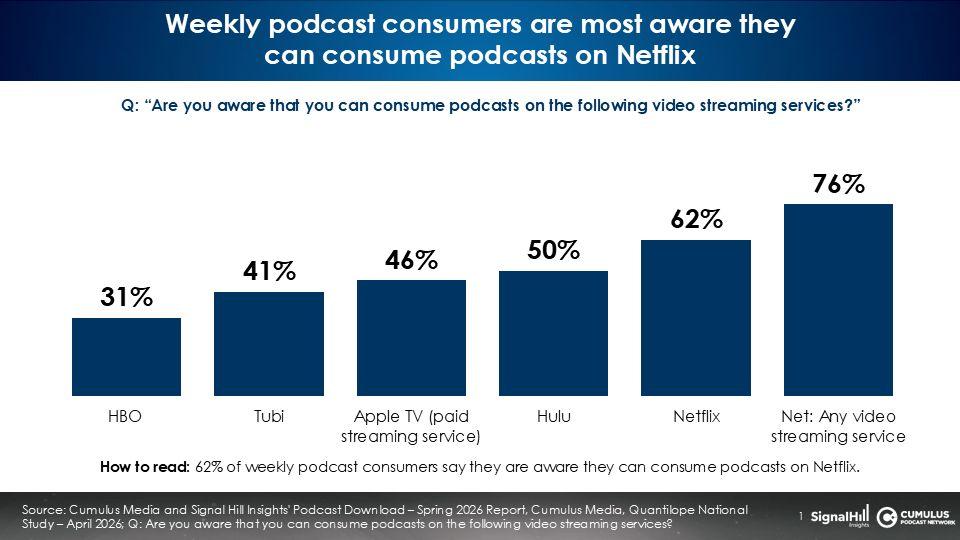
- Netflix off to a big start with podcasts: After introducing podcasts in January 2026, by April, 62% of weekly podcast consumers are already aware they can consume podcasts on Netflix. 76% say they are aware video streaming services now offer podcasts.
- Watchable podcasts hit a new height in popularity: More consumers prefer podcasts with video they can actively watch or minimize vs. podcasts that are just audio.
- Hitting an all-time high, YouTube is the most utilized podcast listening platform in the U.S.: 44% say it is the platform they use the most, followed by Spotify (14%) and Apple (5%).
- With the rise of podcast watching, 38% of weekly podcast consumers listen via a smart TV: Podcast viewership on smart TVs has grown 19% over the past year.
- Audio storms into smart TV: Podcast consumers are more likely to listen to AM/FM radio and music streaming on a smart TV than traditional TV!
- Audio remains the primary mode of podcast consumption despite growing video use: 92% say they “listen” to podcasts. Only 8% say they only watch podcasts.
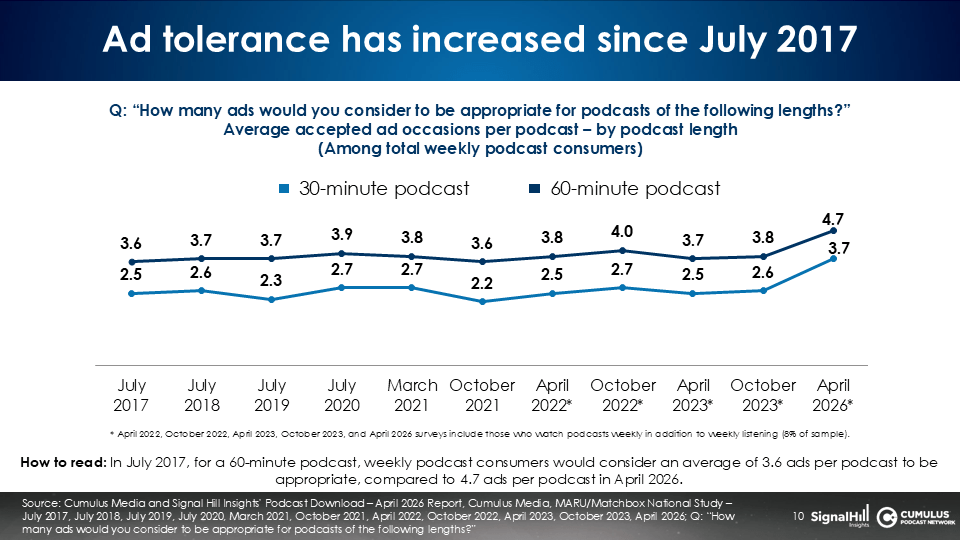
- Podcast ad tolerance has increased: From 2017 to 2023, weekly podcast consumers indicated the ideal ad load for a 60-minute podcast was 3.6 minutes. In 2026, ideal podcast ad loads jump to 4.7 minutes for a 60-minute podcast.
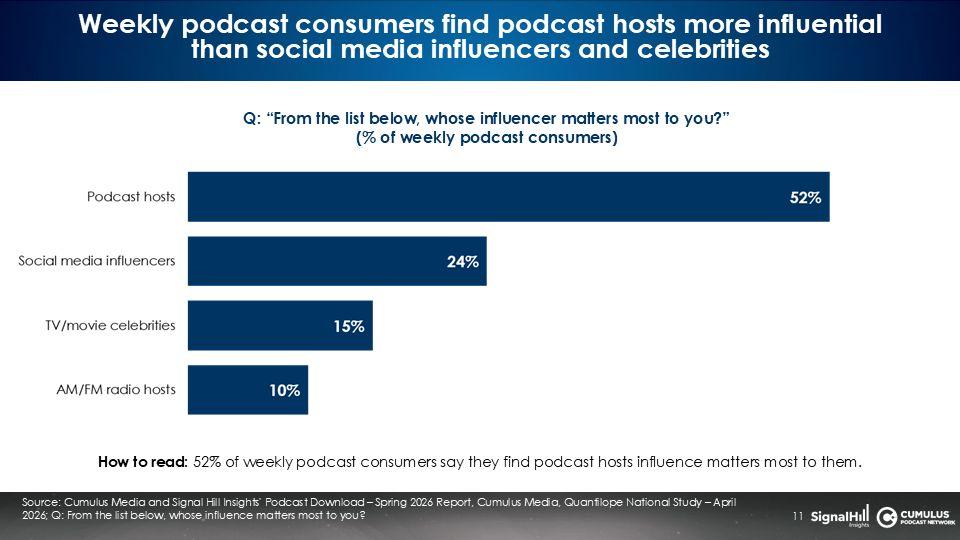
- Podcast hosts are 2X more influential than social media creators.
In the last six months, video streamers have embraced podcasts
- Netflix officially launched video podcasts on its platform in January 2026. The streaming giant rolled out an extensive slate of original and licensed video podcasts through high-profile partnerships with Spotify Studios, The Ringer, iHeartMedia, and Barstool Sports.
- Hulu officially began launching and licensing video podcasts on its platform in late 2025, initially offering companion series for its popular original programming such as Only Murders in the Building. Hulu significantly expanded its standalone offerings in February 2026 by securing exclusive streaming rights for comedy advice podcasts, starting with We’re Here to Help.
- Tubi officially expanded into the video podcast space in late 2025 through an exclusive deal with the true-crime network Audiochuck. In June 2026, the platform made a major expansion by partnering with SiriusXM to add a wide slate of popular video podcasts to its free, ad-supported service.
- Amazon Prime Video was an early mover on podcasts in 2024 when it launched Wondery sports and creator-led podcasts. Hit video podcasts, such as New Heights with Jason and Travis Kelce, began streaming directly on Prime Video.
The word is out: 76% of weekly podcast listeners are aware you can watch podcasts on video streaming services
That was fast. In four short months, three out four weekly podcast consumers are aware that you can access podcasts on the major video streaming services.
62% say you can access podcasts on Netflix. One out of two say Hulu and Apple TV. 41% are aware that Tubi offers podcasts.
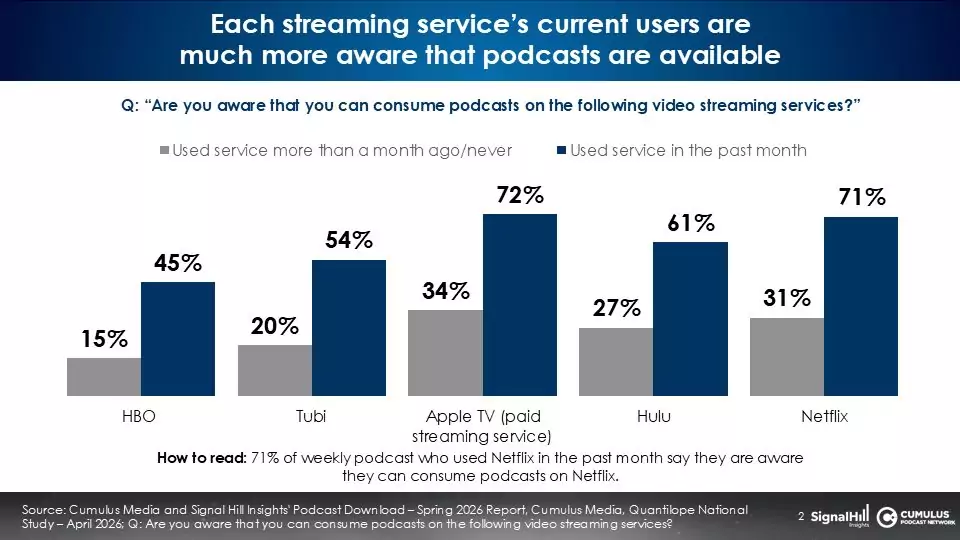
Video streamers have done an excellent job of using their platforms and interfaces to launch podcasts. Seven out of ten of past month Apple TV and Netflix viewers are aware that they can watch podcasts on the two services.
61% of past month Hulu viewers say podcasts are now available on the service. A little over half of Tubi monthly viewers are aware that podcasts have launched on the platform.
Easy to mind, easy to find: Will the launch of podcasts on video streaming services kick off another expansion of podcast audiences?
The launch of podcasts on video streaming services will grow awareness of podcasts as well as make it much easier for consumers to watch them. Podcasts coming to video streaming services is akin to launching a product in Walmart or Target. It’s a massive awareness boost and significant distribution expansion that makes it easy for the consumer to purchase or access.
Marketers use the expression “easy to mind, easy to find” to describe two essential pillars of brand growth: mental availabilityand physical availability.
In the best-selling marketing book How Not To Plan: 66 Ways To Screw It Up, Les Binet and Sarah Carter explain, “The single most important factor driving brand preference is ‘mental availability’: how well known a brand is, and how easily it comes to mind.” Physical availability describes as how easy, convenient, and frictionless it is for a consumer to access and actually purchase a product or service.
Brands (and podcasts) need both mental and physical availability, which rely heavily on each other. One without the other limits consumption.
- Mental without physical: You get attention but consumers can’t find your product to use it.
- Physical without mental: Your product is everywhere but no one thinks to look for it.
- Both together: You lower buyer friction and capture market share.
Podcasts expansion to video streaming services: Welcome to Steve Goldstein’s era of liquid content
Goldstein explains, “We’re in the liquid content era, defined by how audiences behave—not by how the industry wishes they would. A podcast isn’t really a format anymore — it’s a form. It’s a style of storytelling. Increasingly, content no longer belongs to a single format. It moves. It adapts. It flows like liquid.
Podcasting is no longer a one-size-fits-all medium. It has become an ecosystem. A podcast can be a YouTube show, vertical clips, newsletters, short episodes, livestreams, or even a live event. One story can take many shapes — and the content bends around the audience, not the other way around. As Rob Greenlee put it: “The show itself is no longer the final product — it’s the engine.
Liquid content is designed to adapt to context while maintaining meaning. In this era, the audience sits at the center of an ecosystem – not the feed, not the platform, not the format. The fourth era of podcasting isn’t really about redefining what a podcast is. It’s about accepting how people use them now.”
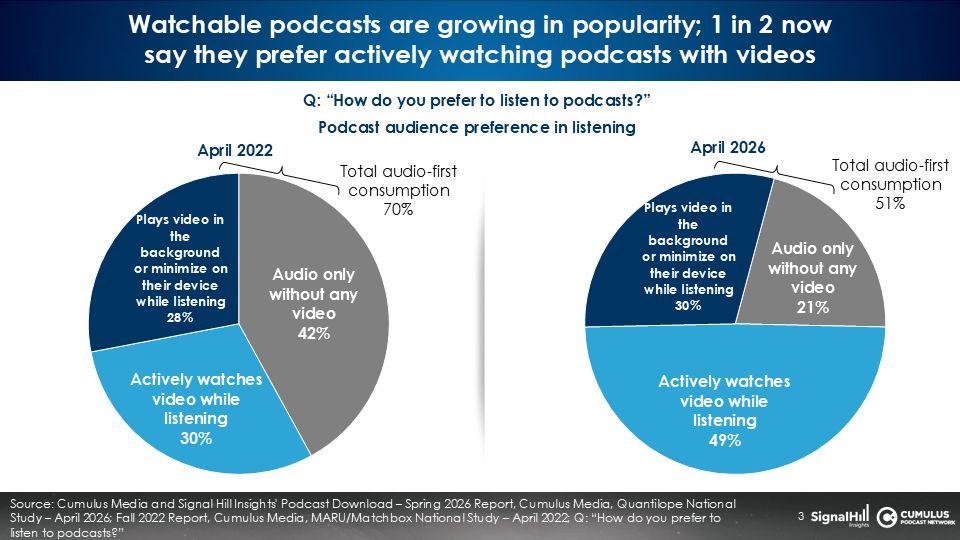
One in two say they prefer actively watching podcasts
The proportion of weekly podcast consumers who say they prefer to actively watch podcast video while listening has grown from 30% in April 2022 to 49% in April 2026.
YouTube continues its eight-year growth trend as the platform used most for podcast consumption
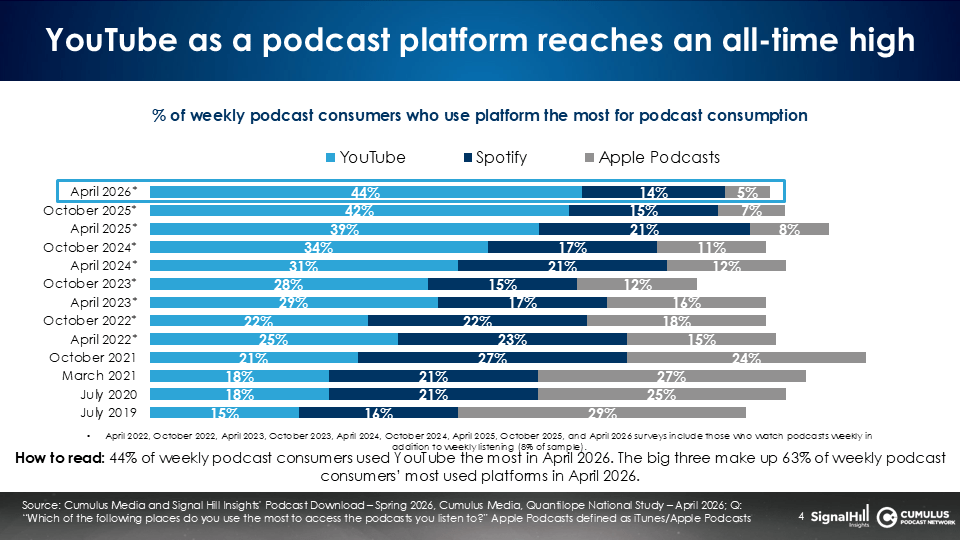
In July of 2019, Apple was the leading podcast listening platform. At the time, 29% said they used Apple most for podcasts, followed by Spotify 16% and YouTube (15%).
As of April 2026, it’s a YouTube podcast world.
44% of weekly podcast consumers day they use YouTube the most to consume podcasts. 14% say Spotify and only 5% cite Apple as their “use most” platform.
YouTube’s position as the leading podcast audience platform is validated by the two major podcast audience measurement services, Edison Podcast Metrics and Triton Digital’s Podcast Metrics Demos+.
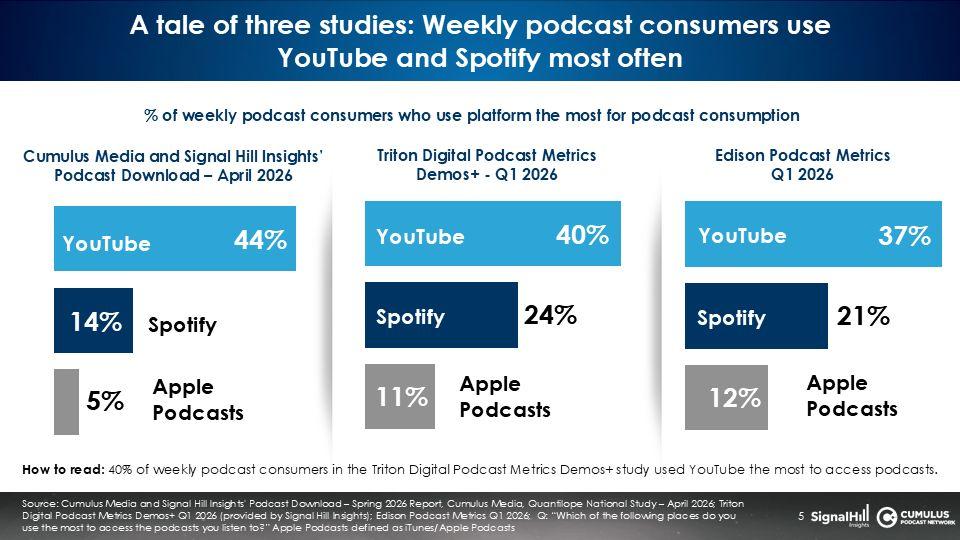
Triton reports 40% indicate YouTube is the most used podcast platform. Edison reveals YouTube’s “use most” is quite similar at 37%.
Both Edison and Triton place Spotify in the low 20% for use most and both have Apple at 11%-12% use most. Given the much larger samples of the Edison and Triton studies, we are more confident about their Spotify and Apple “use most” findings.
Podcast viewership on smart TVs has grown 19% over the past year
38% of weekly podcast consumers say they consume podcasts on a smart TV, up 19% from the prior year (32%).
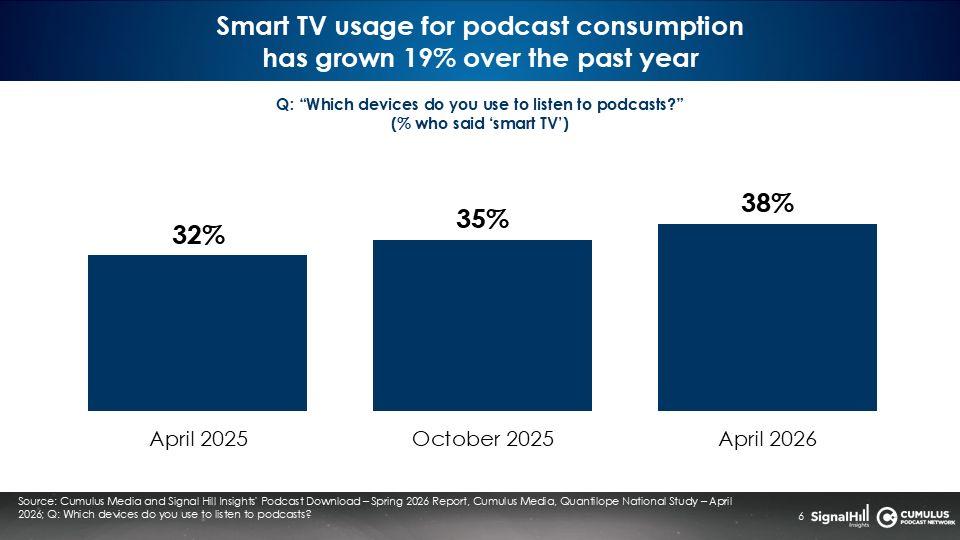
There is strong awareness that podcasts can be experienced on smart TVs. Among the 62% that do not watch podcasts on smart TVs, nearly eight out of ten are aware that you can consume podcasts on smart TVs.
Edison’s Q1 “Share of Ear” study reports 11% of all podcast time spent occurs on a smart TV, nearly 6X smart speakers (2%) and almost a 4X increase from 2017.
| Edison’s “Share of Ear”: % of podcast time spent by device | ||
| Device | Q4 2017 | Q1 2026 |
| Mobile device | 68% | 71% |
| Desktop/laptop | 26% | 15% |
| Internet-connected TV device | 3% | 11% |
| Voice enabled speaker | – | 2% |
| Another kind of device | 4% | 2% |
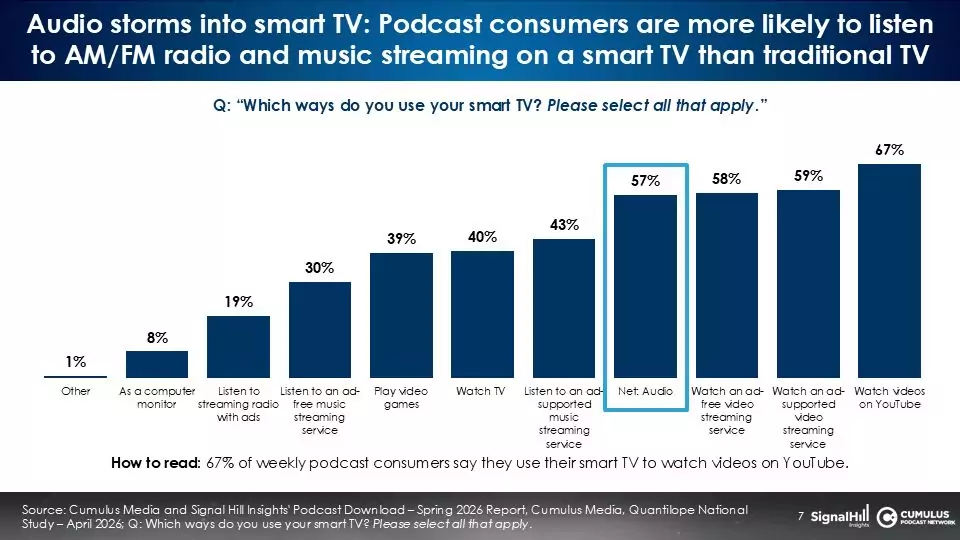
Audio storms into smart TV: Podcast consumers are more likely to listen to AM/FM radio and music streaming on a smart TV than traditional TV
57% of weekly podcast consumers listen to AM/FM radio streams or music streaming services compared to only 40% who say they “watch TV” on a smart TV. Just as many watch free video streaming or subscription video as listen to radio or music streaming.
Leading all content types is YouTube. 67% say they use their smart TV to watch YouTube.
Despite growing video use, audio remains the primary mode of podcast consumption
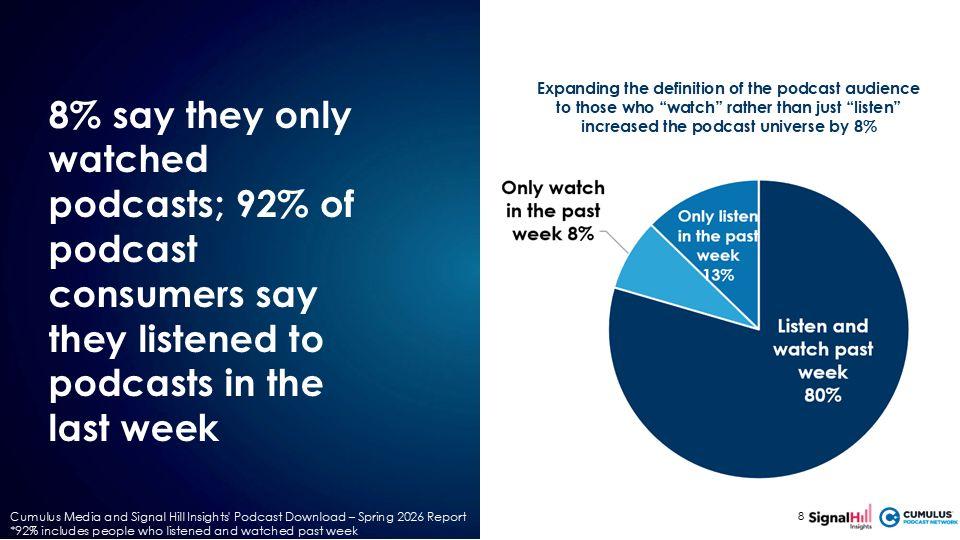
92% say they “listen” to podcasts. Just 8% say they “only watch” podcasts.
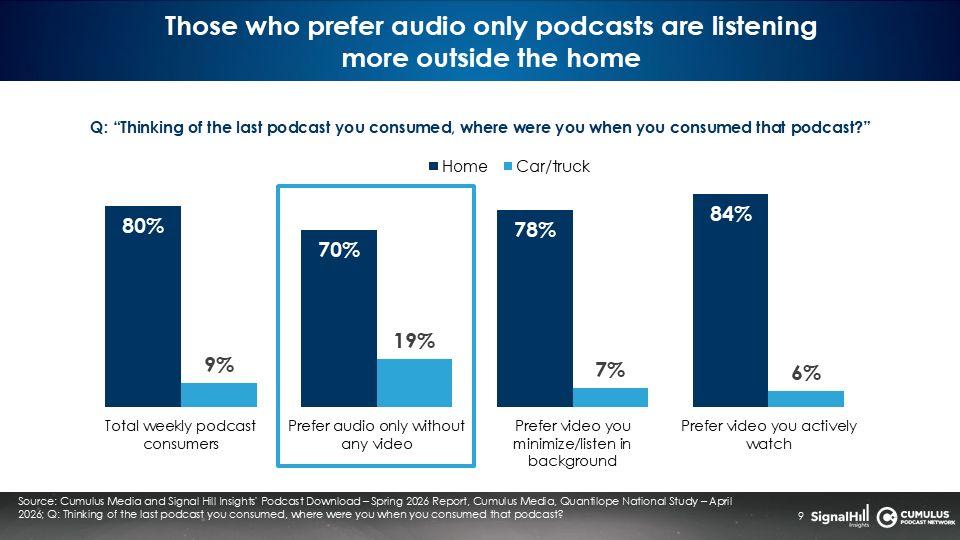
The audio podcast experience is especially important for away from home listening
The majority of podcast listening occurs at home. According to Edison’s “Share of Ear” study, 67% of all time spent with podcasts occurs at home. For the one-third that occurs away from home, the audio experience is crucial.
Podcast ad tolerance grows
Podcasts are under commercialized. Magellan reports that in Q1 2026, only 7.8% of U.S. podcasts are devoted to advertising. This pales in comparison to TV and video streaming ad loads:
- Broadcast TV (e.g., ABC, FOX, NBC) 20% to 27%
- Cable TV 25% to 33%
- Ad-supported streaming (e.g., Hulu, Max basic) 7% to 15%
Since 2017, the Podcast Download study has queried the weekly podcast audience on the number of ads that would be appropriate for 30-minute and 60-minute podcasts.
While these preferences are directional and perceptual in nature, they have held steady from 2017 to 2023. The most recent reading reveals an increase in the number of ads the podcast audience feels is appropriate.
Ad receptivity is strong in podcasts because podcast hosts are twice as influential as social media influencers
Key findings:
- Netflix off to a big start with podcasts: After introducing podcasts in January 2026, by April, 62% of weekly podcast consumers are already aware they can consume podcasts on Netflix. 76% say they are aware video streaming services now offer podcasts.
- Watchable podcasts hit a new height in popularity: More consumers prefer podcasts with video they can actively watch or minimize vs. podcasts that are just audio.
- Hitting an all-time high, YouTube is the most utilized podcast listening platform in the U.S.: 44% say it is the platform they use the most, followed by Spotify (14%) and Apple (5%).
- With the rise of podcast watching, 38% of weekly podcast consumers listen via a smart TV: Podcast viewership on smart TVs has grown 19% over the past year.
- Audio storms into smart TV: Podcast consumers are more likely to listen to AM/FM radio and music streaming on a smart TV than traditional TV!
- Audio remains the primary mode of podcast consumption despite growing video use: 92% say they “listen” to podcasts. Only 8% say they only watch podcasts.
- Podcast ad tolerance has increased: From 2017 to 2023, weekly podcast consumers indicated the ideal ad load for a 60-minute podcast was 3.6 minutes. In 2026, ideal podcast ad loads jump to 4.7 minutes for a 60-minute podcast.
- Podcast hosts are 2X more influential than social media creators.
Click here to view or download the full report.
Liz Mayer is the Senior Insights Manager of the Cumulus Media | Westwood One Audio Active Group®.
Paul Riismandel is the President/CEO of Signal Hill Insights.
Contact the Insights team at CorpMarketing@westwoodone.com.