
How Many Ads Should A Radio Station Run? Cumulus Media | Westwood One And RAB Reveals Guidelines
Click here to view a 16-minute video of the key findings.
Click here to download a PDF of the slides.
The Radio Advertising Bureau (RAB) fields questions daily regarding research, best practices, promotional ideas, and more. One of the most frequently asked questions is, “How many ads should I run per week?” The answer always starts with, “That depends. What is your goal?”
Key takeaways:
- The number of ads needed for minimum (very light), maintenance (light), high impact (medium), and launch (heavy) campaigns vary based on radio programming format.
- Agencies and radio sellers dramatically underestimate the number of ads needed to reach two-thirds (high impact/medium schedule) or 78% of a radio station’s audience (launch/heavy schedule).
- The very successful Wizards of Ads ad agency recommends the high impact/medium schedule: weekly reach of two-thirds of a station’s audience exposed an average of three times, run for 52-weeks.
- Media Monitors: Only a small fraction of American AM/FM radio schedules achieves launch/heavy or high impact/medium reach levels while the vast majority of weekly radio station campaigns are minimum/very light.
- iHeartMedia attribution study: As the number of daily AM/FM radio ads increases, auto dealer website traffic lift surges. Campaigns with AM/FM radio ads in all days and dayparts generate stronger results.
- Advertising is not “one size fits all”: Understanding the campaign goal is crucial to determining the right AM/FM radio media plan.
Four approaches to reaching a radio station audience
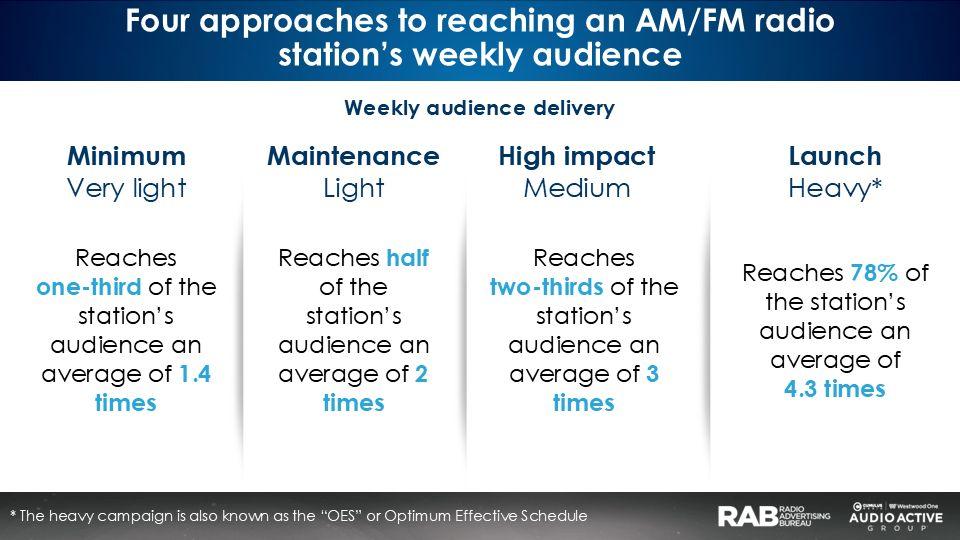
Cumulus Media | Westwood One and the Radio Advertising Bureau partnered to determine and set guidelines based on four campaign goals that range from a 34% reach to a 78% reach of a station’s audience.
Using these reach levels as scenarios, the tiers are defined as minimum (very light), maintenance (light), high impact (medium), and launch (heavy).
- Minimum/very light and maintenance/light schedules: Ideal for advertisers who want a maintenance campaign with modest levels of reach and frequency. The very light/minimum weekly schedule reaches only one-third of a station’s audience an average of 1.4 times. The maintenance/light weekly schedule reaches half of the station audience an average of two times.
- High impact/medium schedule: A general sales event or promotional campaign where a good number of listeners are reached often. The Wizards of Ads ad agency, which has great success with local clients, recommends this campaign, as an always on, 52-week approach. This weekly schedule reaches two-thirds of a station’s audience an average of three times.
- Launch/heavy schedule: A major sales event or product launch where many people are reached very frequently. This schedule was conceived by legendary sales consultant Steve Marx as his “Optimum Effective Schedule” or O.E.S. This schedule reaches 78% of a station’s audience weekly an average of 4.3 times.
Turnover is the audience metric that determines how many ads are needed to run on a radio station
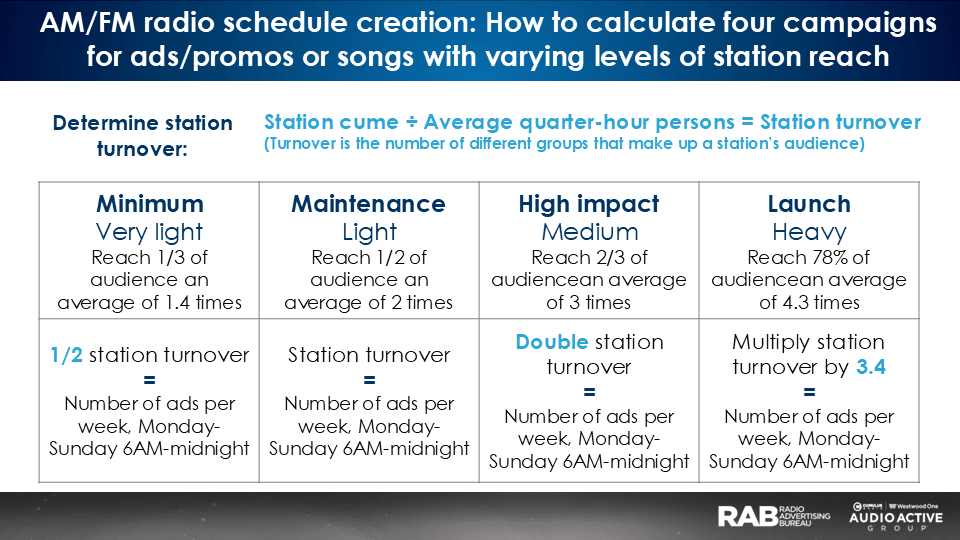
Turnover is a ratio that’s calculated by dividing a radio station’s cume by its average quarter-hour audience. The cume refers to the number of different people reached by a station in a week.
The average quarter-hour audience is the number of people listening to a station in a typical fifteen-minute period. Think of the average quarter-hour audience as the number of people reached by one commercial.
Turnover is a ratio that represents the number of groups of people that make up a radio station’s audience. The greater the turnover, the more ads needed to reach the audience. Stations with high turnovers have lower time spent listening (TSL).
Stations with lower turnovers have higher time spent listening. Low turnover stations require fewer weekly ads to accomplish reach objectives.
There is no such thing as a good or bad turnover
You just need to know what it is. Turnover is a helpful ratio to understand how many commercials, promos, or song spins are needed to reach a station’s audience.
To determine the number of ads needed for a minimum/very light schedule, take half the turnover. For a maintenance/light schedule, use the turnover. For a high impact/medium schedule, double the turnover. For a launch/heavy weekly campaign, multiply the turnover by 3.4.
Let’s say a radio station format has a 22-weekly turnover:
- The minimum/very light schedule would require 11 weekly ads (half the turnover)
- The maintenance/light schedule would need 22weekly ads (the turnover)
- The high impact/medium schedule requires 44 ads in a week (double the turnover)
- The launch/heavy schedule would need 75 weekly ads (3.4 X the turnover)
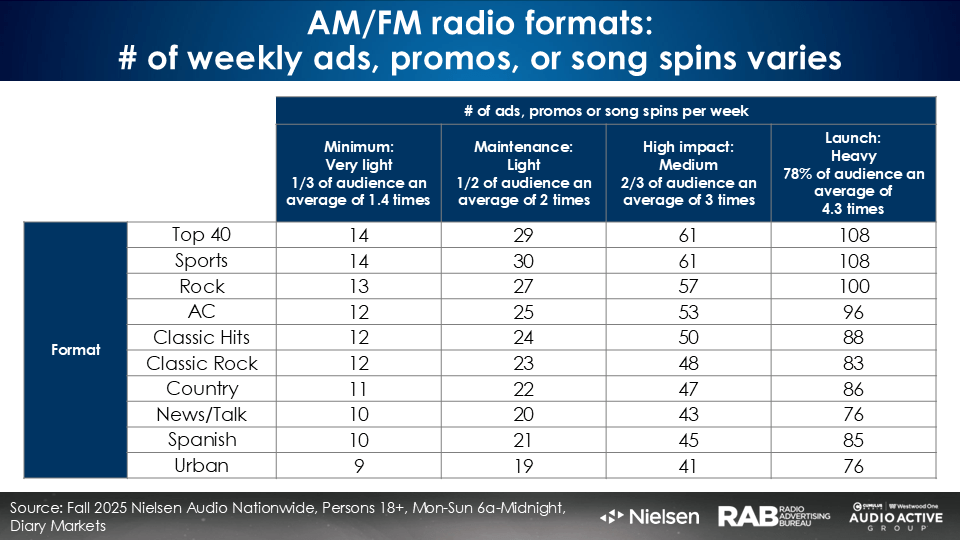
The number of ads needed to achieve each of the four levels of radio station reach vary by AM/FM radio programming format
Agencies and sellers dramatically underestimate the number of ads needed to run the high impact and launch campaigns
An RAB study of 334 ad agencies and sellers asked how many weekly ads were needed to reach two-thirds (high impact) and 78% (launch) of a radio station’s audience. Responses revealed half of what is required!
Agencies perceived 33 weekly ads are needed to reach two-thirds of a station’s audience. In reality, an average of 51 weekly ads is required for the high impact campaign!
For some radio formats, up to 61 ads are needed to reach two-thirds of a station’s audience. Radio sellers also vastly misjudged the number of weekly ads needed to reach two-thirds of a station’s audience.
To reach 78% of a radio station’s audience, agencies estimated 46 weekly ads were necessary. In reality, over twice as many ads (102 spots weekly) are needed to achieve the launch campaign and reach 78% of a radio station’s audience.
Again, radio sellers were in the same boat, significantly underestimating the number of ads needed to reach 78% of a radio station’s audience.
What kinds of campaigns are actually being run?
To understand the prevalence of the four types of schedules, Doug Hyde, former Senior Director, National and Local Insights at Cumulus Media | Westwood One, conducted a Media Monitors analysis of AM/FM radio advertising in 99 markets during a week. Media Monitors captures every ad run on thousands of American radio stations.
During the first week of August 2020, 183,425 commercials were run on 1,685 monitored radio stations in 99 markets. Campaigns were assigned to the four types of schedules: minimum/light, maintenance/very light, high impact/medium, and launch/heavy. Station reach and frequency analyses were conducted for all campaigns during the one-week period.
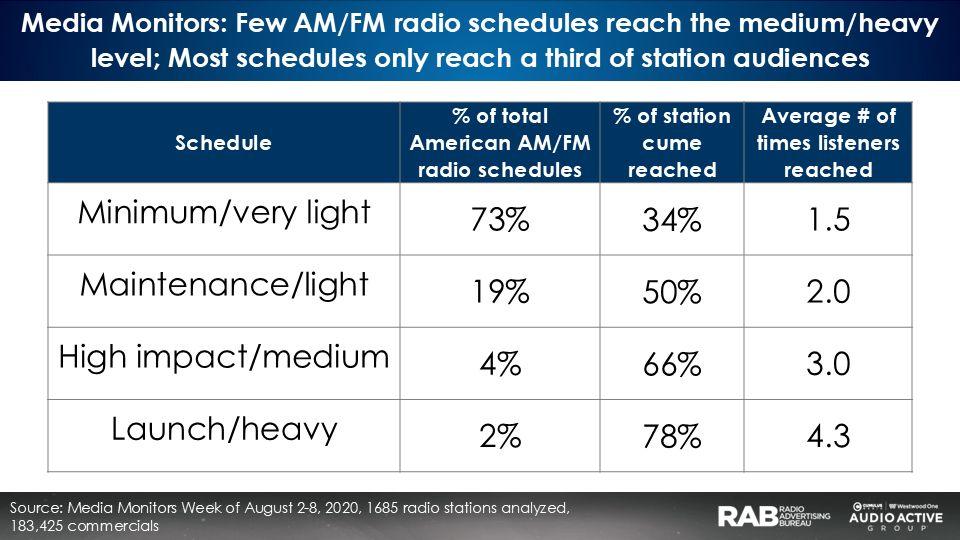
Only 2% of U.S. weekly AM/FM radio campaigns are considered launch/heavy. Only 4% of weekly AM/FM radio campaigns were of high impact/medium intensity.
Just a fraction of American AM/FM radio schedules reach over half the station audience. Most weekly radio station campaigns (73%) are very light, reaching only one-third of a radio station’s audience, less than two times.
iHeartMedia: As the number of daily AM/FM radio ads increases, auto dealer website traffic lift surges
The largest AM/FM radio attribution study ever conducted was this study of auto dealer website traffic by iHeartMedia and LeadsRx. iHeart studied 310 auto dealers who ran 1.8 million AM/FM radio ads in 100 markets over 17 months. According to the study, auto dealer website traffic surges as the number of daily AM/FM radio ads increases.
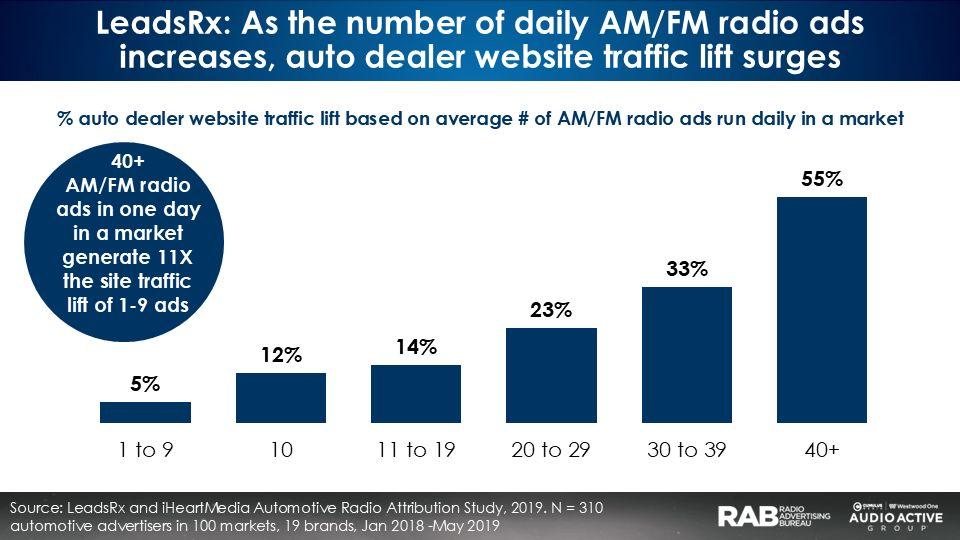
- 1 to 9 radio ads a day aired in the market generated a +5% lift in auto dealer website traffic.
- 20 to 29 daily radio ads resulted in a +23% increase in auto dealer website traffic.
- 40+ daily AM/FM radio ads in the market caused a massive +55% increase in auto dealer website traffic.
The iHeart study had three major recommendations:
- Run every day: There is very little difference in web traffic by day.
- Run full week campaigns: Lift doubles when the number of days in a schedule grows from 3-4 days a week to 7 days a week.
- Run lots of ads each day: The more ads run per day in the market, the greater the site traffic. 10 ads per day have twice the site traffic of 1-9 ads per day. 40+ ads per day have eleven times the lift of 1-9 ads per day.
Next steps: How can you put this into practice?
Set the right expectations. Don’t expect grand opening results from a light weekly campaign. The number of people reached and the number of times they are reached impact results. The iHeartMedia auto dealer website study reveals the direct relationship between the number of ads and impact.
Advertisers: Examine your annual plan. Does schedule intensity match desired results? Evaluate your annual marketing calendar to ensure sales events have sufficient station reach and frequency to drive impact. The number of weekly ads needed for the high impact/medium and launch/heavy station schedules is much higher than you think. Between sales events, is there a continuous level of advertising to ensure your business is “known before it is needed”?
Sellers: Create weekly investment levels for the four campaigns. A grid can be created with the four campaigns. This one pager allows you to build proposals based on desired client outcomes, ie. if a client wants a maintenance campaign, promote a typical sales event or a major sales event, or product launch.
Don’t underestimate the number of ads needed to achieve specific campaign goals
Delivering the message to the audience and achieving the campaign’s goal is the basic role of advertising. However, the number of ads needed to achieve specific campaign goals is often underestimated.
Key takeaways:
- The number of ads needed for minimum (very light), maintenance (light), high impact (medium), and launch (heavy) campaigns vary based on radio programming format.
- Agencies and radio sellers dramatically underestimate the number of ads needed to reach two-thirds (high impact/medium schedule) or 78% of a radio station’s audience (launch/heavy schedule).
- The very successful Wizards of Ads ad agency recommends the high impact/medium schedule: weekly reach of two-thirds of a station’s audience exposed an average of three times, run for 52-weeks.
- Media Monitors: Only a small fraction of American AM/FM radio schedules achieves launch/heavy or high impact/medium reach levels while the vast majority of weekly radio station campaigns are minimum/very light.
- iHeartMedia attribution study: As the number of daily AM/FM radio ads increases, auto dealer website traffic lift surges. Campaigns with AM/FM radio ads in all days and dayparts generate stronger results.
- Advertising is not “one size fits all”: Understanding the campaign goal is crucial to determining the right AM/FM radio media plan.
Click here to view a 16-minute video of the key findings.
Pierre Bouvard is Chief Insights Officer of the Cumulus Media | Westwood One Audio Active Group®.
Contact the Insights team at CorpMarketing@westwoodone.com.