
The End Of The Click: AI Overviews In Search Sharply Reduce Traffic; If Your Business Depends On Paid Search, It’s Time To Build Your Brand
Click here to read the article “Marketers Need to Prepare Themselves for the End of the Click.”
Google’s AI Overview is a year old and has generated sharp reductions in organic and paid search clicks. Advertisers must prioritize top of funnel advertising so they can “be known before they’re needed.”
Key findings:
- As a result of Google’s AI Overviews, search traffic is down sharply and maintaining it now costs significantly more than it did two years ago.
- If people already know your name, AI search helps you. If they do not, it buries you.
- In a world where you can’t reliably pay platforms to send customers your way, a strong brand will remain the best insurance policy. Strong brands are not built on clicks but on memories.
- Steve’s Pest Control of Columbia, Missouri built a massive business that beats all national competitors with a long-term brand building campaign on AM/FM radio. Steve’s has a stunningly strong unaided awareness of 34%.
- Local unaided awareness studies reveal “don’t know” is the number one brand in many local categories and a huge opportunity.
- Advertising creates memories and memories generate sales. The brand that’s remembered is the brand that is bought.
- Brand building is no longer a soft, long-term play. It is a hard, measurable defense against algorithmic disruption. The companies that invested in being known and trusted are being rewarded.
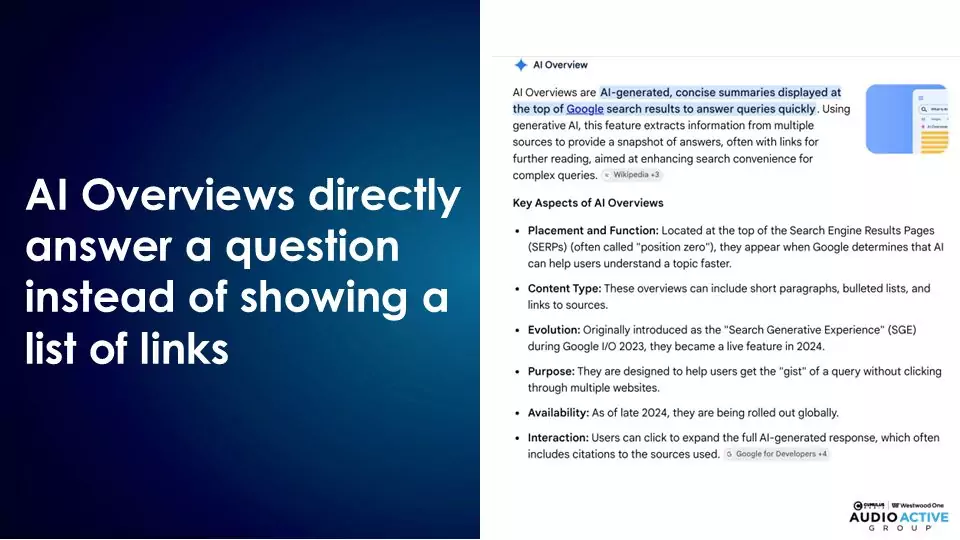
AI Overviews directly answer a question instead of showing a list of links
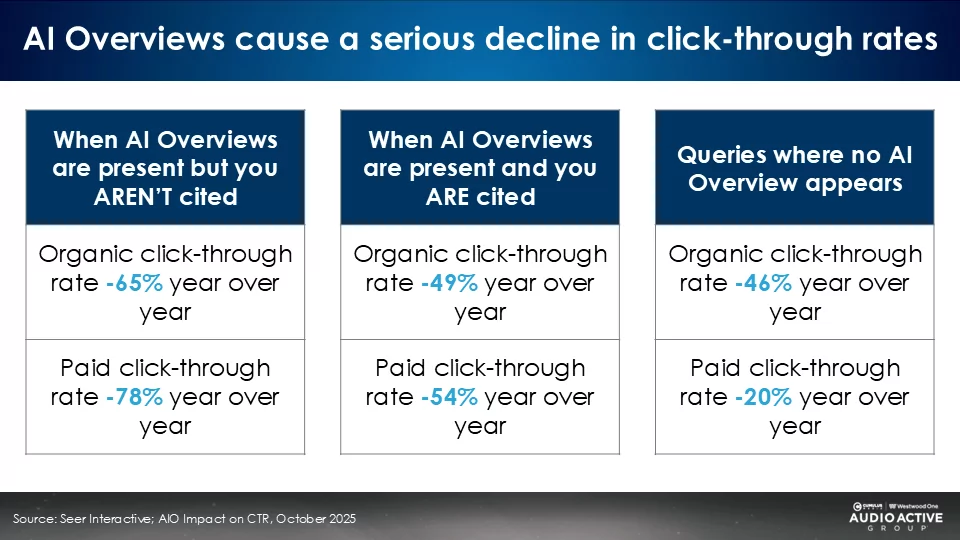
Seer Interactive report reveals significant erosion in click-through rates
In a recent article in Marketing Week, Thomas Barta, the founder of the Marketing Leadership Institute, reports, “Several CMOs confirmed to me that their search traffic is down sharply – and maintaining it now costs significantly more than it did two years ago”.
Branded search is doing better in AI Search
Thomas Zeoga Ramsey, Founder/CEO of Neurons Inc., noted one bright spot, “Branded queries are actually performing better in AI search. Amsive found that branded queries with AI Overviews see an 18% increase in click-through rate, while generic queries see a 34 to 46% decrease. Seer Interactive’s study showed that brands cited within AI Overviews earned 35% more organic clicks and 91% more paid clicks compared to brands that were not cited.”
“Assume there is no search”: Conde Nast CEO Roger Lynch
On a recent episode of the Technology Business Programming Network (TBPN) podcast, Conde Nast CEO Roger Lynch said, “Each of the last three years, we would do our budgets, and we’d put forecasts in of search traffic declining. Why? Because we’d seen the pattern of algorithm changes. And generally, those algorithm changes were negative. Every year, our search traffic was down more than we had forecast.
So last year I told our teams, ‘Assume there’s no search.’ You have to have your businesses planned as if search is zero.
We don’t expect it to be zero, [but] we expect it to be a single-digit percentage of our traffic. So, we started working on plans for each of our brands around that.”
Google is no longer passing people on
Thomas Barta says, “For two decades, marketers treated Google like a demand vending machine: insert budget, select keywords, receive customers. We built an entire profession around tweaking websites and keywords, so that brands show on Google page one.
Search marketing worked because of an implicit agreement: Google passes people on. That agreement has now been cancelled – and it’s just a preview of what comes next. Increasingly, AI agents can make purchasing decisions on behalf of humans. The platforms will no longer just be intermediaries. They could turn into buyers.”
“Google just killed search as we know it. Here’s what that means for every brand on the internet”
Thomas Zeoga Ramsey, wrote recently, “For the entire life of the product, Google Search has been a gateway. You went to Google. Google pointed you somewhere else. The value was speed and relevance. The better Google got at sending you to the right website, the more you trusted it.
That model is being retired.
The new Google Search does not want to send you anywhere. It wants to be the destination. It wants to read the articles, so you do not have to. It wants to build the tools, so you never need to download an app. It wants to monitor the web so you never need to check back.
Google is repositioning from librarian to concierge. From “here’s where to find it” to “here, we already did it.”
“In a world where you can’t reliably pay platforms to send customers your way, a strong brand will remain the best insurance policy”
“Strong brands and direct customer relationships will decide the winners,” concludes Barta. “If customers look for your brand instead of the category, you have already won half the battle … Strong brands survive platform shifts; weak brands probably won’t.” He continues, “Strong brands build preference … Preference is what makes someone ask for you by name, before they even check out alternatives.”
“The takeaway is blunt. If people already know your name, AI search helps you. If they do not, it buries you.”
Thomas Zeoga Ramsey, concludes, “Brand building is no longer a soft, long-term play. It is a hard, measurable defense against algorithmic disruption. The companies that invested in being known and trusted are being rewarded. Generic content operations are being obliterated.
The era of free, predictable traffic from Google is ending. What replaces it is a world where brand recognition, citation authority, and direct audience relationships matter more than ranking position. The companies that invested in being known, trusted, and sought out by name are the ones best positioned to survive. Everyone else is running out of time.”
Aim for fame. The lesson of Steve’s Pest Control of Columbia, Missouri: Be known, before you’re needed
Steve’s Pest Control knows what Madison Avenue has forgotten. To generate substantial sales and profit, a business needs to create future demand rather than just obsess over clicks.
Steve Hotsenpiller and his wife Anita started their pest control business over three decades ago with one truck. They bought ads on a small radio station.
Each year, they devoted about 8.5% of their revenues to advertising. As they grew, they bought ads on more radio stations and soon became one of the largest advertisers on local radio.
Their ads are charming, funny, and entertaining. They usually end with the jingle that exclaims, “Now you’ve got a friend in the pest control business – Steve’s Pest Control!” Today, with over 90 trucks, Steve’s Pest Control is now the undisputed leader in the pest control business in Columbia, Missouri.
To understand the magnitude of the brand Steve’s Pest Control built with long-term advertising on AM/FM radio, the Cumulus Media | Westwood One Audio Active Group® commissioned MARU/Matchbox to conduct an unaided awareness study of consumers in the Columbia-Jefferson City.
Steve’s Pest Control dominates unaided brand awareness
Consumers were asked, “When you think of pest and insect control services, which ones come to mind?” Respondents had to write in all the brand names they could think of. They were not provided with a list of firms.
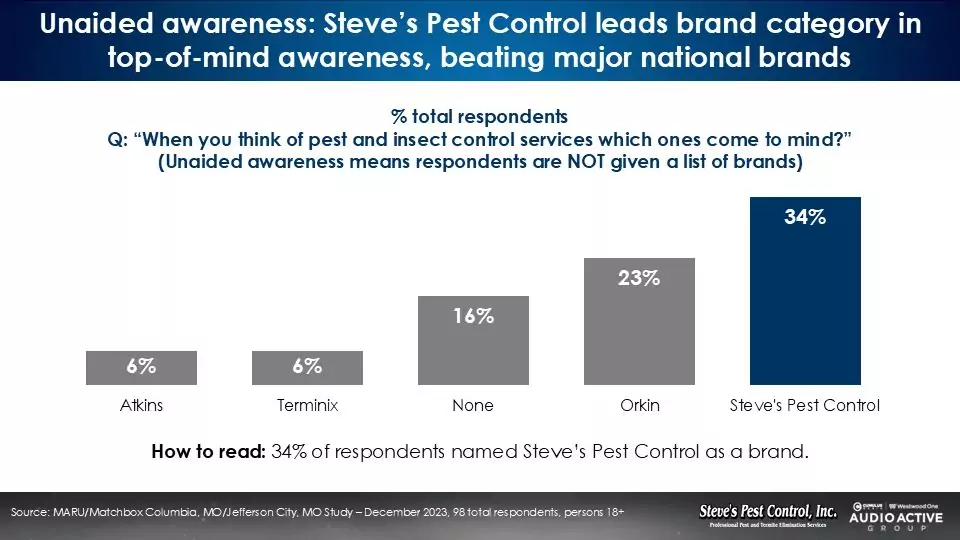
Steve’s long-term commitment to brand building on AM/FM radio built a massive business with a brand that leads its category and beats the major national brands.
Auto dealers: Can people name your dealership or just the brands you sell?
The Cumulus Media | Westwood One Audio Active Group® recently conducted local unaided awareness studies in over 14 markets in the U.S. Consumers were asked to name all the local brands they could name for a series of categories.
For auto dealers, respondents were asked, “When you think of auto dealerships, which ones come to mind?” Consumers had to name dealerships top of mind, any auto dealers they could think of, without getting any help.
In this sampling of markets below, it’s evident that consumers can name auto brands like Ford or Toyota but have difficulty naming an actual dealership.
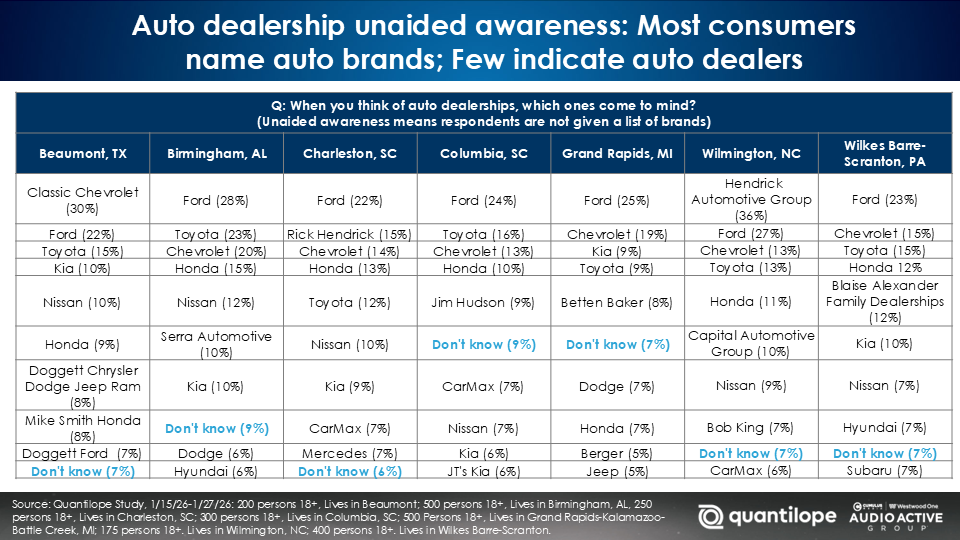
“Don’t know” is the number one brand in many local categories and a huge opportunity
For many local categories like roofing, plumbers, and chiropractors, consumers are unable to name one business. “Don’t know” is the leading brand across a wide variety of local categories.
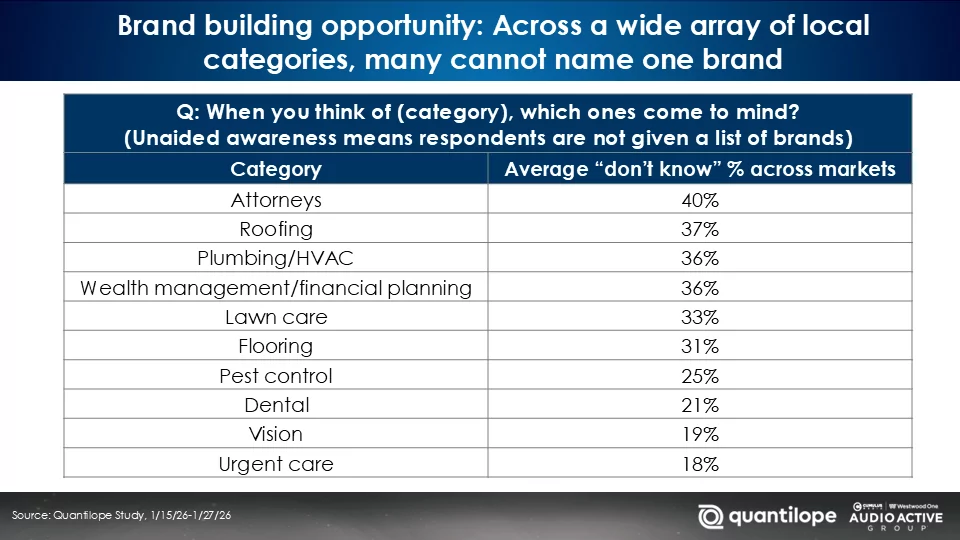
In a category where the number one brand is “don’t know,” there is a great opportunity to drive awareness for your business.
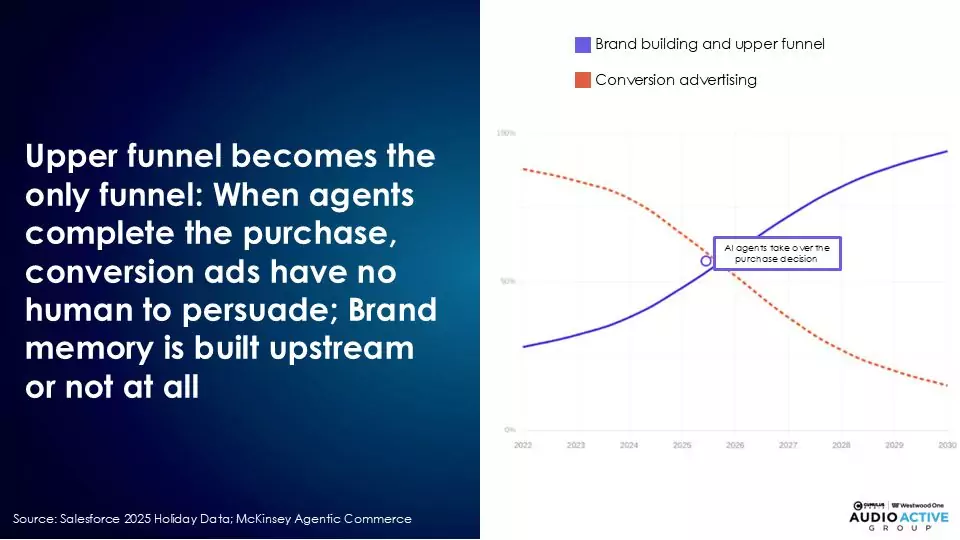
Upper funnel becomes the only funnel: Brand spent as a % of media budgets will grow as lower funnel marketing becomes unnecessary
Thomas Zeoga Ramsey forecasts that the upper funnel will be the only funnel. When AI agents do the research and make the purchase, conversion ads will no longer have humans to persuade. Brand memory is built upstream, or not at all.
To grow, advertisers have to build strong memories of their brand
Jon Lombardo, Founder of marketing insights firm Evidenza, says, “The ‘most important search engine’ is your brain. It’s your memory that got you to Google in the first place and your memory is going to pull strong brands. Strong brands are not built on clicks, but on memories.”
The brand that’s remembered is the brand that is bought
Ty Heath, from the B2B Institute at LinkedIn says, “The goal is not to create a lead; the goal is to create a memory. Lead generation is short-term. Memory generation is long-term. Win the mind to win the market. Mind share equals market share.”
Advertising creates memories and memories generate sales
Mind share equals market share
As advertisers can no longer rely on Google to send traffic, Jeremy Bullmore, former Chairman of J. Walter Thompson London, described by Campaign magazine as “quite possibly the most admired man in advertising”, reminds us that brands need to be “easy to mind and easy to find”:
“We have learned of the immense commercial value of a strong brand reputation. We know beyond doubt that a strong brand is more resistant to competition; is less dependent on price promotions to maintain volume sales; and is as secure a certainty of future profit as is possible in any organic, competitive market.
At much the same time, we have begun to understand the contribution that advertising can make to the reputation of brands. People construct their feelings about a brand, automatically and unconsciously, as a result of every encounter, actual or remote, that they have with that brand.
It should never be forgotten that (performance marketing) work most efficiently when the brands that they feature are already well-known and are already thought to be desirable. Of all the properties that a strong brand needs, simple familiarity must top the list.
Familiarity implies trust, reassurance – even affection. Familiarity is acquired and maintained directly through experience and remotely through communications.”
Key findings:
- As a result of Google’s AI Overviews, search traffic is down sharply and maintaining it now costs significantly more than it did two years ago.
- If people already know your name, AI search helps you. If they do not, it buries you.
- In a world where you can’t reliably pay platforms to send customers your way, a strong brand will remain the best insurance policy. Strong brands are not built on clicks but on memories.
- Steve’s Pest Control of Columbia, Missouri built a massive business that beats all national competitors with a long-term brand building campaign on AM/FM radio. Steve’s has a stunningly strong unaided awareness of 34%.
- Local unaided awareness studies reveal “don’t know” is the number one brand in many local categories and a huge opportunity.
- Advertising creates memories and memories generate sales. The brand that’s remembered is the brand that is bought.
- Brand building is no longer a soft, long-term play. It is a hard, measurable defense against algorithmic disruption. The companies that invested in being known and trusted are being rewarded.
Click here to read the article “Marketers Need to Prepare Themselves for the End of the Click.”
Pierre Bouvard is Chief Insights Officer of the Cumulus Media | Westwood One Audio Active Group®.
Contact the Insights team at CorpMarketing@westwoodone.com.