
Edison’s Q2 2026 “Share Of Ear”: Spotify’s Ad-Supported Music Streaming Audience Is Downscale And Very Small, Contrary To Advertiser Perceptions
Click here to view a 15-minute video of the key findings.
Marketers and media agencies perceive Spotify’s ad-supported music streaming audience as upscale and large. It’s neither.
Marketers and agency decision makers who subscribe to Spotify’s ad-free service mistakenly think Spotify’s ad-supported audience is like them, upscale with jobs and college education. The socio-economic profile of Spotify’s ad-free subscription service and the ad-supported free service is completely different.
Spotify’s ad-supported streaming music audience skews low income, is far less likely to work full time, and is less likely to have at least four years of college education. Spotify’s audience is four times smaller than what advertisers and agencies believe, according to Advertiser Perceptions.
Edison Research at SSRS’ quarterly “Share of Ear” study is the authoritative examination of time spent with audio in America. The study, in its eleventh year, surveys 4,000 Americans annually to measure daily reach and time spent for all forms of audio.
Here are the key findings from Edison’s Q2 2026 “Share of Ear” report:
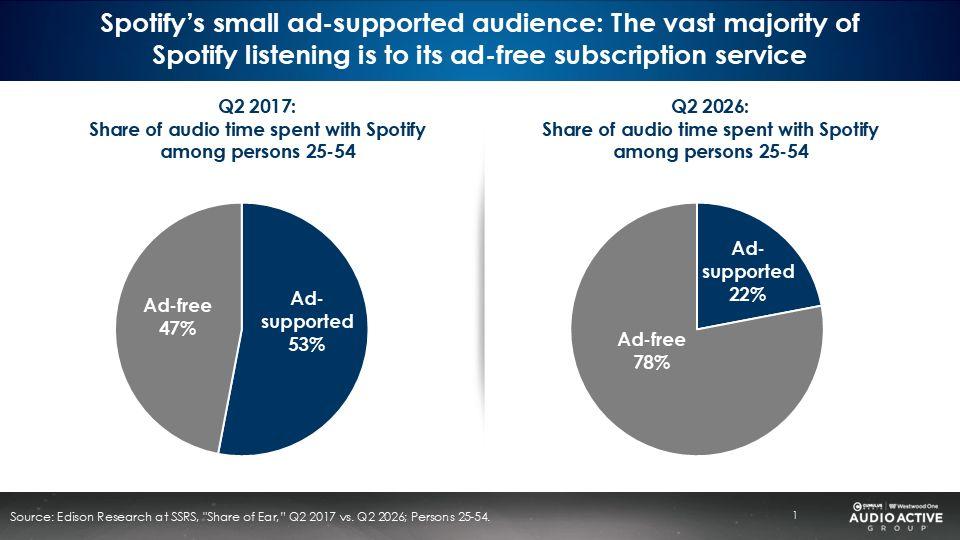
- Most of Spotify’s music streaming audience is not available to advertisers. 78% of total time spent with Spotify goes to the ad-free subscription service among adults 25-54.
- Spotify’s ad-supported free music streaming service skews downscale: 59% of the impressions have less than a $50K income compared to 29% for the total market.
- Tale of two Spotifys: The ad-free Spotify that advertisers and agencies listen to does not have the profile of the service where they run ads. Spotify’s ad-supported streaming music audience skews low income, is far less likely to work full-time, and is less likely to have at least four years of college education.
- Marketers and media agencies need to “take the me out of media,” believing Spotify has a 25% audience share of audio. In reality, ad-supported Spotify only has a 6% share. AM/FM radio’s audience share is 10X larger than Spotify’s (62% versus 6%).
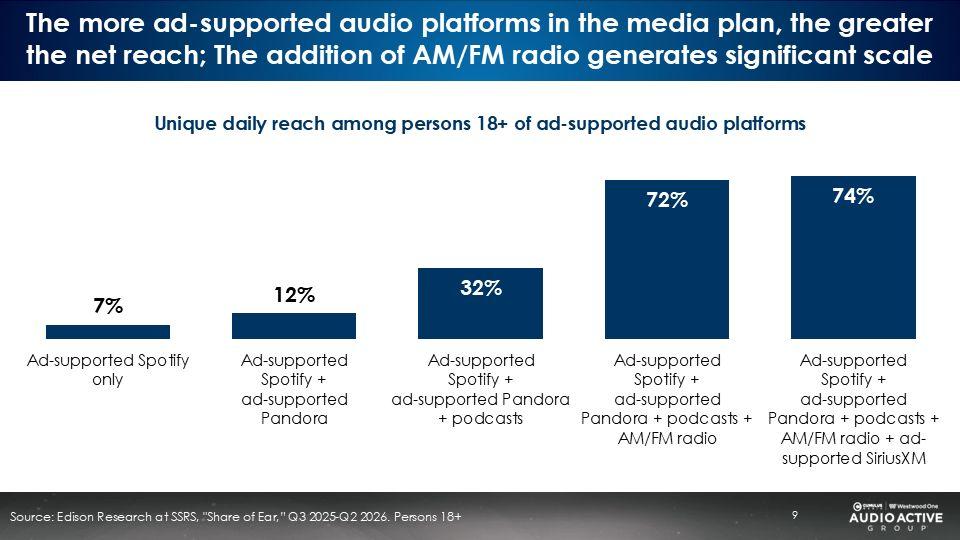
- To achieve scale in an audio buy, it is essential to have AM/FM radio on the media plan. In a typical day, only 32% of the U.S. is reached by digital audio (Spotify, Pandora, and podcasts). Adding AM/FM radio to the plan causes net reach to soar to 74%.
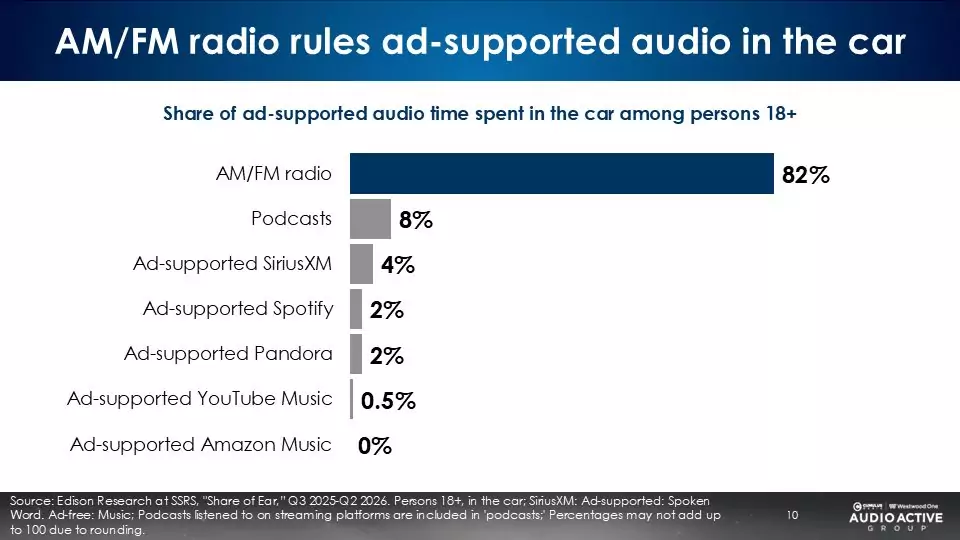
- AM/FM radio rules ad-supported audio in the car with an 82% share among adults 18+.
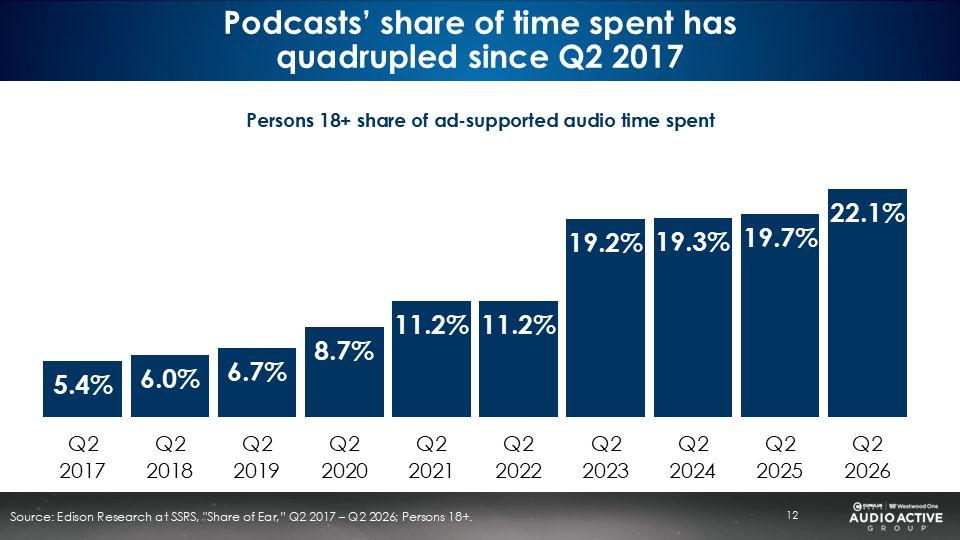
- Podcasts’ 18+ ad-supported audience share grows to 22% after three years of stable 19% shares.
78% of time spent with Spotify is with the ad-free subscription service among adults 25-54
Most of Spotify’s music streaming audience is not available to advertisers. Only 22% of Spotify’s audience impressions are ad-supported, down from ten years ago when 53% was ad-supported.
Perception vs. reality: Agencies and advertisers underestimate AM/FM radio shares and overestimate Pandora and Spotify audiences
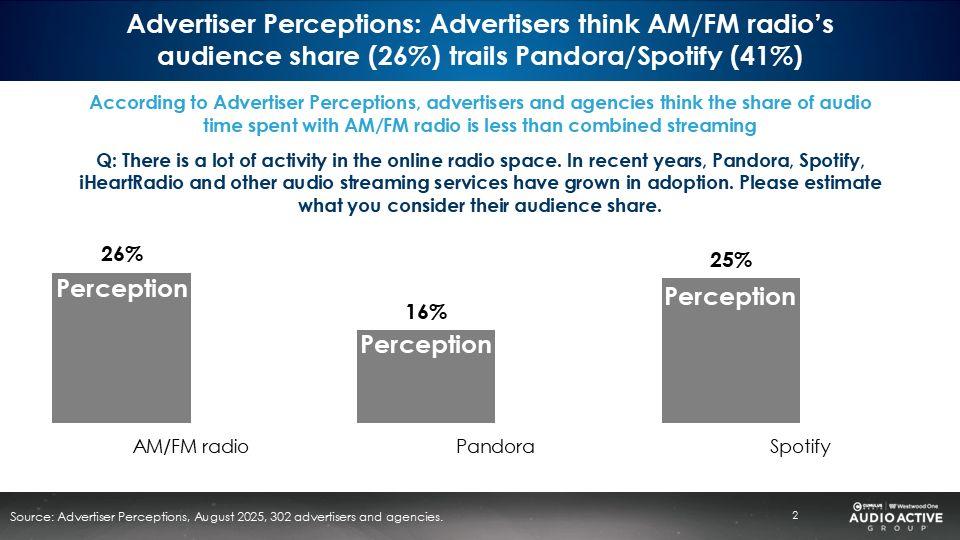
The Q2 2026 “Share of Ear” report reveals a yawning gap in agency/marketer perceptions of audio audiences versus actual audience shares. An Advertiser Perceptions study of 302 media agencies and marketers conducted in August 2025 found the perceived combined audience share of Spotify/Pandora is 41%, much greater than the perceived share of AM/FM radio (26%).
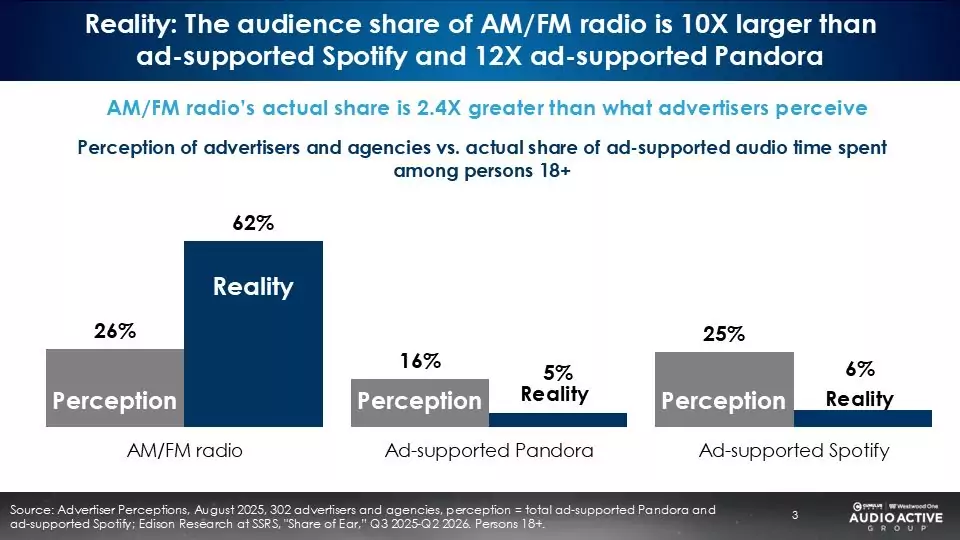
AM/FM radio’s actual share (62%) is 2.4 times larger than what advertisers perceive (26%).
Agencies and advertisers vastly overestimate Pandora and Spotify shares. According to Edison’s Q2 2026 “Share of Ear,” AM/FM radio’s persons 18+ share of ad-supported audio (62%) is 12 times larger than ad-supported Pandora (5%) and 10 times larger than ad-supported Spotify (6%).
Ad community perceptions of media audiences are often completely opposite to reality. Duncan Stewart, Director of Research, Technology, Media & Telecommunications at Deloitte, puts it best: “Why do people think that nobody listens to radio anymore? Because there is a narrative that new media kills old media, so nobody bothers to look at evidence that doesn’t fit the narrative.”
Take the “me out of media”
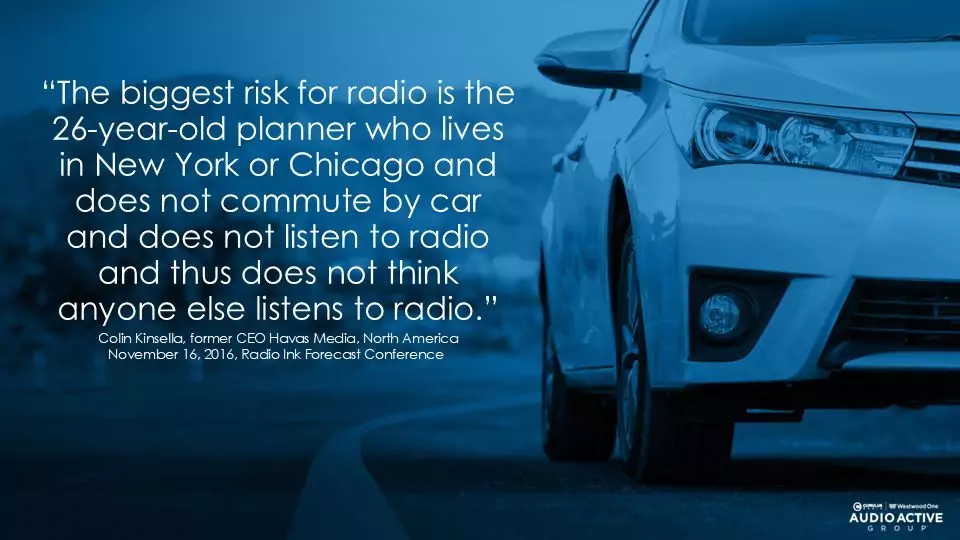
Collin Kinsella, the former CEO of Havas Media, explains, “The biggest risk for radio is the 26-year media planner who lives in New York or Chicago and does not commute by car and does not listen to radio and thus does not think anyone else listens to radio.”
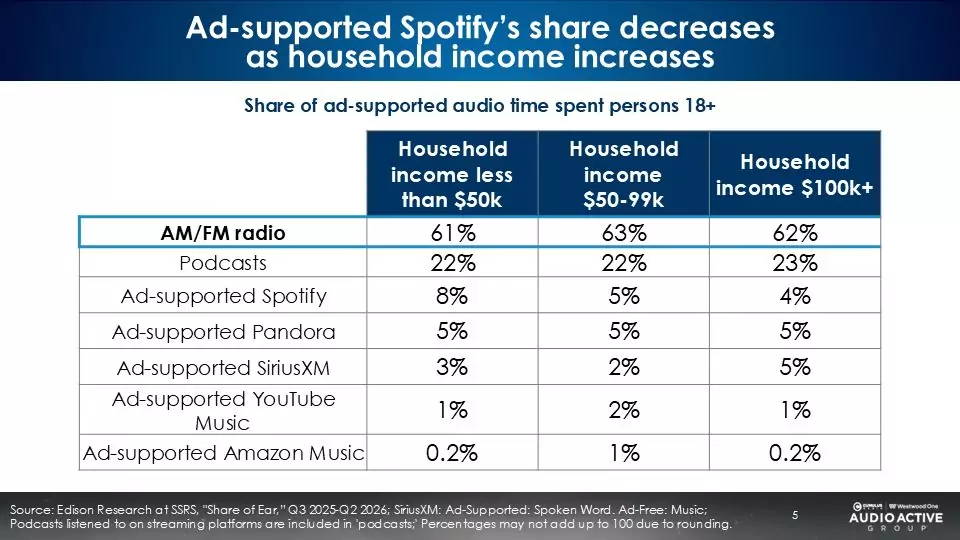
Spotify’s free ad-supported audience skews downscale: The lower the income, the greater Spotify’s audience share
Among those with a $100K+ income, ad-supported Spotify only has a 4% share. AM/FM radio’s share (62%) is 16 times greater than Spotify among those with a $100K+ income.
Among those with less than a $50K income, ad-supported Spotify has an 8% share, double it’s $100,000 4% share. All other audio platforms have consistent audience shares across low, medium, and high-income segments.
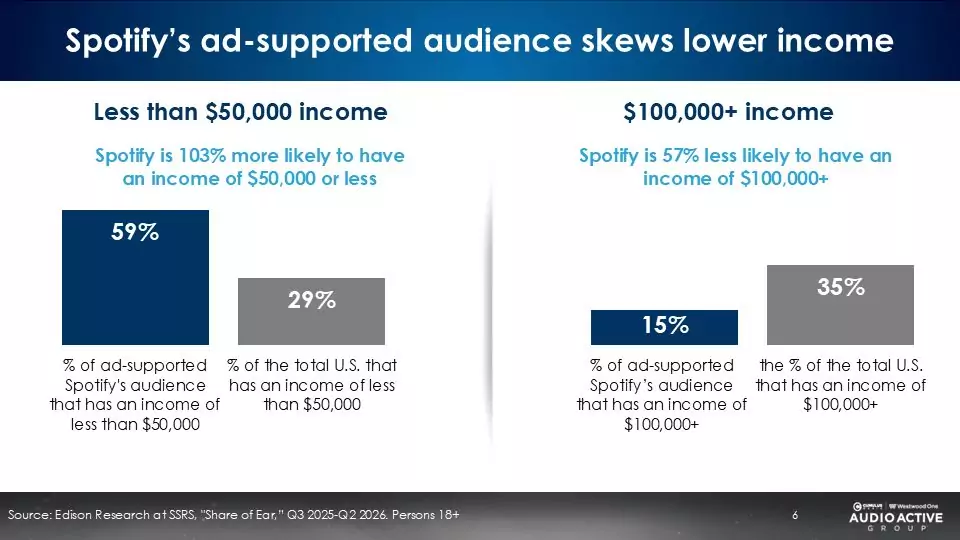
Spotify’s ad-supported audience is 2X more likely to have an income of less than $50,000
59% of ad-supported Spotify’s impressions have an income of less than $50,000 compared to 29% for the total market, a 2X difference.
Only 15% of ad-supported Spotify’s impressions have $100,000+ income versus 35% of the total market. Spotify’s impressions have less than half the $100,000+ income composition of the overall market.
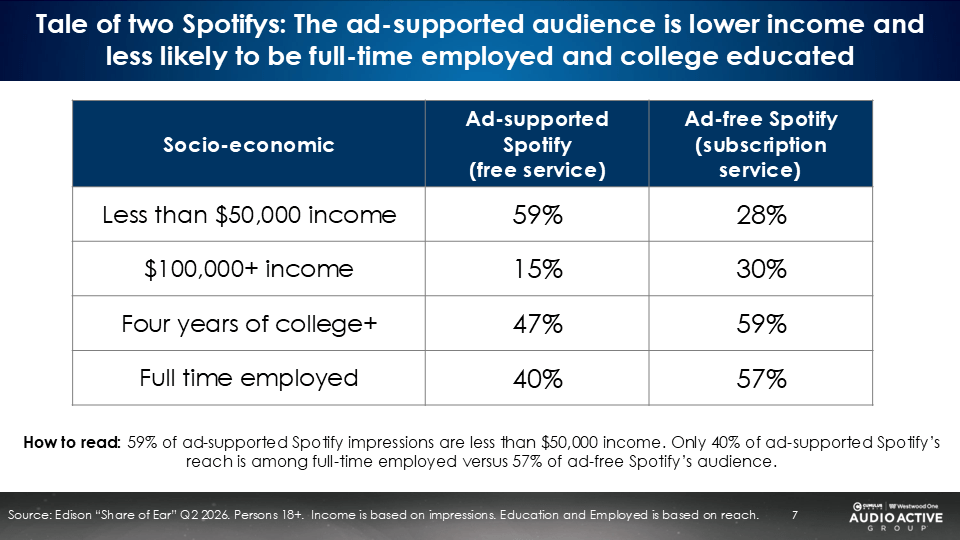
Tale of two Spotifys: Spotify’s ad-supported audience is lower income and far less likely to work full time and have at least four years of college education
- 59% of Spotify’s ad-supported music streaming audience has less than a $50,000 income versus only 28% of Spotify’s ad-free subscription service.
- 59% of Spotify’s ad-free audience has at least four years of college compared to only 47% of ad-supported Spotify’s audience.
- 57% of those who listen to Spotify’s ad-free subscription service have a full-time job. Only 40% of those who listen to Spotify’s ad-supported free service have a full-time job.
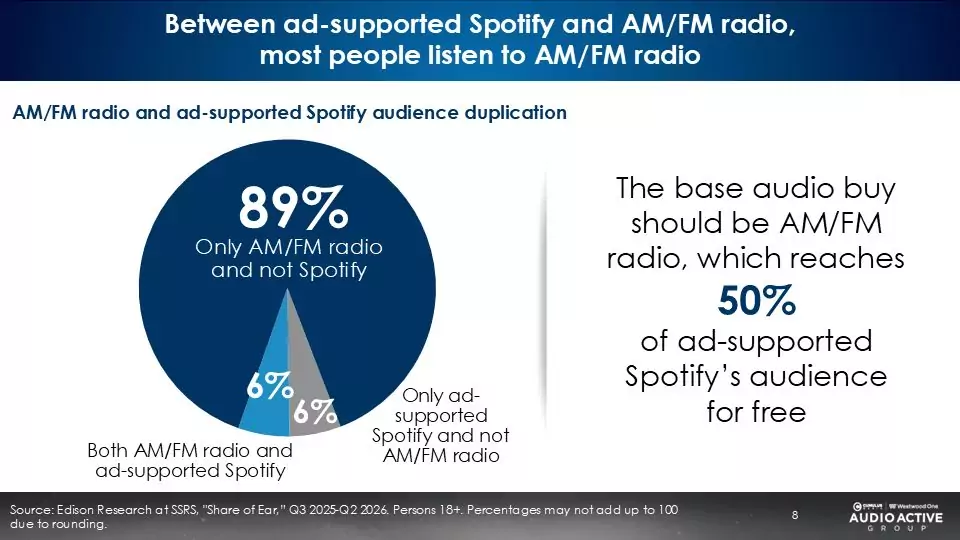
Between ad-supported Spotify and AM/FM radio, in a typical day most people (89%) only listen to AM/FM radio and never listen to Spotify
Edison reports that only 6% listen to ad-supported Spotify and don’t listen to AM/FM radio. 6% listen both to Spotify and AM/FM radio. Nine of ten only listen to AM/FM radio and not Spotify in a typical day.
To achieve scale in an audio buy, it is essential to have AM/FM radio on the media plan
In a typical day, only 32% of the U.S. is reached by digital audio (Spotify, Pandora, and podcasts). Adding AM/FM radio to the plan causes reach to soar to 74%.
AM/FM radio rules ad-supported audio in the car with an 82% share
AM/FM radio is the queen of the road with an 82% share of in-car ad-supported audio.
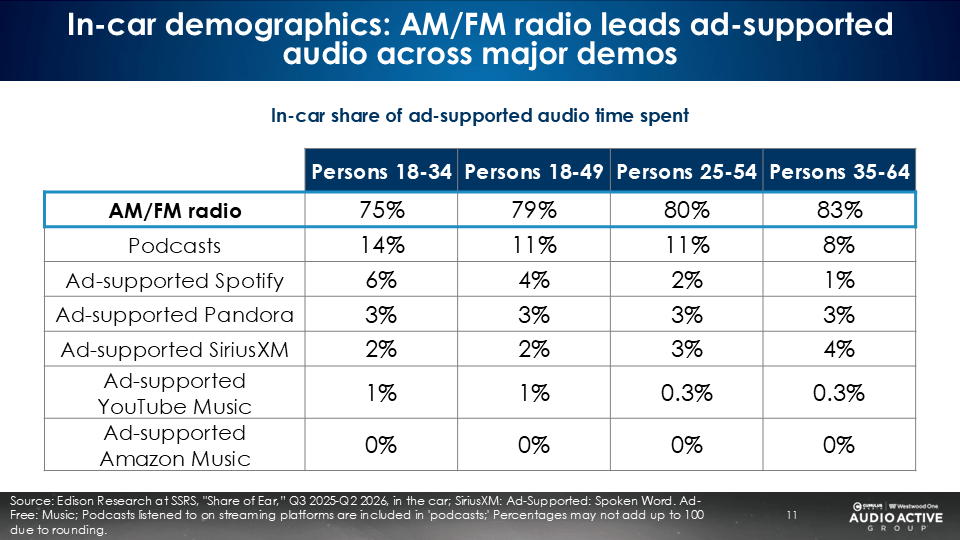
Regardless of the demographic, AM/FM radio is the ideal platform to reach Americans on the path to purchase. Even among 18-34s, AM/FM radio has a 75% share of in-car ad-supported audio.
After three years of stable ad-supported shares, podcasts’ audience jumps to 22% share of ad-supported audio
Key takeaways:
- Most of Spotify’s music streaming audience is not available to advertisers. 78% of total time spent with Spotify goes to the ad-free subscription service among adults 25-54.
- Spotify’s ad-supported free music streaming service skews downscale: 59% of the impressions have less than a $50K income compared to 29% for the total market.
- Tale of two Spotifys: The ad-free Spotify that advertisers and agencies listen to does not have the profile of the service where they run ads. Spotify’s ad-supported streaming music audience skews low income, is far less likely to work full-time, and is less likely to have at least four years of college education.
- Marketers and media agencies need to “take the me out of media,” believing Spotify has a 25% audience share of audio. In reality, ad-supported Spotify only has a 6% share. AM/FM radio’s audience share is 10X larger than Spotify’s (62% versus 6%).
- To achieve scale in an audio buy, it is essential to have AM/FM radio on the media plan. In a typical day, only 32% of the U.S. is reached by digital audio (Spotify, Pandora, and podcasts). Adding AM/FM radio to the plan causes net reach to soar to 74%.
- AM/FM radio rules ad-supported audio in the car with an 82% share among adults 18+.
- Podcasts’ 18+ ad-supported audience share grows to 22% after three years of stable 19% shares.
Click here to view a 15-minute video of the key findings.
Pierre Bouvard is Chief Insights Officer of the Cumulus Media | Westwood One Audio Active Group®.
Contact the Insights team at CorpMarketing@westwoodone.com.