
Want To Grow Market Share? Increasing Brand Awareness Drives Up Share Of Search, Which In Turn Expands Market Share
Click here to view a 15-minute video of the key findings.
Click here to download a PDF of the slides.
Need to justify brand spend?
A new study from Google and Tracksuit, the brand tracking firm, reveals “brand awareness drives share of search. Share of search growth precedes market share increases. The earlier you invest in brand, the greater the return. That’s not a feeling. That’s return on awareness.”
Key findings:
- Google and Tracksuit found investing in brand awareness generates quantifiable business outcomes: Increasing brand awareness drives up share of search, which in turn expands market share.
- Share of search is a powerful and free predictor of your business’s success.
- For small brands, awareness growth generates significant share of search increases. Five gets you five. Every five points of brand awareness growth translates directly into a five-point share of search increase.
- Les Binet: Share of search is a leading indicator for market share with predictive power.
- Advertising has both short-term and long-term effects on search behavior.
- Long-term effects are the main way advertising influences search behavior.
- The earlier you invest in brand, the greater the return. That’s return on awareness.
Major global study analyzed 31 brands across 15 categories
For each of the brands, Tracksuit conducted always-on tracking of awareness, consideration, and preference. Google conducted “share of search” calculations. The study is called, Return Of Awareness: How Brand Awareness Drives Share Of Search And Why It Pays To Invest Early.
“Search of search” is a powerful and free predictor of your business’s success
Share of search divides the number of searches for a brand over all the searches for brands in a category and competitive set. It’s like an audience share: a station’s time spent listening divided by all time spent to listening in the market.
It’s free: how to determine “share of search” for your business
- Go to Google Trends in your web browser.
- Enter your brand and up to four competitors in the comparison tool.
- Set your location and time range to match your target market and period (such as the past 12 months).
- Download the CSV data using the download icon on the comparison chart.
- Open a spreadsheet and import the downloaded numbers.
- Calculate the percentage by dividing an individual brand’s value by the total sum of all brands on that row, then multiplying by 100.
- Repeat the process to download more brands If there are more than five competitors.
If you need more sophisticated share of search analyses conducted (content creation, market research, trend signals, AI visibility, product marketing, etc.), a great firm called MyTelescope can be an invaluable partner.
A strong brand shifts consumer behavior; When a brand earns a place in memory, it earns a place in search results
Brand awareness is not a “soft metric.” It is a leading indicator of what gets found, considered, and bought.
The Google/Tracksuit study found a clear connection between brand awareness and commercial intent. Brands with higher awareness commanded greater share of search.
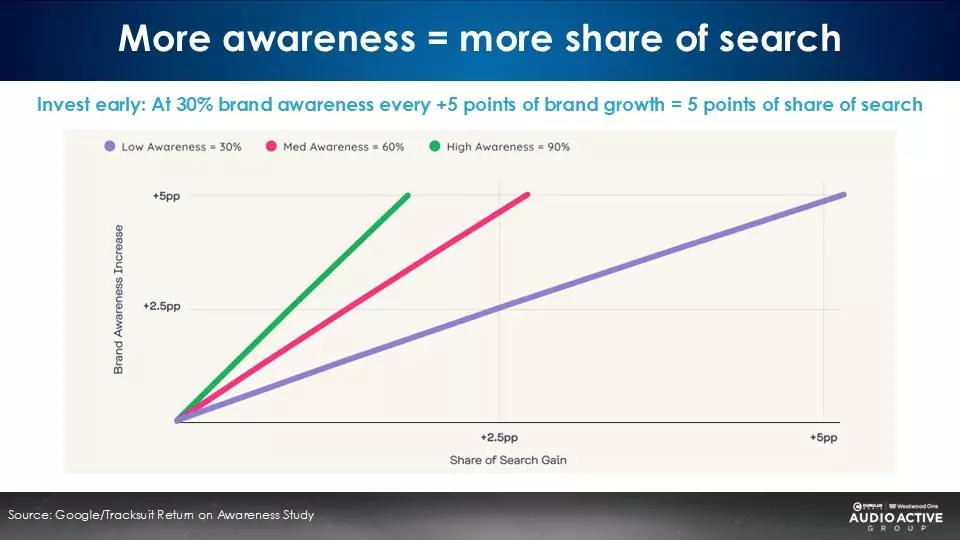
Brands were classified as low (30%), medium (60%), and high (90%) awareness. Awareness growth drove share of search growth. This proves “you have to be known before you’re needed.”
For small brands, awareness growth generates significant share of search increases; Share of search growth for small brands is almost seven times greater than for large brands
- Large brands: A 2.5-point growth in brand awareness generates about half a point of share of search growth.
- Medium brands: A 2.5-point increase in brand awareness yields about a point in share of search growth.
- Small brands: A 2.5-point rise in brand awareness grows share of search by 3.75. This share of search growth is over seven times greater than the growth for large brands!
Every five points gained in brand awareness translates directly into five points of share of search. The earlier you commit to brand, the greater the return.
Early awareness investment delivers the highest return
Often, small brands dismiss brand marketing as a “nice to have luxury.” This Google/Tracksuit study makes the hard business case that small brands should invest in brand marketing.
The Google/Tracksuit report concludes for small and mid-sized brands, “Every point of awareness growth translates into meaningful, measurable behavioral change in search, and ultimately in market share. Growth stage and disrupter brands have the most to gain. Brand investment at this stage isn’t a soft spend, it’s one of the most commercially efficient things a marketer can do.”
For brands that are better known, the priority shifts to staying top of mind and defending existing brand perceptions since advertising memories fade. When share of search growth plateaus in line with awareness, investment should shift towards influencing consideration and brand preference.
High awareness brands should focus on “reaching new category entrants, lapsed users and low-frequency buyers. Pairing distinctive assets and category cues with broad targeting and scaled reach is what wins familiarity and buying moments.”
TikTok and Tracksuit: A strong brand makes your performance marketing work harder
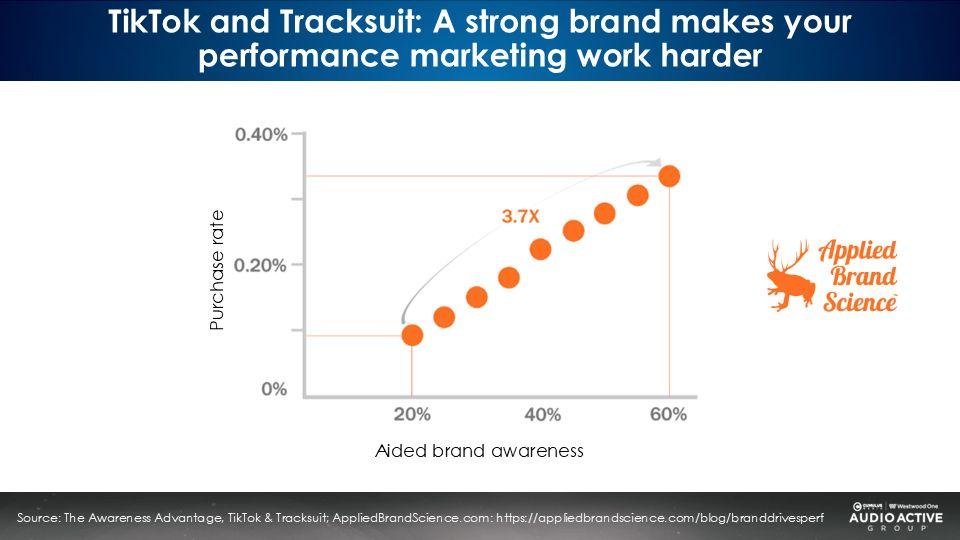
A great new study from Tracksuit, the brand tracking firm, reveals how aided awareness drives conversion rate and improves performance efficiency. The study, conducted in partnership with TikTok, analyzed a large number of campaigns and compared sales response with the advertisers’ brand strength. Tracksuit found:
- The greater the awareness, the greater the conversion rate: There is a direct relationship between aided awareness and conversion rate.
- Stronger brand awareness improves performance marketing impact by as much as 2.86X: The stronger your brand, the greater your performance efficiency. Compared to low-awareness brands, medium-awareness brands generate 1.48X greater conversion. Brands with high aided awareness have 2.86X greater conversion rates compared to low awareness brands.
- Brand awareness is a controlling factor for the outcomes of performance marketing: Brand is the foundation on which performance success is built: the stronger the brand, the stronger the foundation.
In the best-selling marketing strategy book How Not to Plan: 66 Ways to Screw It Up, Les Binet and Sarah Carter explain, “The single most important factor driving brand preference is ‘mental availability’: how well known a brand is, and how easily it comes to mind.”
Les Binet: Share of search is a leading indicator for market share with predictive power
If there was a “Mount Rushmore of Marketing Effectiveness”, Les Binet would certainly deserve that honor. As a global thought leader and author, he has been called one of the “godfathers of marketing effectiveness.”
Binet has published two major studies: the first on share of search as a brand metric and the second on share of search as an advertising metric.
Binet conducted a ten-year deep dive analysis of share of search across automotive, power utilities, and mobile phones. Quarterly search data over the ten-year period was examined for dozens of brands along with each brand’s quarterly market share and sales trajectory.
Share of search correlates with market share
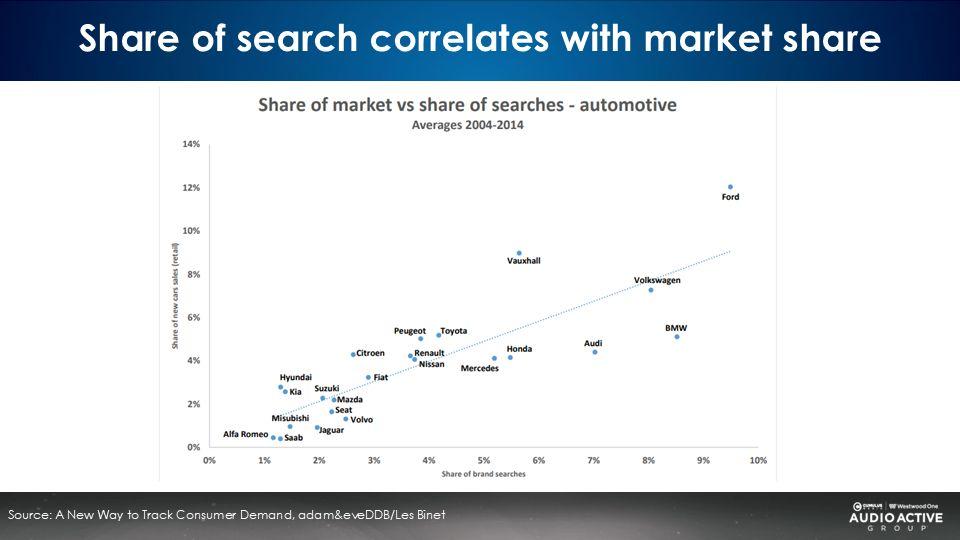
Over a ten-year period, Binet found a very strong relationship between automotive brand searches and share of new car sales.
Fast and free: Share of search is a useful indicator of latent demand for a brand like awareness or consideration. It gives faster feedback and it costs nothing to measure.
Share of search is leading indicator for market share shifts: Eroding share of search predicts market share decreases. Increasing share of search foretells market share growth.
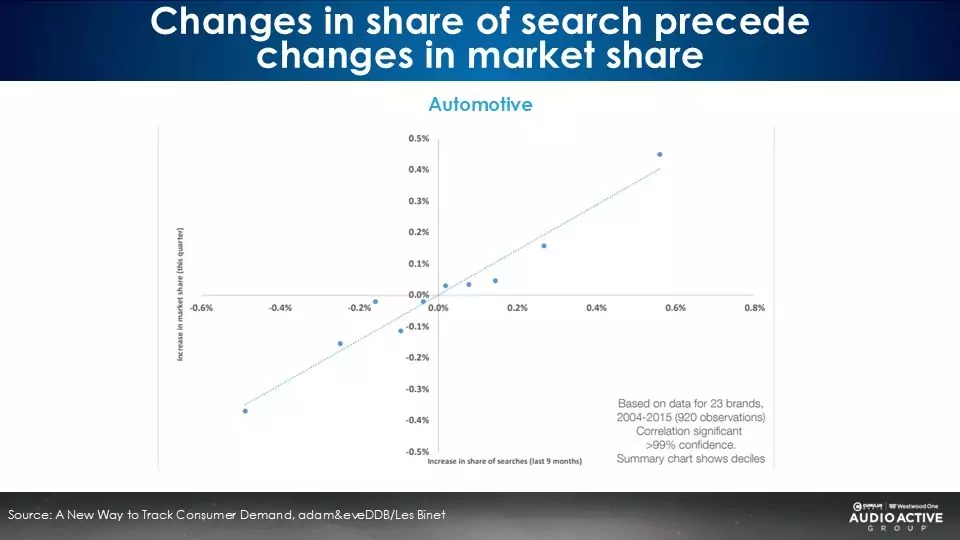
Based on 920 observations of 23 automotive brands across a ten-year period, there was a very high correlation between shifts in share of search and corresponding market share movement.
The horizontal axis depicts the quarterly change in the automotive share of search in the last nine months. The vertical axis shows the change in automotive market share.
Auto brands in the lower left quadrants experienced erosion in share of search resulting in reduced market share. Brands in the top right quadrant saw growth in share of search and increases in market share.
The lag time between share of search and market share can be quite long
Binet’s research found the lead time for auto brands was 12 months. It took a year for auto brand changes in share of search to show up in market share changes.
For mobiles phones there were six months between share of search movement and market share shifts. For power utilities, the share of search lead time to market share changes was only three months.
A simple math equation can predict if sales grow, fall, or remain stable
Les Binet, former Head of Effectiveness at adam&eveDDB, and Peter Field, Marketing Consultant, studied the world’s largest database of marketing case studies for their book Media in Focus: Marketing Effectiveness in the Digital Era. They popularized their famous “share of voice/share of market” visual.
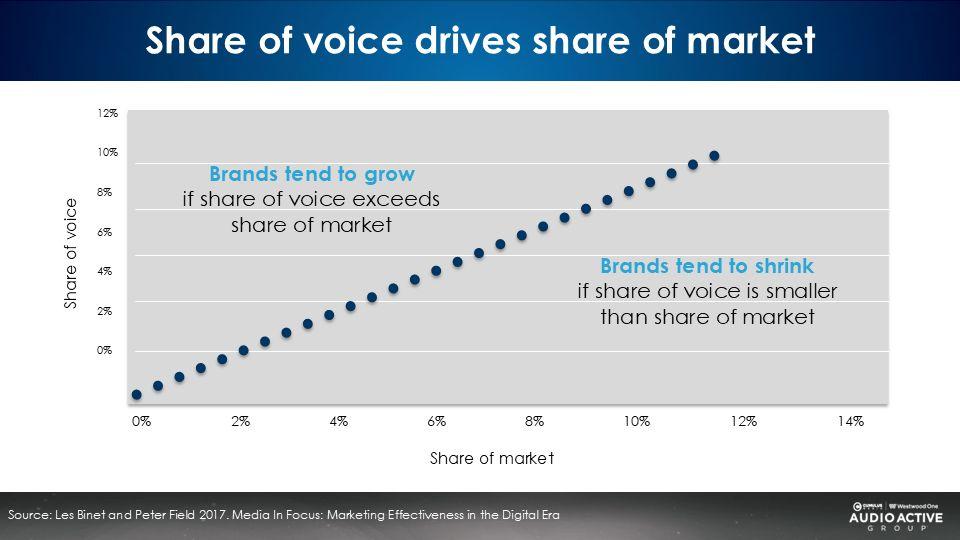
Let’s say your brand or business has a 10% share of voice in your category. Share of voice is your brand’s total ad impressions or ad budget divided by total spend in your competitive category or total impressions.
Let’s assume your revenue share of 10%. Generally, if your share of voice is close to your market share, your ad spend is just enough to achieve stable sales. No major growth or erosion, just flat sales.
- If share of voice exceeds share of market, sales tend to grow.
- If share of voice is similar to share of market, sales tend to be stable.
- If share of voice is smaller than share of market, sales tend to shrink.
“Extra share of voice” (ESOV): A powerful concept which leads to growth
If your share of voice exceeds your revenue share, your brand will grow in the future. Let’s say you have a 20% share of voice versus your 10% market share. Your future sales are likely to grow. Conversely, if your share of voice is 3% and your market share is 10%, your future sales will drop.
Extra share of search can be a leading indicator for market share growth
Binet found the same relationship exists with share of search. He examined a one-year period of LG mobile phone sales growth and the movement of the brands extra share of search (+10% greater share of search versus market share).
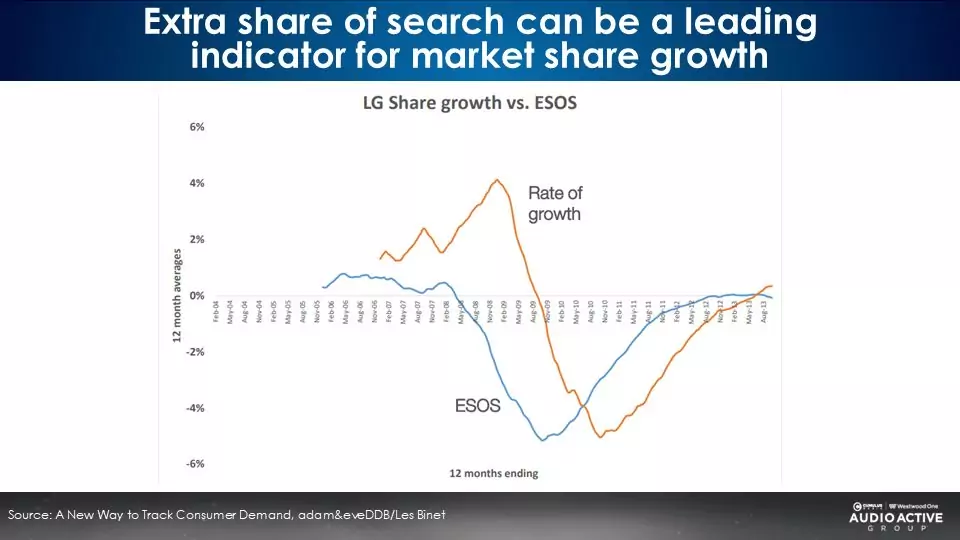
The blue line above represents LG’s extra share of search and the orange line depicts LG’s rate of growth. Four months after LG’s extra share of search started plunging, LG’s sales began to sharply drop. The rebound of LG’s extra share of search preceded by four months, the recovery of their sales growth rate.
Advertising has both short-term and long-term effects on search behavior
Binet’s work found most searches are driven by factors other than ads. This “base level” of demand varies by brand, reflecting the size of the customer base and the underlying strength of the brand.
Advertising can increase demand over and above the base level of search. Advertising’s long-term and short-term effects on search behavior are similar for the brands and categories studied and are consistent with other research on advertising short-term and long-term impact.
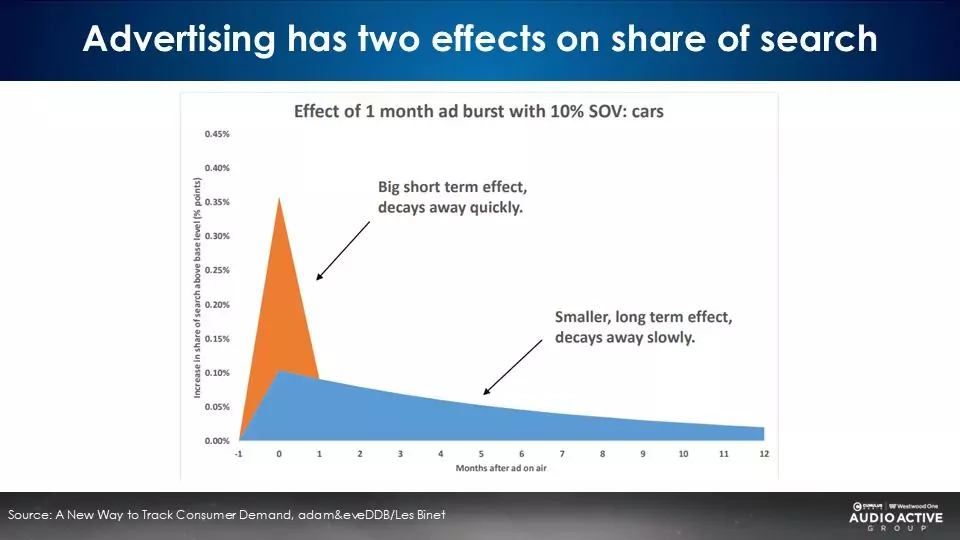
A one-month burst of advertising produces an immediate increase in brand searches: A 10% increase in share of voice yields a 0.4 increase in share of search.
Advertising has two effects on share of search: The big, short-term effect dies away within a month. Long-term effects are twice as important as short-term effects.
Long-term effects are the main way ads influence search behavior
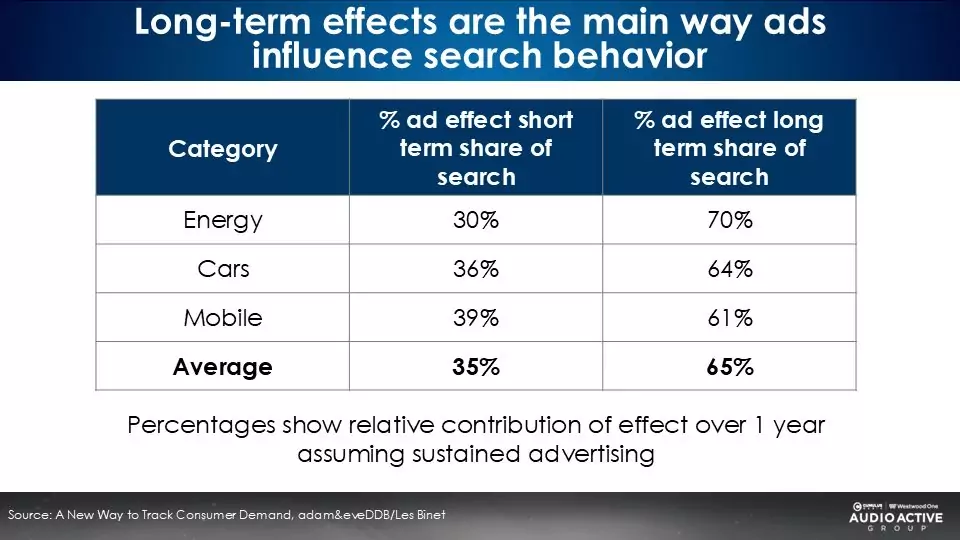
Two-thirds of advertising impact on search occurs over the long term, while about a third occurs in the short term. This is not surprising as only 5% of consumers are in the market at any point in time for a product or service.
A massive 95% are not in the market. It may take years for people to enter a category, conduct research, and make a purchase.
Key findings:
- Google and Tracksuit found investing in brand awareness generates quantifiable business outcomes: Increasing brand awareness drives up share of search, which in turn expands market share.
- Share of search is a powerful and free predictor of your business’s success.
- For small brands, awareness growth generates significant share of search increases. Five gets you five. Every five points of brand awareness growth translates directly into a five-point share of search increase.
- Les Binet: Share of search is a leading indicator for market share with predictive power.
- Advertising has both short-term and long-term effects on search behavior.
- Long-term effects are the main way advertising influences search behavior.
- The earlier you invest in brand, the greater the return. That’s return on awareness.
Click here to view a 15-minute video of the key findings.
Pierre Bouvard is Chief Insights Officer of the Cumulus Media | Westwood One Audio Active Group®.
Contact the Insights team at CorpMarketing@westwoodone.com.