
AI Best Practices For Local Advertisers Using Artificial Intelligence To Inform Media Planning
Can local advertisers have artificial intelligence (AI) inform their media plans? Yes, but there are some watchouts and best practices to consider.
AI platforms offer new ways to find information and solve problems. However, AI does not work the same as a Google search.
AI requires specific methods of searching, especially when used by local advertisers to inform their media plans and buying decisions.
A recent national Quantilope study of 2,000 average Americans reveals only 34% of adults 18+ use AI at work on a monthly basis. 58% have never used AI for work.
Here are AI best practices for local advertisers and media sellers:
- Be exact: The more specific the language used, the more accurate the response; State a desired outcome like “grow awareness”, “increase sales”, or “expand my customer base”
- Use reputable sources within search queries to get accurate information
- Take careful note of sourcing and dates: Don’t take data at face value without checking it
- Understand that AI platforms are different: Results will vary depending on the platform
- Expect responses will change: Lots of factors impact the AI answers so read them carefully
ChatGPT is a conversational AI assistant that can help with a wide variety of tasks
ChatGPT’s tasks include:
- Answering questions and explaining concepts
- Drafting, rewriting, or summarizing content
- Providing creative suggestions (e.g. writing stories or ideas)
- Solving problems through logical reasoning
- Translating between languages
For the busy local advertiser, it sounds like a dream. ChatGPT can answer questions, solve a targeting problem, and provide creative ideas for media plans.
Here are some best practices to get accurate, usable information from ChatGPT:
Be exact: The more specific the language used in a query, the more accurate the response; State a desired outcome like “grow awareness”, “increase sales”, or “expand my customer base”
Asking simple questions in ChatGPT without enough context or specifics on the desired outcome can lead to unreliable results.
Below are examples of prompt do’s and don’ts for achieving desired results:
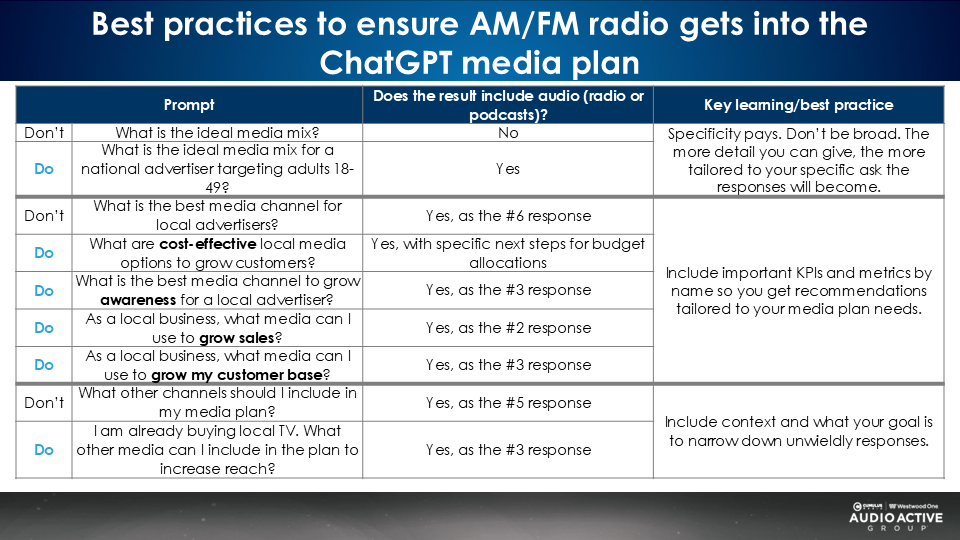
As this chart demonstrates, the way the question is asked can affect the extent to which audio and AM/FM radio are included in media plan recommendations.
Use the names of reputable sources within search queries to make sure you get accurate information
Instead of having to sift through multiple sources and determine their validity, including the name of a reputable source from the audio industry in the query can narrow down the answers.
Tack on a source to a query:
For example, use the Radio Advertising Bureau (RAB). The RAB compiles all of the most up to date and relevant data about AM/FM radio advertising.
“What is radio’s weekly reach according to the Radio Advertising Bureau?”
ChatGPT response: “According to the Radio Advertising Bureau (RAB), radio’s weekly reach is 87% of Americans aged 18+. rab.com”
Or use the Audio Active Group®, a comprehensive marketing advisory that partners with clients to measure the impact of audio campaigns and specializes in audio insights, audio creative best practices, media planning, and measurement.
“What is radio’s weekly reach according to the Audio Active Group?”
ChatGPT response: “According to the Audio Active Group, AM/FM radio reaches 87% of U.S. adults weekly. radioink.com”
The data is linked to a trusted and current source in each instance. By including the name of a reputable company or website, you are focusing the AI on one data source with current data.
ChatGPT provides quick responses to endless queries. But due to its ever-changing outputs, personalized-by-user nature, and lack of sourcing, it does not replace facts provided by syndicated data sets and real-world case studies.
Take careful note of sourcing and dates carefully: Don’t take data at face value without checking it
Take a relatively simple query: “What is radio’s weekly reach?”
ChatGPT responds: “In the U.S., radio’s weekly reach (i.e. the number of people aged 12+ who listen to radio at least once in a typical week) is estimated at ~ 244.4 million people. Radio World
That corresponds to about 92% of the U.S. population aged 12 and older. Radio World+1”
While the response seems accurate, the source provided is from an out-of-date piece published in 2014.
Verifying up to date and accurate sourcing as well as information from respected websites is an essential step in using any information provided by an AI platform. Check for the most updated data to ensure the narratives are based on current studies.
Understand AI platforms are all different and results will vary depending on platform used
For the purpose of this piece, the platform examined was ChatGPT. Each AI comes with their own learnings and history that can change the answers to queries.
A recent study by BrightEdge compared ChatGPT and Google AI responses to the same queries. According to Digital Information World and BrightEdge, “ChatGPT recommended tools or apps people could start using right away. Google [Gemini], on the other hand, pointed to articles and online resources designed to explain a topic before any decision is made.”
Expect responses will change: Lots of factors can impact the AI answers so read them carefully
Many factors impact what answer an AI platform will provide. For example, responses to the same question will vary depending if the user is logged in versus logged out.
Users who are logged in can use the memory feature, defined by ChatGPT as: “ChatGPT can remember useful facts you’ve shared (like your name, preferences, or goals) to personalize future responses. You can view, edit, or delete memories at any time.” As the memory feature adjusts on an individual basis, results will vary by user.
Key AI best practices:
- Be exact: The more specific the language used, the more accurate the response; State a desired outcome like “grow awareness”, “increase sales”, or “expand my customer base”
- Use reputable sources within search queries to get accurate information
- Take careful note of sourcing and dates: Don’t take data at face value without checking it
- Understand that AI platforms are different: Results will vary depending on the platform
- Expect responses will change: Lots of factors impact the AI answers so read them carefully
Bob Walker is the President of Cumulus Operations.
Contact the Insights team at CorpMarketing@westwoodone.com.