
Media Mix Modelers Should Consider Radio As A New Media Channel Due To New As-Run Radio Deliveries Which Are A “Trend Break,” “Stand Alone” Dataset; Modelers Should Not Constrain Current Radio ROI With Historical Performance

Editor’s note: John Fix is responsible for returning Procter & Gamble into the world of audio advertising. Since his retirement from P&G, John has opened his consultancy with Westwood One as one of his early clients. At P&G, John was one of the first to be dedicated to media analytics, from planning to attribution. He was responsible for the analysis and selection of media measurement applications and planning tools. At one point, John led U.S. media mix modeling, multi-touch attribution, and market testing. In his years at P&G, they went from non-existent to first in radio over a 5-year period.
Often media mix models apply “historical guard rails” to constrain ROIs to conform to prior performance ranges. In essence, current ROI performance conforms to the past. This assures a constancy in ROI trending but is improper when a major change in the data quality occurs.
It is also difficult to utilize planned media. As the visual below reveals, planned media weight is problematic. It creates a “smoothing effect,” which makes it difficult to correlate AM/FM radio ads with sales.
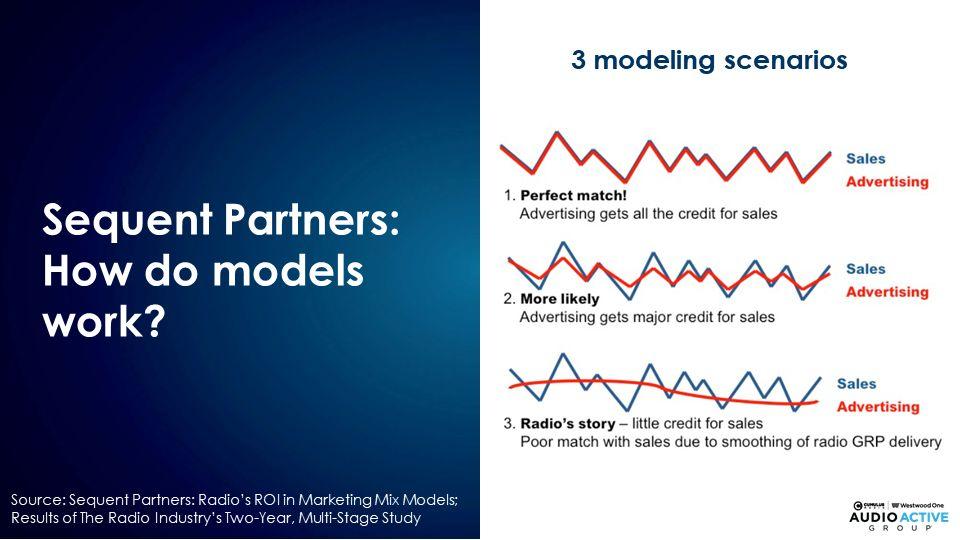
New “as run, actual” radio delivery data should be considered as a “trend break.” Don’t let history be the best predictor of the future. Modelers should loosen up dependencies on priors to allow the model to find something with better, improved radio data.
2024/2025: When radio learned that as-run radio deliveries were critical to improving media mix modeling performance
A lot has been written this past year about radio data and MMM. The topic is not new. In 2012 Sequent Partners reported that, “One of the primary reasons that Radio did not fare well historically in Marketing Mix Models was that the data was not granular enough.”
The narrative continued in 2024 as Dave Hohman, EVP and GM, Global Marketing Mix of Circana, the leading Media Mix Modeling firm, shared that best practices for having radio in MMM include:
- Use as-run data
- DMA-level delivery matters
- Plan for adequate GRPs
The radio and MMM conversation has changed significantly in 2025 as tangible steps have been taken to facilitate changing the narrative by addressing each recommendation.
Advertisers now have access to as-run radio deliveries
Broadcasters have partnered with Media Monitors, software platform Act1, and Nielsen to formalize a methodology that provides as-run radio data for their total radio buys. Media Mix Modeling requires weekly as-run GRPs and the radio industry can now provide detailed, weekly data. Marketers and agencies can reach out to iHeart and Westwood One to obtain as-run campaign deliveries for the entire radio campaign.
Media Monitors’ radio DMA expansion to 250 markets
In August 2025, Media Monitors announced the expansion of their coverage from 106 U.S. radio markets to 250 markets. This coverage changes the story that radio data is too sparse to be useful.
Weekly level, as-run radio data will look significantly different than weekly planned data due to natural variation in delivery. This actual variation creates an improved signal for modeling and no longer looks like monthly, planned levels merely divided by the number of weeks in the month.
The industry recommends a reset
As a result of these changes to the input data, where using as-run data instead of planned data is considered significant to modelers, the following recommendations are being made:
- Ensure that the entire radio dataset for the model is as-run, delivered data. Do not append recent data to an old model that does not have as-run data. Model refreshes should include as-run radio data for the entirety of the model.
- Communicate with the MMM provider that the radio data is different from historical. Radio broadcasters believe that very few MMMs have been utilized as-run, weekly data and few, if any, MMMs have used as-run delivery data at the DMA level.
- Acknowledge that the recent methodology that produces as-run terrestrial radio data should cause the radio media channel to be treated as a new media channel. Advertisers and modelers have very little experience using weekly radio as-run data for MMM. This change, as well as added granularity in the data, should mean that historical benchmarks for radio performance should be reconsidered.
MMM, radio, and a “reset”: Understanding the role that history can play in MMM
A deep dive into traditional market mix methodology will uncover that the use of “priors” serves an important role in MMM. Priors, sometimes referred to as Bayesian priors, have the potential to guide the statistical modeling process by constraining and stabilizing the model. (Think of this as a way to keep the model from endlessly searching for an optimum solution when an estimate of the solution is known based on prior experience.)
Priors have also been applied in some models to incorporate media channel expertise by using external measurements. Modelers have the ability to consider the results from incrementality tests and local market testing to inform the MMM to an “expectation” of performance established by having tested the media channel.
- Suggest that the modeler relax the model’s reliance on historical priors for radio. As-run radio data has rarely, if ever, been modeled by MMM providers. It is appropriate for the modeler to weaken reliance on historical norms, especially if brand specific, in order to allow the model to use this “new” dataset. Modelers may have years of experience modeling many brands within a category. This experience can be represented as a probability function that guides the model as it converges on a solution. Probability functions can take many shapes and can represent the range of strength of the prior.
- Uninformed (flat) prior: Used in the case where it is a new media channel and/or where there is sparse or limited data. This prior assigns a uniform probability that the ROI is somewhere >0 but less than an unbelievable number.
- Weak (wide) prior: These priors can look like a wide normal curve with an average point chosen to be the most likely contribution to sales but with the allowance for the data to create variance from historical response.
- Informative (tight) prior: These apply when there is strong existing knowledge from past campaigns or testing that suggest the sales response should be consistent to historical norms. There is some comfort in a model that confirms the belief in a media channel but stability can be misleading when the execution of media changes mix, demo, or creative quality.
- Work closely with broadcaster partners and modelers.
- Use the right data: Broadcasters and MMM providers should ensure the data supplied for terrestrial radio represents as-run, weekly data.
- Discuss how historical performance effects your MMM: Acknowledge that there is potentially no prior experience with this new as-run data set. Discuss the potential that this MMM model might produce a result that is different from previous models of the same brand for radio. Share results from external testing that may have caused confusion (ie. local market testing suggests profitable ROI where historical MMMs have suggested poor performance).
The MMM process should always be seen as a conversation among advertisers, media suppliers, and modeling companies. Advertisers contribute their knowledge of the campaigns run and share the main business questions they have in order to form the data breakouts and create meaningful granularity.
Specific to radio, broadcasters should be included to ensure that the data provided reflects the delivery and they can also review the media briefing to suggest areas where breakouts (on-air read vs. recorded, duration, radio programming format) could be optimized.
Modelers should be transparent with the advertiser, acknowledging the role that historical norms and prior models play as well as establishing the rules for the current model, especially when new data or new media channels are introduced.
John Fix can be reached at johnfixltd@gmail.com.