
Don’t Be Shocked By The Podscribe/Oxford Road Podcast Sales Effect Study That Reveals Audio Ads Beat YouTube Video Ads In Effectiveness
Click here to view a 17-minute video of the key findings.
Click here to download a PDF of the slides.
It’s a head snapper. YouTube podcast views are 18-25% less effective at driving purchases than audio podcast ads, according to a just released study from Oxford Road and Podscribe.
Those who closely follow advertising effectiveness results are not surprised. This is the latest in a series of studies that reveal audio ads trump video ads in attentiveness, engagement, and sales effect.
Key findings:
- Oxford Road/Podscribe: YouTube podcast views are 18-25% less effective at driving purchases than audio podcast ads.
- Game of Thrones audio book beats the TV show in consumer engagement: Audio narratives require active participation to imagine the story. Video narratives require less of the audience, resulting in passive engagement.
- Adelaide attentiveness measurement: Despite the lack of “sight and motion,” audio platforms generate nearly the same attentiveness as TV.
- Lumen attentiveness measurement: Audio ads outperform video for attention and brand recall.
- DVJ Insights: You can look away but you cannot shut your ears. In TV ads, audio does all the heavy lifting for brand recall. As audio brand mentions increase, brand recall explodes and soars.
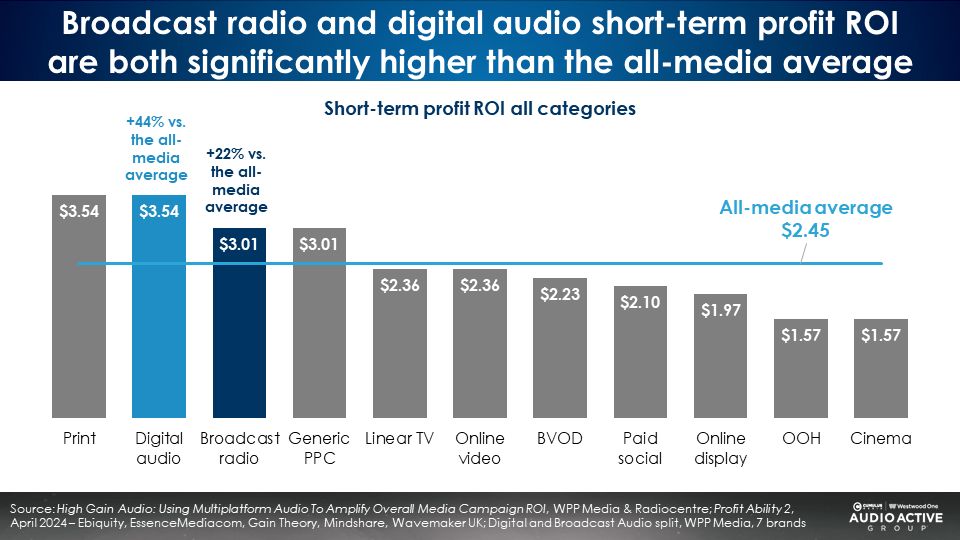
- WPP Media: Digital audio’s short-term ROI is tied for first, outperforming the all-media average by +44%. Broadcast radio is second in ROI, surpassing the all-media average ROI by +23%.
Oxford Road/Podscribe: Video ads underperform audio ads in sales effect
This first of its kind industry study from Oxford Road, the leading audio specialist agency, and Podscribe, a leader in sales attribution measurement, was a major undertaking. The study examined 1,000+ podcast campaigns across 100+ brands.
The stark conclusion: If you’re spending $1M on YouTube podcast impressions, you’re losing up to $250K in conversion value compared to audio podcast campaigns.
What’s driving the audio advantage? Oxford Road and Podscribe assert there are three key explanations.
- Audio listeners are intentional. YouTube viewers are passive and algorithm-driven: Audio listeners often seek out content intentionally, fostering stronger host connections. YouTube viewing can be more passive and algorithm-driven, reducing ad impact.
- Audio first mindset is more effective: When people listen to audio podcasts, they’re often focused on the host’s voice and recommendations, creating a more intimate and persuasive environment.
- YouTube audiences don’t pay as much attention: Viewers might be multitasking, or the visual element distracts from the core podcast content and the sponsor message, making it feel less personal.
A large body of research reveals audio ads trump video ads in attentiveness, engagement, and impact.
Game of Thrones audio book beats the TV show in consumer engagement: Audio trumps video in creating consumer engagement
Consumers are far more engaged with an audio story than a video narrative. The Game of Thrones audio book audience showed greater physiological responses (heart rate, body temperature, and galvanic skin response) than viewers of the TV show.
The authors report:
“Physiological responses revealed more cognitive and emotional engagement while listening to audio narratives. … spoken narratives require the participant to be an actively engaged listener, whereas videos deliver rich stimulation to a more passive viewer. The pictures in the listener’s mind [from the audio narrative] may not be as vivid and as detailed as those onscreen … yet the imaginative generation of those images requires greater cognitive and emotional processing, and so they are physiologically more engaging.”
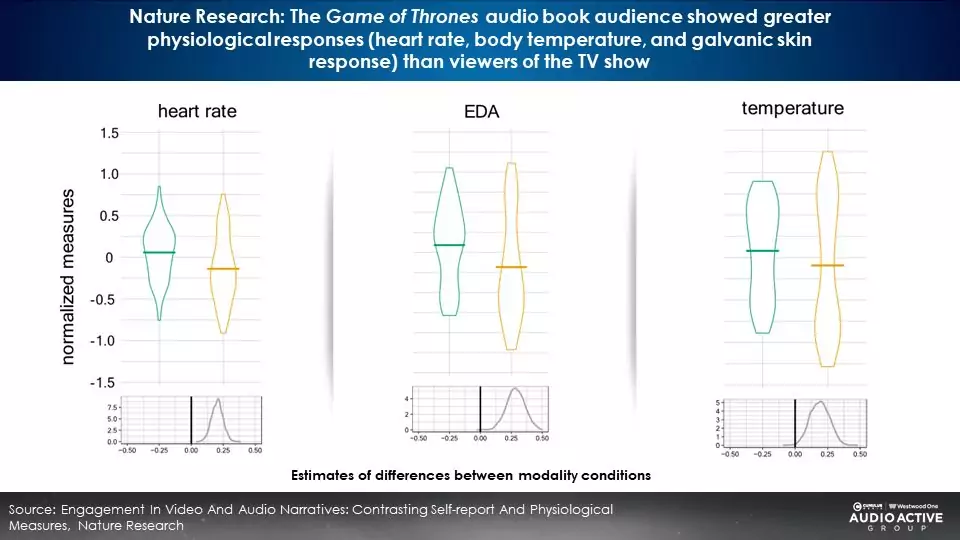
Audio narratives require active participation to imagine the story. Video narratives require less of the audience, resulting in passive engagement. Thus the “sight, sound, and motion” ideal that brands seek actually results in less engagement than the same ad on a podcast or AM/FM radio.
Adelaide AU scores: Despite the lack of “sight and motion,” audio platforms generate nearly the same attentiveness as TV
Adelaide, an attentiveness measurement firm, uses their “Attention Unit,” or AU score, to compare advertising attention by media.
Recent findings from Adelaide decisively smash the myth that ads with “sight, sound, and motion” are significantly more effective than audio ads. This is the latest in a series of studies that reveal audio attention is much closer to video and visual ad formats than previously suspected.
“The strong performance of audio formats challenges long-held assumptions and offers marketers a compelling opportunity to maximize effectiveness,” said Marc Guldimann, CEO and Co-Founder at Adelaide.
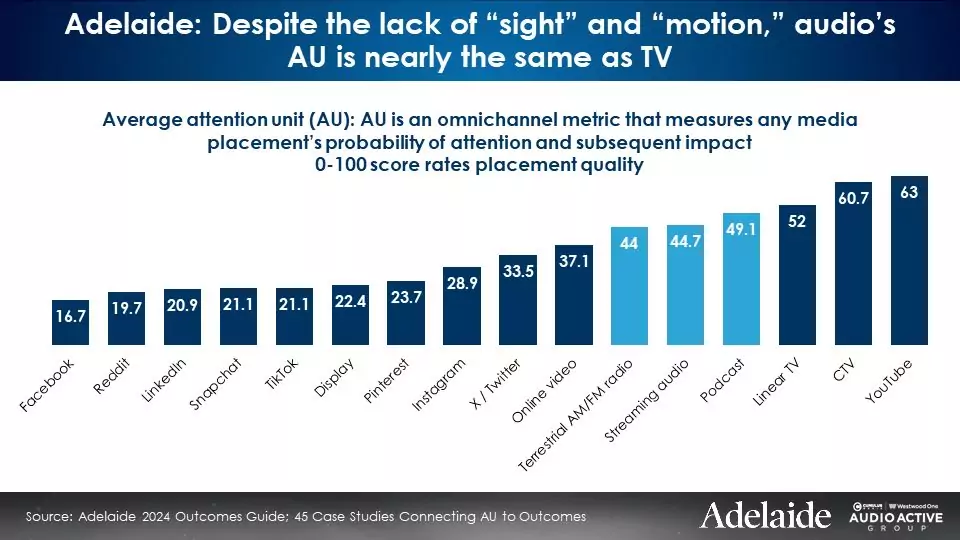
- AM/FM radio has 85% of the attentiveness of linear TV at one-fourth the CPM
- Streaming audio has 86% the attentiveness of linear TV
- Podcasts have 94% of the attentiveness of linear TV
Are 1,000 impressions on social media the same as 1,000 impressions on TV, online video, or AM/FM radio? Adelaide’s attentiveness measurement data says no. They conclude there is a significant difference in advertising attention across media platforms.
The Advertising Research Foundation defines advertising attention as “the degree to which those exposed to the advertising are focused on it.” Adelaide measures how ads on media platforms get noticed, hold attention, and impact memory.
An analysis of Adelaide’s AU scores reveals what would have to be spent on other media to achieve the same attentiveness of a $1,000 AM/FM radio advertising investment:
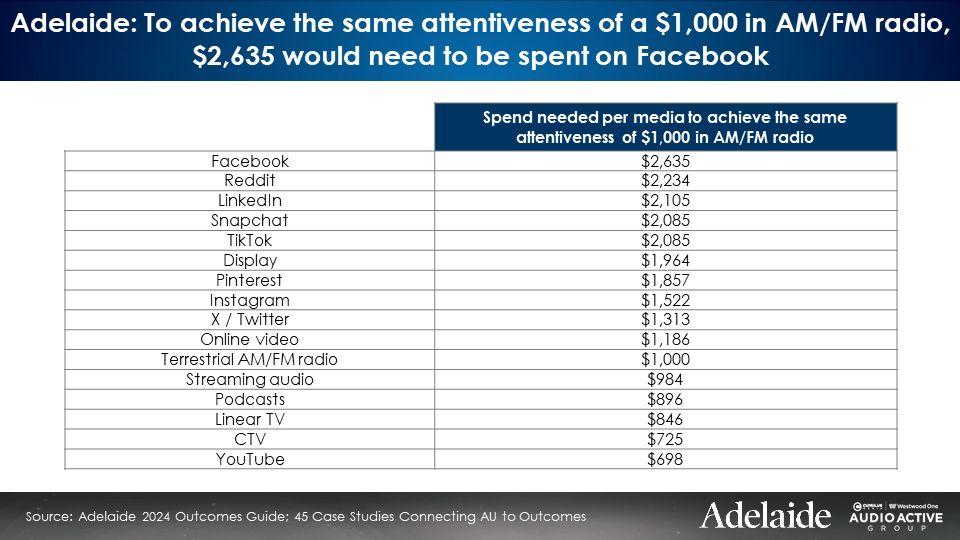
In order to achieve the same degree of AM/FM radio advertising attention, twice as much would have to be spent on display digital ads, TikTok, Snapchat, LinkedIn, and Reddit. Platforms such as YouTube and connected TV would require less than $1,000 to match the attentiveness of a $1,000 AM/FM radio ad investment.
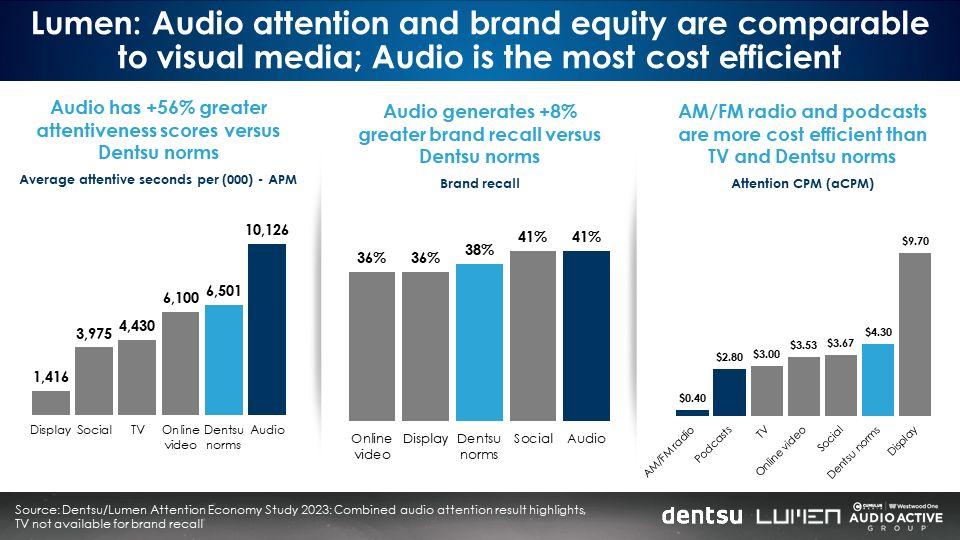
Lumen: Audio ads outperform video for attention and brand recall
A major study released by Lumen, an attentiveness measurement firm, was commissioned by Dentsu, one of the world’s largest media agencies. The Lumen study squashed the myth that video ads are exceptionally more effective than audio ads.
“Audio Ads Outperform Video for Attention and Brand Recall” was the head snapper of the headline in Ad Age. The Lumen study also revealed that audio ad formats were stunningly efficient on an attention CPM basis.
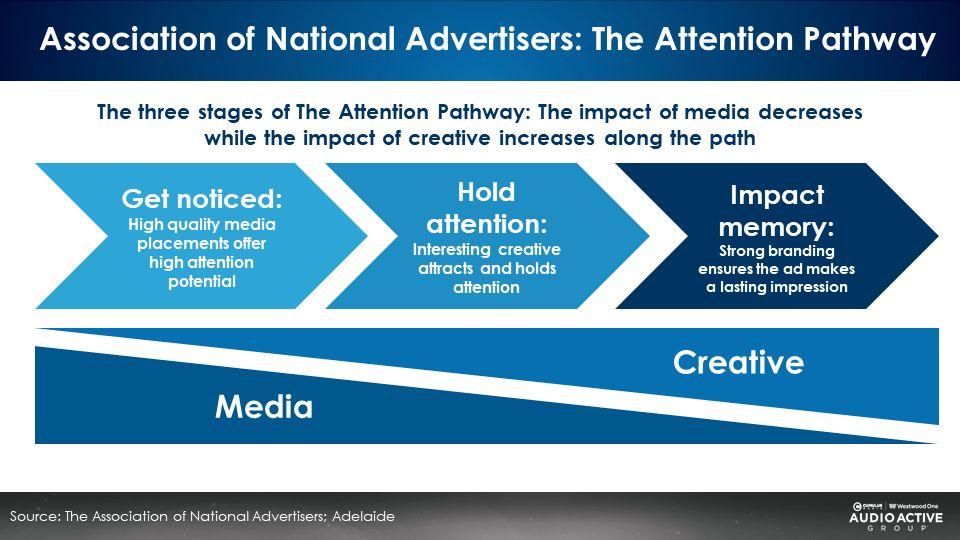
The Association of National Advertisers reveals there are three stages to what they define as the Attention Pathway
- “Get Noticed – advertising requires an environment that fosters attention. This is the job of a media placement. How well it gets that job done is a good indicator of its quality: the best quality placements create the greatest potential for attracting attention.
- Hold Attention – it’s vital to keep the viewer focused on the ad. In some circumstances, this can be measured using duration. This requires a stable media placement and interesting creative.
- Impact Memory – with attention now assured, the creative must deliver a brand message that affects the short- or long-term memory of the person paying attention to the ad.”
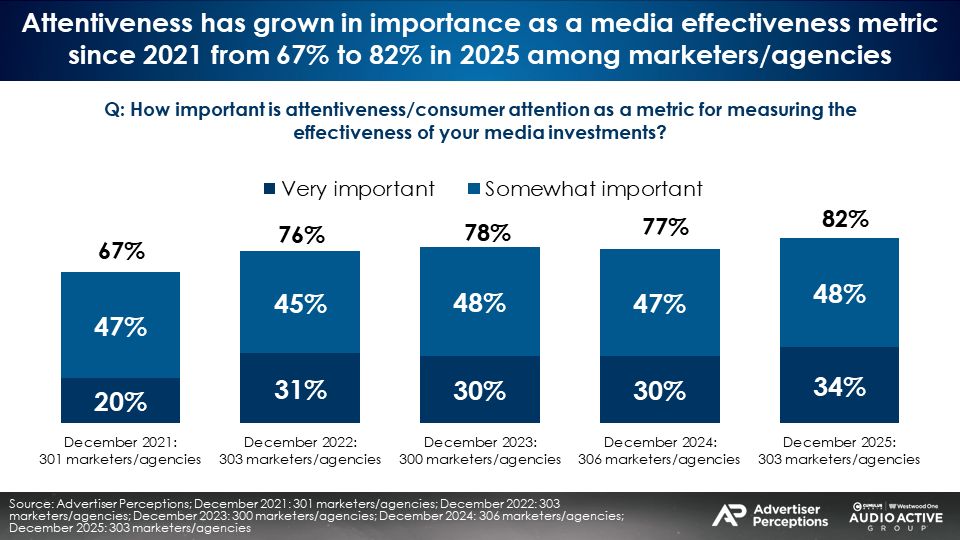
Advertiser Perceptions: 82% of marketers and media agencies say attentiveness is important as a metric for measuring the effectiveness of media investments
The Advertiser Perceptions annual study of attentiveness commissioned by the Cumulus Media | Westwood One Audio Active Group® reveals the importance of attention measurement has grown over the last five years.
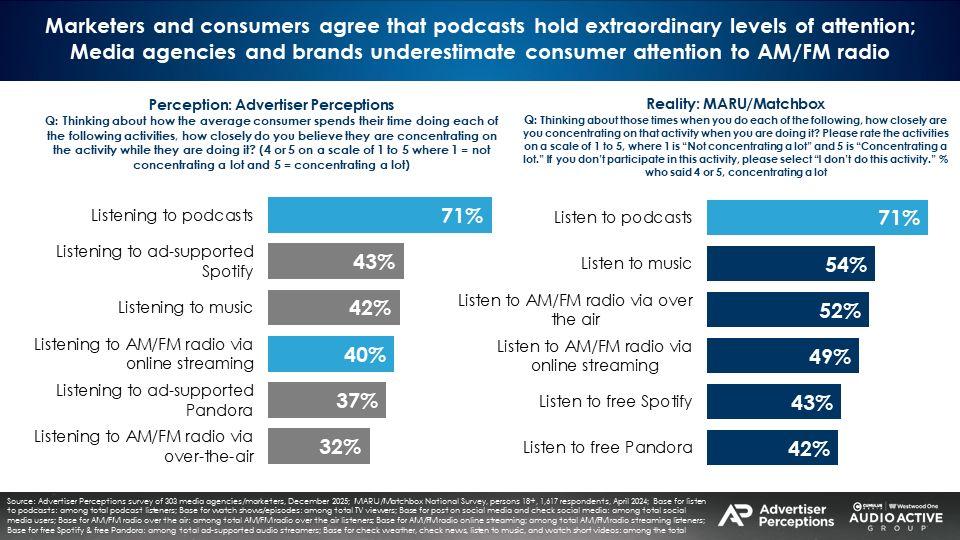
Marketers and consumers agree that podcasts hold extraordinary levels of attention; Media agencies and brands underestimate consumer attention to AM/FM radio
The Advertiser Perceptions study of media agencies and advertisers reveals similar levels of attention to AM/FM radio and music streaming services. Consumers feel otherwise. They indicate a greater degree of concentration to AM/FM radio versus music streaming brands.
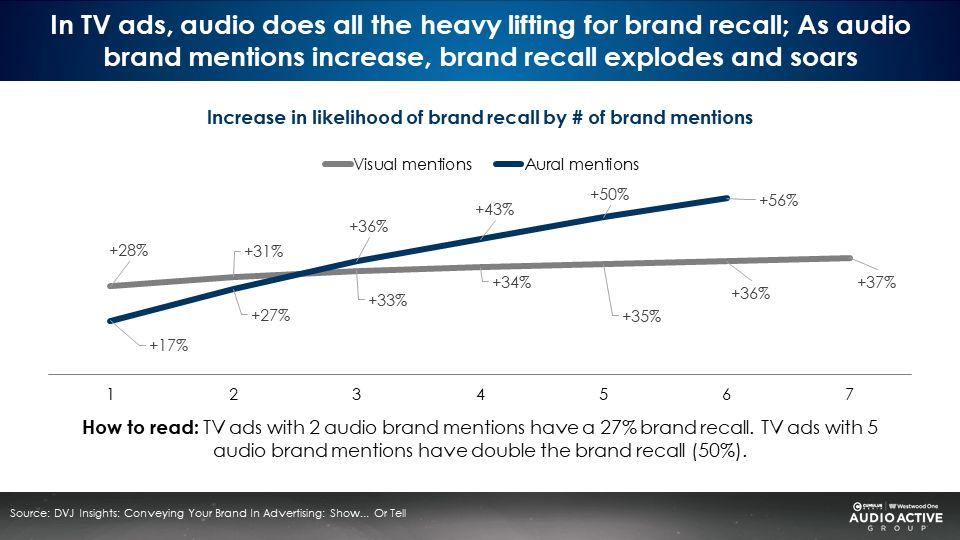
You can look away but you cannot shut your ears: Why audio branding does all the brand recall heavy lifting
A major TV study from DVJ Insights found that the more times the brand name was said in the audio track of the TV ad, the greater the brand was linked to the ad. One or two visual logo flashes in the ad have modest brand effect. Increasing visual logo flashes after the first instance shows weak improvement in brand recall.
Video ads with one visual logo appearance versus those with six visual logo appearances only add 9 points of brand recall. Video ads with one audio brand mention compared to those with six audio brand mentions add an astounding 39 points of brand recall!
Why does increased visual branding generate so little lifts in brand recall?
Attentiveness studies reveal that only 40% of TV ad occurrences are seen. Most of the time, TV ads are only heard or play to empty rooms. In video ads, audio branding does all the heavy lifting to drive brand recall.
The strong performance in audio attentiveness leads directly to sustained sales effect.
WPP Media and Radiocentre, the UK-based audio effectiveness think tank, have released a major new analysis of the sales effect of AM/FM radio and digital audio.
The study High Gain Audio: Using Multiplatform Audio To Amplify Overall Media Campaign ROI was conducted by Jane Christian, EVP Analytics for WWP Media and Mark Barber, Planning Director for Radiocentre. The report was sourced from the Profit Ability 2 project, one of the world’s largest advertising effectiveness studies every conducted.
Key findings:
- Oxford Road/Podscribe: YouTube podcast views are 18-25% less effective at driving purchases than audio podcast ads.
- Game of Thrones audio book beats the TV show in consumer engagement: Audio narratives require active participation to imagine the story. Video narratives require less of the audience, resulting in passive engagement.
- Adelaide attentiveness measurement: Despite the lack of “sight and motion,” audio platforms generate nearly the same attentiveness as TV.
- Lumen attentiveness measurement: Audio ads outperform video for attention and brand recall.
- DVJ Insights: You can look away but you cannot shut your ears. In TV ads, audio does all the heavy lifting for brand recall. As audio brand mentions increase, brand recall explodes and soars.
- WPP Media: Digital audio’s short-term ROI is tied for first, outperforming the all-media average by +44%. Broadcast radio is second in ROI, surpassing the all-media average ROI by +23%.
Click here to view a 17-minute video of the key findings.
Pierre Bouvard is Chief Insights Officer of the Cumulus Media | Westwood One Audio Active Group®.
Contact the Insights team at CorpMarketing@westwoodone.com.