
Masterclass Part One: How Advertising Works
Click here to view a 30-minute video of the key findings.
Click here to download a PDF of the full deck.
In recent years, a treasure trove of new advertising effectiveness studies has revealed how advertising works. These lessons and best practices can benefit brands of any size. These studies have been published by global leaders in marketing effectiveness:
- Les Binet, Peter Field, Sarah Carter, Andrew Tindall, Mark Ritson, Jon Evans, and Will Davis
- The Institute for the Practitioners of Advertising (IPA)
- The Ehrenberg-Bass Institute of Marketing Science
- System1 creative effectiveness measurement
- Effie, the global effectiveness competition
- The World Advertising Research Center (WARC)
- Tracksuit brand tracking measurement
- WPP Media, eatbigfish, Ebiquity, and Thinkbox
Part one of the masterclass focuses on how advertising works. Next week’s part two will highlight creative effectiveness.
Key findings:
- The key to advertiser revenue and profit growth: “Be known before you’re needed”
- Balance brand building to create future demand with performance marketing to convert existing demand
- Excessive use of sales events and lower funnel tactics leads to performance marketing “valley of death”
- Creating future demand via brand building improves conversion rates, lifts share of search, and is responsible for most revenue and profit growth
- Avoid a dangerous obsession with ROI; Focus on growth in customers, revenue, and profit
- Small brands: Beware the sales cliff drop of “going dark”
Les Binet: How advertising works
Les Binet is known as one of the “godfathers of marketing effectiveness.” Along with many collaborators, Binet has written some of the most famous studies and books on how advertising works. Here is his famous one-pager:
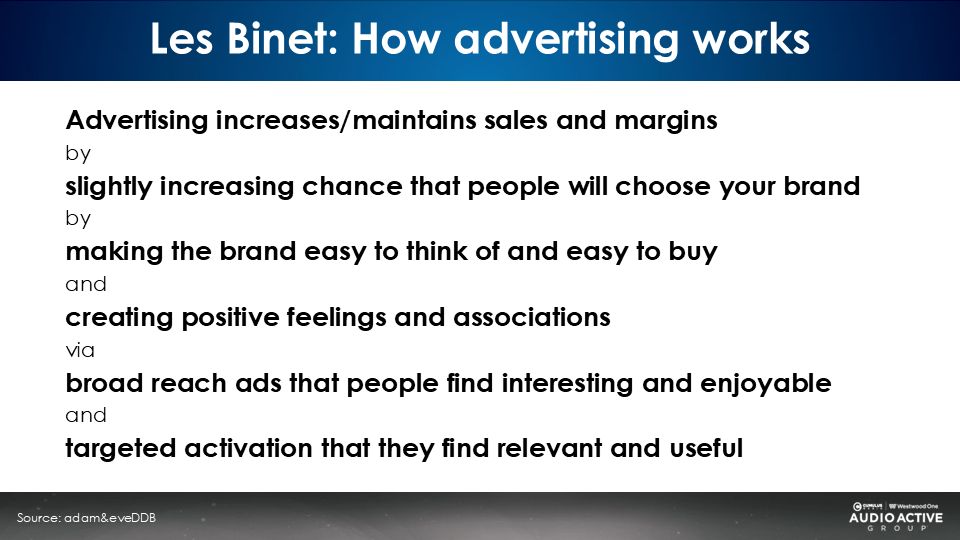
Advertising is a nudge, not a shove
Binet says advertising “slightly increases the chance that people will choose your brand.” Adverting does not magically convert all those exposed. Andrew Ehernberg, the founder of the Ehrenberg-Bass Institute of Marketing Science, famously said, “Advertising is in an odd position. Its extreme protagonists claim it has extraordinary powers and its severest critics believe them. But both are wrong.”
Advertising rarely works through heavy persuasion or manipulation. Decades of consumer data show it works as a “weak force.” Advertising is a gentle nudge that builds brand awareness and reinforces existing habits rather than a brute force conversion of non-believers.
WPP Media: Win the mind to win the market
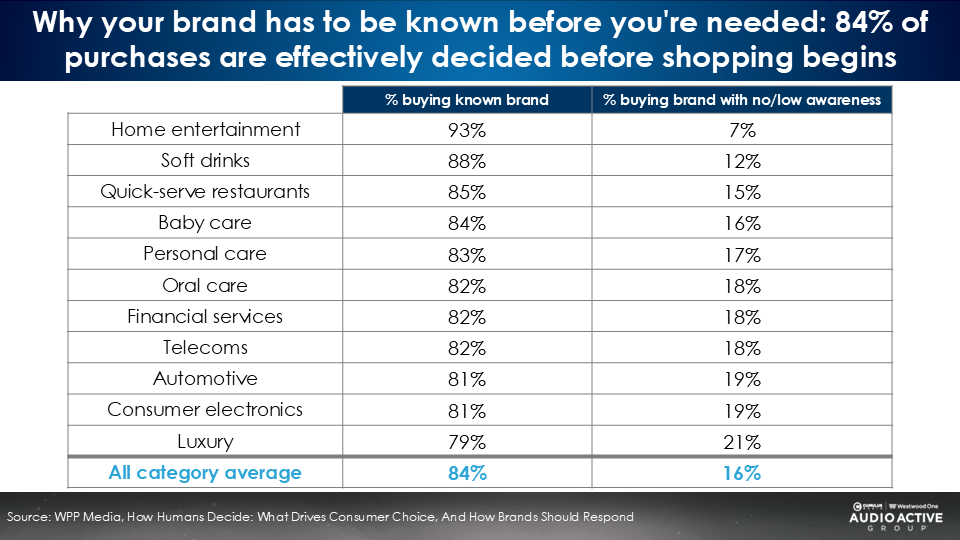
WPP Media, the global advertising agency, recently released a massive shopper decision study. Conducted over a decade in 47 countries, it studied 1.2 million consumer purchase journeys covering 200 categories.
WPP Media found 84% of purchases are effectively decided before shopping begins. Brands must be known long before they’re needed.
Across a wide array of categories, the vast majority of purchases are made with brands and services that are already known. If your brand is not known before people come into the market, you have little chance of being purchased.
Ty Heath from the Business-to-Business Marketing Institute says, “The brand that’s remembered is the brand that is bought. Win the mind to win the market.”
Erwin Ephron, the father of modern planning, explains, “Most advertising usually works by reminding people about brands they know, when they happen to need that product. Ads work best when the consumer is ready to buy. Reminding a lot of consumers is better than lecturing a few.”
The 95/5 rule: Only 5% of consumers are in the market at any time
The prestigious Ehrenberg-Bass Institute of Marketing Science reports a very small amount of people are in the market for a product or service at any time. Whether it’s a home repair, an automotive purchase, healthcare need, or furniture, most people are not in the market.
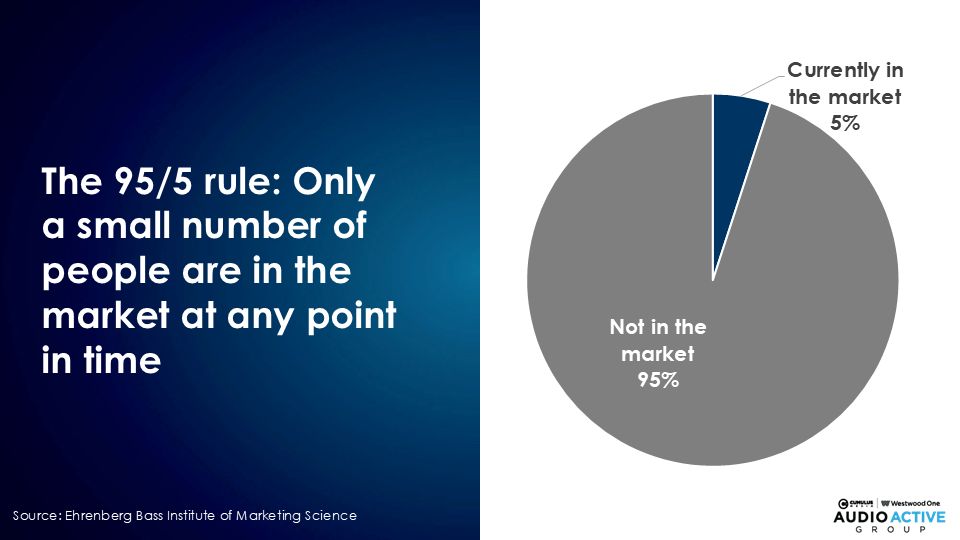
Advertisers need to formulate two distinct marketing strategies: one to target the tiny 5% that are in the market. The second is to target the massive 95% who are not in market now but will eventually enter the category.
Marketing has two equally important jobs: Converting existing demand (lower funnel sales activation) and creating future demand (brand building)
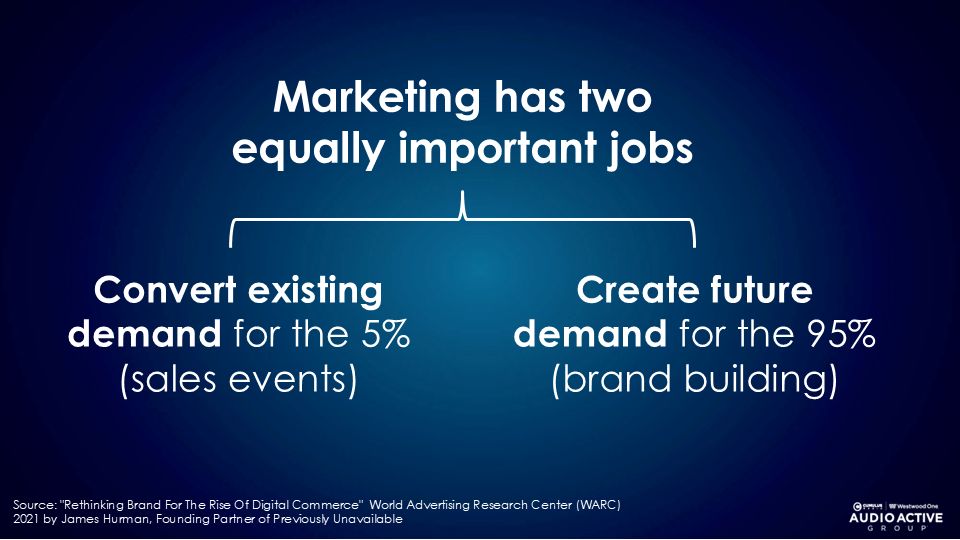
Advertising needs to form around these two key strategies. First, convert existing demand by reaching the five percent who are in the market. Usually that takes the form of a sales event, or lower funnel sales activation.
Second, create future demand. Brand building focuses on the 95% of consumers who are not in the market, not thinking about the category, and not interested in a sales event.
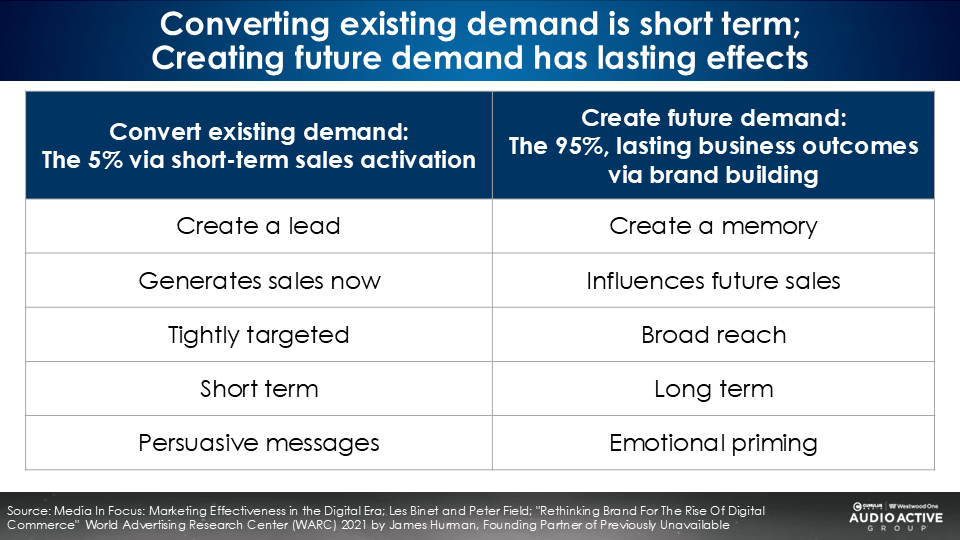
John Dawes from the Ehrenberg-Bass Institute recommends:
- Expect sales results mostly in the long term, not in the short term.
- Develop creative that will be remembered mostly by future buyers, not current buyers.
- Maximize reach mostly against out-of-market buyers, not in-market buyers.
Binet and Field: Performance marketing’s sugar high, fast crash, and no long-term sales growth
Les Binet and Peter Field created the visual seen by millions of marketers around the world. It shows the sales uplift over base sales generated by short-term performance campaigns that convert existing demand.
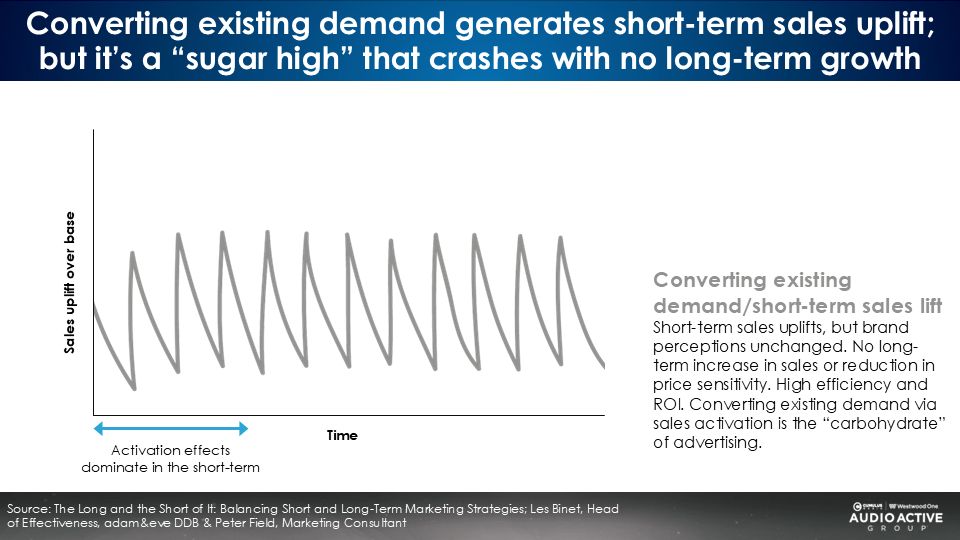
Performance marketing generates short-term sales uplift but brand perceptions are unchanged. There is no long-term increase in sales or reduction in price sensitivity. These are high efficiency and ROI campaigns.
Converting existing demand via sales activation and lower funnel tactics is the “carbohydrates” of advertising. It’s the sugar rush of short-term sales uplift with a fast crash.
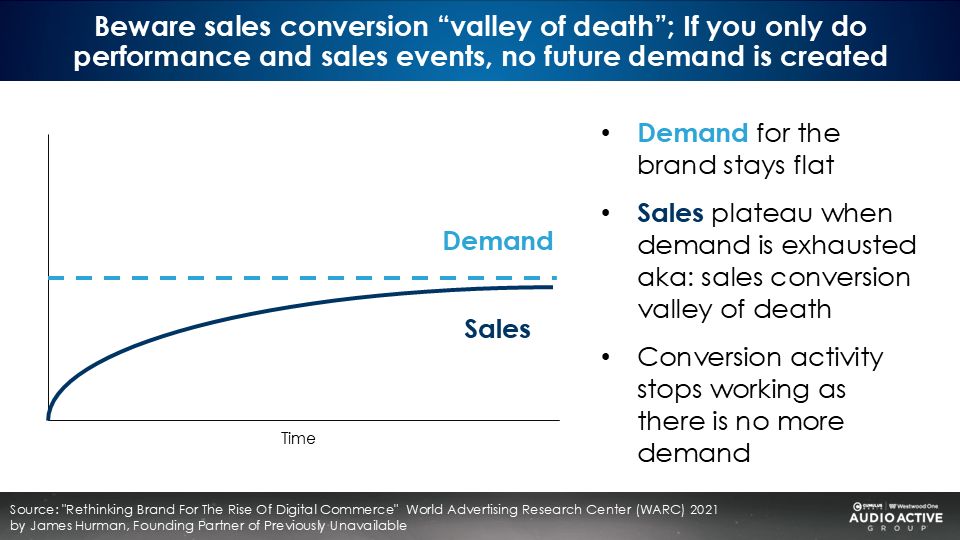
Brands that overspend on lower funnel enter the “sales conversion valley of death.” Sales plateau and cost per action soars as demand evaporates. Demand is exhausted since there has been no future demand creation.
Binet and Field: Creating future demand via brand building is the protein of advertising that builds long term growth
The full Binet and Field visual depicts a grey line that represents performance marketing sugar highs and fast crashes. The blue line represents the sales effect of creating future demand via brand building.
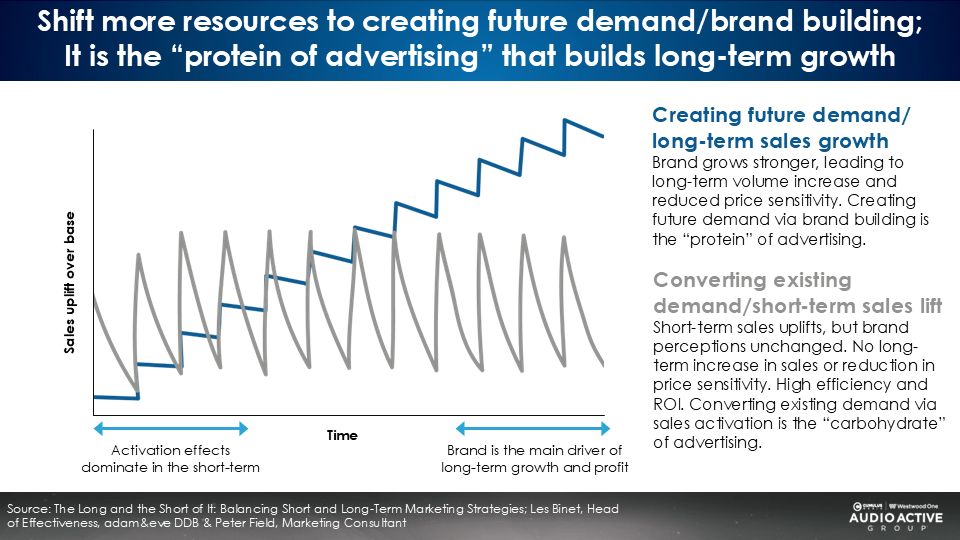
By creating future demand, the brand grows stronger, leading to long-term volume increase and reduced-price sensitivity. Creating future demand via brand building is the “protein” of advertising.
The key is to balance investments to convert existing demand and create future demand. Smart brands believe in “bothism,” as legendary marketing professor Mark Ritson endorses. Converting existing demand AND creative future demand. The ideal mix is 60% brand building and 40% sales activation.
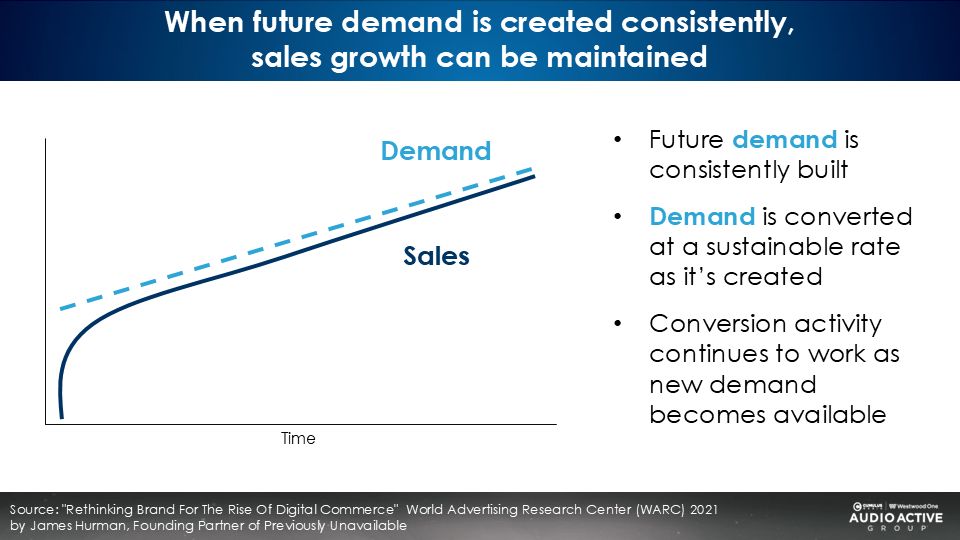
This constant future demand creation allows for the conversion of existing demand. Sales grow as demand increases.
Binet and Field explain, “a succession of short-term response-focused (offer) campaigns will not succeed as strongly over the longer term as a single brand-building campaign designed to achieve year-on-year improvement to business success.”
WARC: Underspending on creating future demand (brand building) reduces sales growth
WARC’s major study, The Multiplier Effect: A CMO’s Guide to Brand Building in the Performance Era, reveals the short-term and long-term sales effect of the three marketing strategies.
The WARC study examines the incremental revenue generated by:
- 100% performance tactics (grey bars)
- A mix of 30% brand building /70% performance (bright blue bars)
- A 50/50 mix of brand building and performance (dark blue bars)
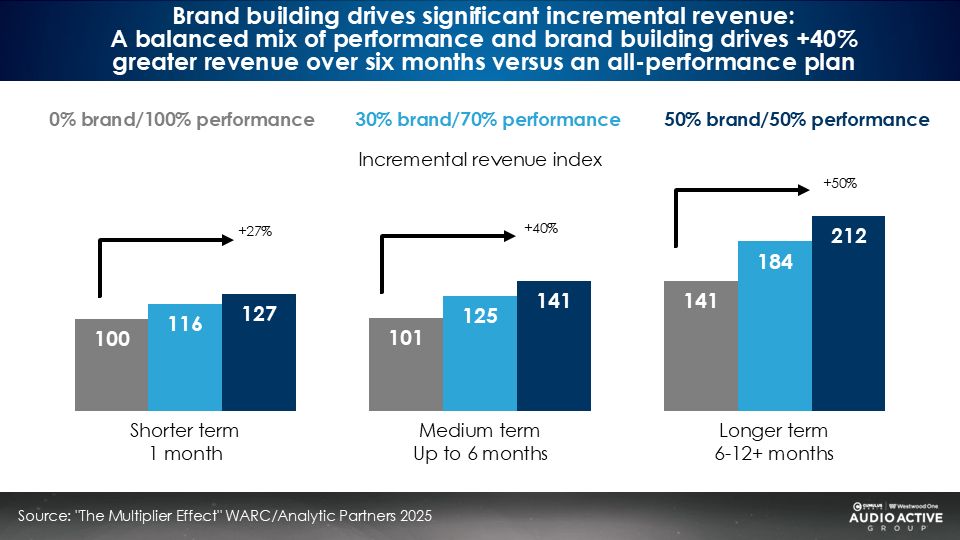
- Over a one-month period, the 50/50 mix of brand building and performance marketing generates 27% more revenue growth than the all-performance strategy.
- Up to six months, the 50/50 brand/performance mix outperforms the all-performance strategy by 40%.
- Beyond six months, the 50/50 brand/performance mix yields 50% greater sales growth than an all-performance strategy.
Google and Tracksuit: How brand awareness drives share of search
The WARC study clearly demonstrates marketers devoting at least 50% of marketing spend to creating future demand (brand building) generate 25% to 50% more revenue than brands who only focus on converting existing demand with lower funnel tactics with 100% performance spend.
Why does creating future demand via brand building generate more revenue? It’s because brand building generates greater share of search, according to a study from Google and Tracksuit, the brand tracking firm.
The study examined 31 brands across 15 categories. Google determined “share of search” for each brand. Search volumes for each brand were divided over all search activity for the respective category. Tracksuit conducted always on tracking of awareness, consideration, and preference.
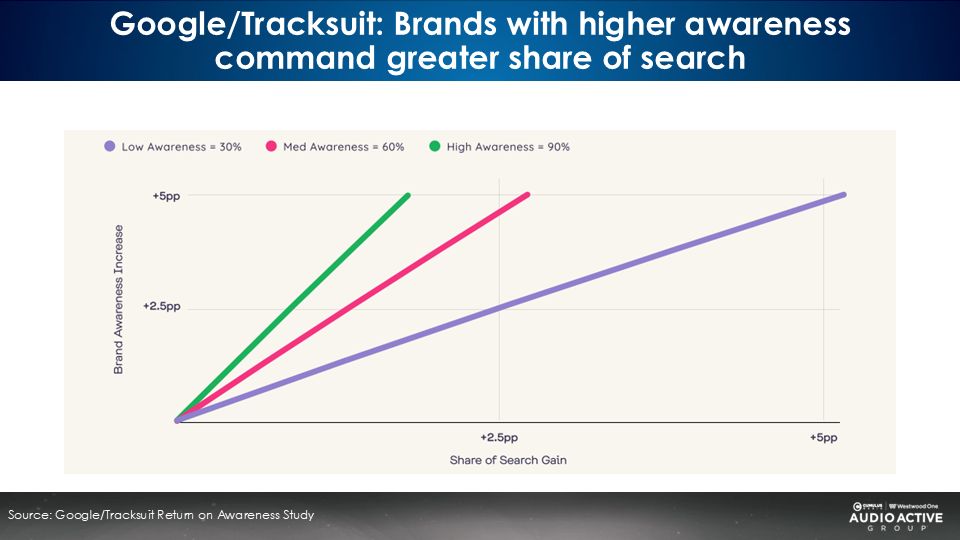
Brands were segmented in three groupings based on awareness: high, medium, and low. The green line above represents large brands with 90%+ awareness, the red line is medium awareness brands (60%), and the blue line denotes low awareness brands (30%).
Google and Tracksuit found investing in brand awareness generates quantifiable business outcomes. Increasing brand awareness drives up share of search, which in turn expands market share.
For small brands, awareness growth generates significant share of search increases. Five gets you five. Every five points of brand awareness growth translates directly into a five-point share of search increase.
Small brands incorrectly dismiss brand marketing as a “nice to have luxury”; The Google/Tracksuit study makes the hard business case that small brands should invest in brand marketing
The Google/Tracksuit report concludes for small and mid-sized brands, “Every point of awareness growth translates into meaningful, measurable behavioral change in search, and ultimately in market share. Growth stage and disrupter brands have the most to gain. Brand investment at this stage isn’t a soft spend, it’s one of the most commercially efficient things a marketer can do.”
TikTok and Tracksuit: Brand building campaigns drive better sales conversions
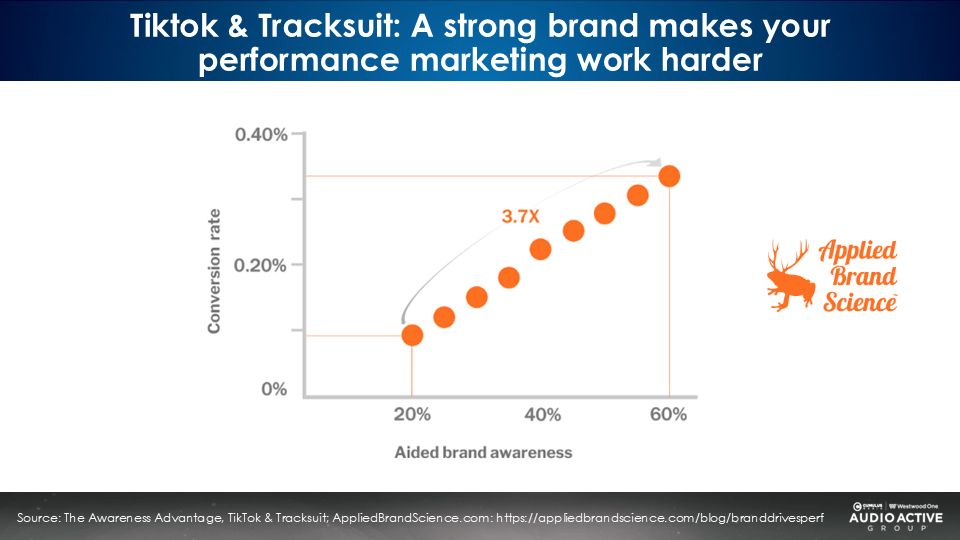
A recent study from TikTok and Tracksuit emphasized how awareness drives sales conversions. People buy more from companies they know.
The more famous your brand, the greater your sales conversions. Brands with 60% awareness drove nearly 4 times the sales conversions of lesser-known firms.
Jeremy Bullmore, former Chairman of J. Walter Thompson London explains, “It should never be forgotten that (performance marketing) works most efficiently when the brands that they feature are already well-known and are already thought to be desirable. Of all the properties that a strong brand needs, simple familiarity must top the list. Familiarity implies trust, reassurance – even affection. Familiarity is acquired and maintained directly through experience and remotely through communications.”
Most advertising effects take place over an extended period of time
A massive global study called Profit Ability 2: The New Business Case for Advertising from five major agencies examined 141 brands across 14 sectors spending $1.8 billion over 10 media channels.
Given that only 5% of consumers are in the market for a product or service at any point in time, it’s no surprise that nearly 60% of the profit generated by advertising occurs between week 14 and two years.
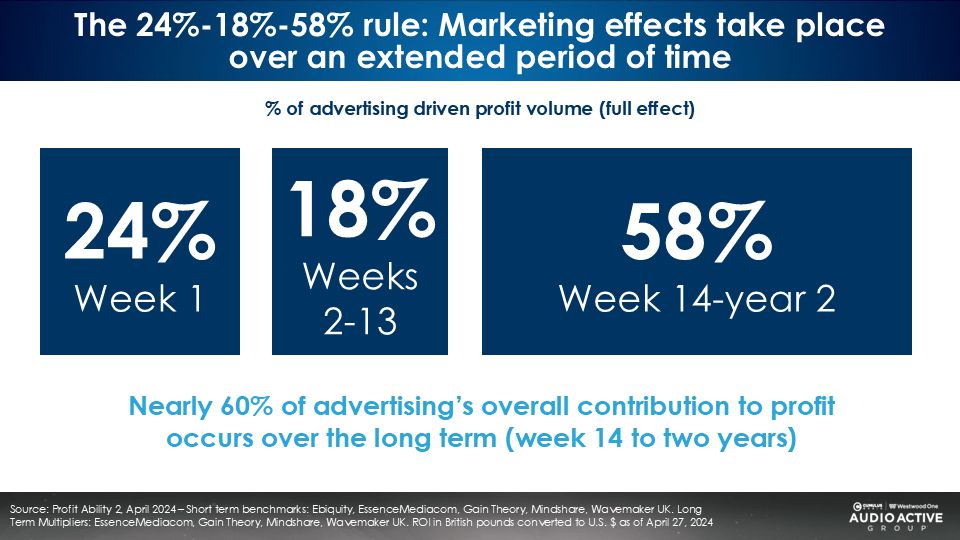
Advertising is a long-term business but we foolishly attempt to judge impact over the short term. Bill Harvey, one of the giants of advertising research, posed the following analogy:
“Suppose you planted a tomato on Monday and pulled it out of the ground on Friday to see how it was doing. Finding no tomatoes, you might conclude that gardening offers a disappointing return on investment. Most media buyers would recognize the absurdity of such short-term thinking. However, they might nevertheless spend Friday afternoon preparing a budget recommendation which does something remarkably similar.”
Your ROI obsession is killing sales and profit growth and could destroy your brand
Since COVID, advertising ROI has grown 4% but the profit driven by advertising has dropped by 11%, reports Les Binet, one of the world’s foremost authority on marketing effectiveness. These findings come from a brand-new study published by Les Binet and Will Davis called, Go Big Or Go Home: How Small Thinking is Killing Advertising and What To Do About It.
Davis is the founder of Medialab, an advertising agency with a data-driven approach to media planning and buying. Davis brings forensic, results-focused discipline to brand building.
ROI is mistaken for business outcomes such as sales growth, profit growth, and customer growth. ROI is none of those things. It is simply a ratio of revenue/profit generated by ad spend.
ROI is a ratio of spend and profit/revenue generated
- ROI formula = profit/revenue generated ÷ ad spend
- Example: $20,000 of sales were generated by a $10,000 advertising campaign
- $20,000 sales revenue ÷ $10,000 ad campaign = $2.00 ROI
- How to read: For every dollar of advertising, $2 of sales were generated
Which ROI would you desire?
Would you rather an ROI of $4, $3, $2, or $1.50? The biggest ROI would seem the most desirable. However, ROI does not reveal anything about actual revenue growth, profit growth, or customer growth. It is simply a ratio.
Now, which ROI would you select?
Here is the revenue generated by each campaign:
- $4 ROI generates $120,000 in sales
- $3 ROI generates $165,000 in sales
- $2 ROI generates $260,000 in sales
- $1.50 ROI generates $345,000 in sales
Now which campaign is more desirable? The smaller the ROI, the greater the sales!
The most important number that really determines sales and profits is not ROI. It’s the budget! Advertising profit is the result of budget and ROI, however ROI is 9 times more of a profit driver than ROI.
ROI and sales move in the opposite directions, explain Les Binet and Sarah Carter in their spectacular book, How NOT to Plan: 66 Ways To Screw It Up
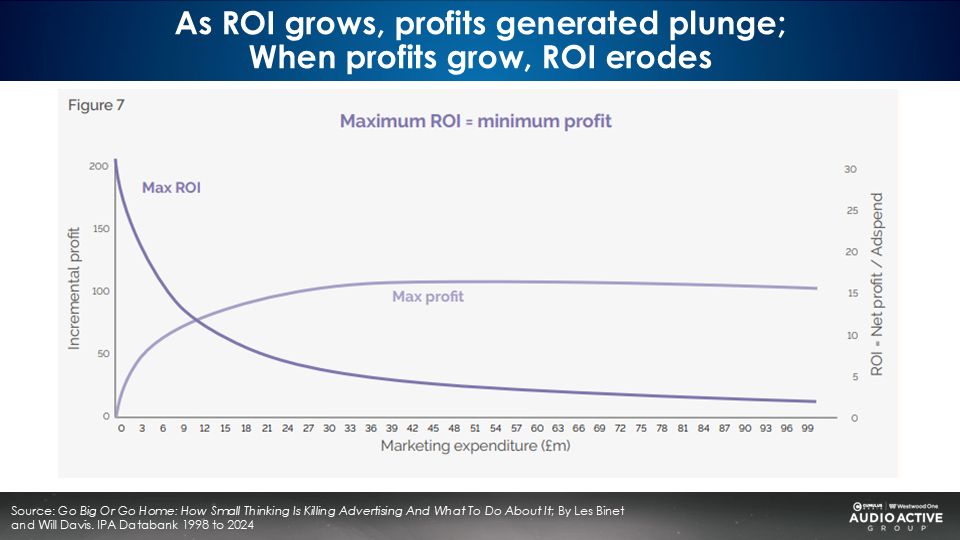
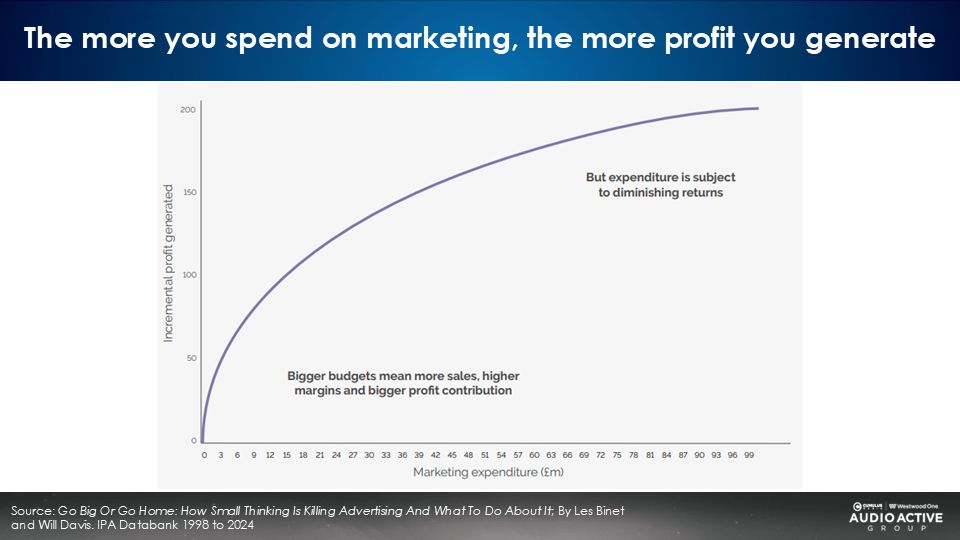
“As you spend more on advertising, it often gets more effective (sales and profits generated go up), but less efficient (ROI goes down). That’s the nature of diminishing returns.
It means that in practice, the highest ROIs tend to come from small budgets. If your aim was to maximize ROI, you’d go for the small-budget campaign. But that would mean smaller profit. Going for the big-budget campaign would mean lower ROI, but bigger profit. And that’s the nub of it.”
“ROI is usually highest when sales and budget are close to zero. So trying to maximize ROI is a good way to destroy your brand.
This confusion is one example of a general confusion between effectiveness and efficiency. Effectiveness is about reaching targets. Sales and profit are effectiveness measures. Efficiency is about how much effort you expend to achieve a given effect. ROI is an efficiency measure.”
What matters most for driving profit? Budget or ROI? 500 Chief Marketing Officers got it wrong
Researchers asked a panel of 500 Chief Marketing Officers which mattered more for driving profit: budget or ROI. Marketers overwhelmingly picked ROI.
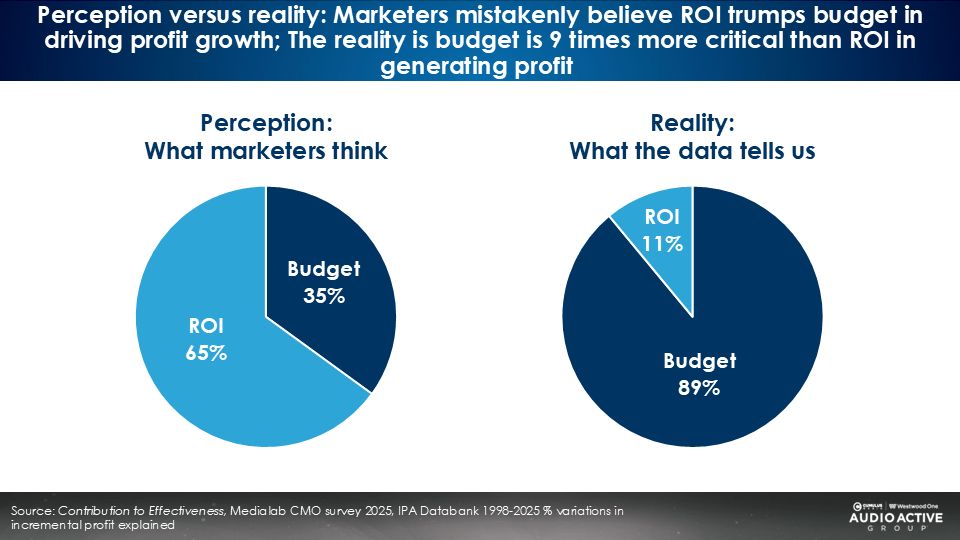
However, analysis of actual business outcomes from the Institute for the Practitioners of Advertising Effectiveness Databank told a different story. Les Binet explains, “The main driver of profit is not ROI, it’s the budget by a factor of eight or nine to one. ROI is not the main driver … Budget is nine times more important than ROI, and that suggests that the most important decision in marketing is actually how much to spend.”
IPA data reveals that 89% of profit variation is due to advertising budget. Only 11% is due to ROI. The pattern is consistent across consumer-packaged goods, retail, services, and durables. Your ad budget is nine times more important to your company profits than your ROI.
ROI and profit move in the opposite direction
Below, the left to right axis depicts ad spend. The vertical axis represents incremental profit from the campaign. As you move to the right, spend grows, profit increases, and ROI drops.
As you move to the left, spend drops, profit drops, and ROI increases. You can get a super high ROI with tiny spend and zero profit growth.
The bigger the ROI, the smaller the profit. The greater the profit, the smaller the ROI.
To grow profit, increase your advertising budget
When you unshackle yourself from your ROI obsession and focus instead on profit growth, a simple but powerful relationship appears. As ad budget grows, so does your profit.
ROI has nothing to do with growing sales; What matters is share of voice, or how much you spend relative to your competitors
According to Les Binet, “What matters is not simply how much a brand spends, but how much it spends relative to competitors. Brands that maintain stronger visibility than their market position would suggest often create conditions for future growth.”
To understand brand or business growth trajectory, first determine “share of voice.”
Share of voice is your ad spend divided by category ad spend. Imagine a furniture store spends $500,000 dollars a year on advertising in a town where there is $5 million dollars of total furniture advertising.
Divide the store ad spend over category spend to determine share of voice. $500,000 divided by $5,000,000 equals a 10% share of voice.
The furniture store represents 10% of furniture store advertising impressions in the market.
You can also determine share of voice using gross rating points or gross impressions.
Firms like Borrell and Associates have detailed estimates on local ad spending. On a national level, MediaRadar reports ad spend of national brands.
Share of market: Revenues as a percentage of category revenues
Market share is a business’ revenue divided by category sales.
Let’s say the furniture store generates $10 million dollars in sales in a town with $100 million dollars of total furniture sales. Divide the store sales over total category sales to determine the market share.
$10 million divided by $100 million equals a 10% share of category spend. The store gets a ten share of furniture sales in the market.
Compare share of voice to share of sales
This simple chart from Les Binet and Peter Field, the “godfathers of marketing effectiveness,” depicts future growth trends of a business or brand.
Market share is shown from left to right. Share of voice is depicted on the vertical axis.
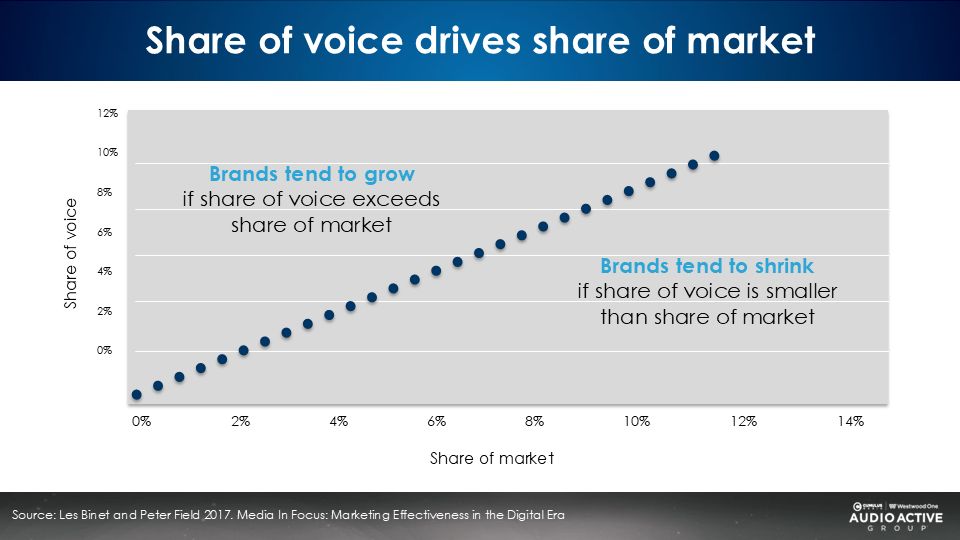
- If share of voice exceeds share of market, sales tend to grow.
- If share of voice is similar to share of market, sales tend to be stable.
- If share of voice is smaller than share of market, sales tend to shrink.
Sales are flat because share of voice matches market share
It’s frustrating when sales are flat despite advertising. But growth depends on the relationship of an ad budget to what’s happening with ad spending in the category.
To grow, budget for “Extra Share of Voice” – implement a larger share of voice than your market share
If share of spending equals market share, business will generally be stable but not achieve the growth. Businesses that grow have an advertising share of voice that’s bigger than their market share.
If the furniture store with a 10% revenue share increased their ad budget to a 15% share of voice, the likelihood of increased sales increases.
Three ways to set your advertising budget
In their report, Les Binet and Will Davis offer three approaches to set an optimal advertising budget. They indicate these concepts could be used together for a well-reasoned process for developing advertising budgets. Given that budget size is nine times more impactful on your company’s profit, it is worthwhile to devote considered care and thought to creating your ad budgets.
- “Advertising spend ratio: A popular approach uses the advertising spend ratio. This metric tends to vary from one category to another. (A general rule of thumb is to devote 8% to 10% of revenues to advertising.) Ad spend ratios tend to be low for commodities and high for luxury goods. Find out what the average ratio looks like in your category. The more you aim above that benchmark, the faster you’re likely to grow.
- Task-based budgeting is also common. Start by setting targets for customer acquisition and churn, then use conversion benchmarks to estimate how many exposures you need. Finally, use Cost per Thousand (CPM) to calculate budget requirements.
- The third approach is Share of Voice analysis. This involves comparing a brand’s share of advertising expenditure (SOV) against its market share. Brands that set their Share of Voice above their market share tend to grow at a rate proportional to ‘extra’ share of voice (ESOV), the gap between share of voice and market share.”
Measure what matters: P&G’s “five-fecta”
Procter & Gamble’s Chief Brand Officer Marc Pritchard defines the “five-fecta” as a commercial growth framework of five key metrics used to measure marketing effectiveness and business impact. The five commercial metrics that make up P&G’s “five-fecta” are:
- Market growth: Expanding the overall category or market.
- Market share: Winning a larger portion of that total market.
- Number of users: Growing the total consumer base.
- Sales: Increasing total revenue and volume.
- Profit: Delivering bottom-line financial return.
P&G uses this framework to tie marketing directly to real commercial performance, ensuring that brand-building efforts matter to CEOs, CFOs, and investors by focusing on concrete business results rather than just surface-level media metrics.
Why it’s important to always advertise; Beware “going dark”
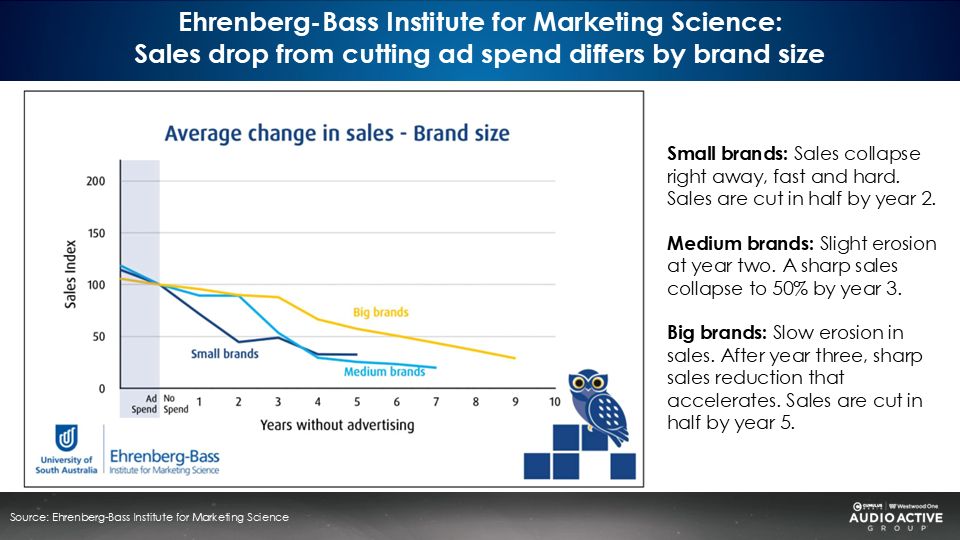
According to the World Advertising Research Center (WARC)/Millward Brown, it can take up to 5 years for brands to recover from “going dark.” Just like a plane can keep flying after the engines are turned off, eventually, the altitude begins to drop. The esteemed Ehrenberg-Bass Institute of Marketing Science reveals the plummeting sales trajectory of going dark.
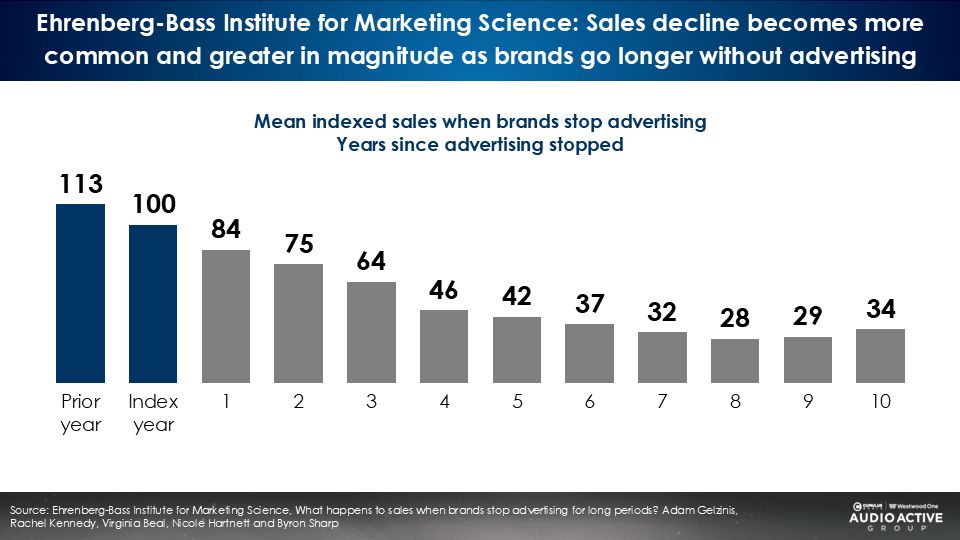
Small brands: beware the sharp sales cliff drop of “going dark”
Larger brands can coast longer on their accumulated awareness and brand images. When small brands represented by the dark line below cut advertising spend, sale collapse right away, fast and hard. Ehrenberg-Bass reports by year two after going dark, small brand sales are cut in half.
Key findings:
- The key to advertiser revenue and profit growth: “Be known before you’re needed”
- Balance brand building to create future demand with performance marketing to convert existing demand
- Excessive use of sales events and lower funnel tactics leads to performance marketing “valley of death”
- Creating future demand via brand building improves conversion rates, lifts share of search, and is responsible for most revenue and profit growth
- Avoid a dangerous obsession with ROI; Focus on growth in customers, revenue, and profit
- Small brands: Beware the sales cliff drop of “going dark”
Click here to view a 30-minute video of the key findings.
Pierre Bouvard is Chief Insights Officer of the Cumulus Media | Westwood One Audio Active Group®.
Contact the Insights team at CorpMarketing@westwoodone.com.