
To Create Future Demand You Need Reach And Media Waste; “Big Media” (AM/FM Radio, TV, And Out Of Home) Can Grow Your Business
Click here to view a 15-minute video of the key findings.
Click here to download a PDF of the slides.
A new book and a brand-new study from two global experts in marketing effectiveness reveal that reaching a lot of people with advertising is crucial to growing your business. Their findings also crush a major advertising myth about waste that prevents revenue and profit growth.
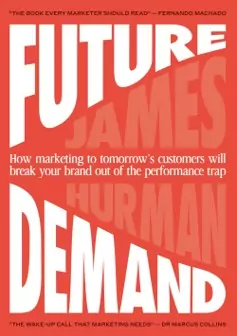
James Hurman, a leading authority of marketing effectiveness, has just published a new book, Future Demand: How Marketing to Tomorrow’s Customers Will Break Your Brand Out of the Performance Trap.
Les Binet, the “godfather of marketing effectiveness,” and Will Davis, the co-owner of the Medialab ad agency, have just released a new study, Go Big or Go Home: How Small Thinking is Killing Advertising and What to Do About It.
Key findings:
- James Hurman’s new book and Les Binet and Will Davis’ new study reveal reaching a lot of people with your advertising is crucial to growing your business.
- Advertisers have two jobs: Convert existing demand by reaching the five percent who are in the market and create future demand via brand building focused on the 95% of consumers who are not in the market.
- The greater the reach, the larger the sales lift, the bigger the brand effect, and profit growth.
- “Big media ads” (AM/FM radio, TV, and outdoor), are more effective at creating future demand because they create a greater sense of quality, popularity, and trust for brands.
- Ads from “big media” (AM/FM radio, TV, and outdoor) stick in minds more than digital or social media ads. Over 85% of online ads don’t reach the 2.5 second Attention-Memory Threshold, according to Amplified Intelligence’s Karen Nelson-Field.
- Don’t be afraid of “waste.” It’s the part of advertising that works.
Because of the 95/5 rule, every advertiser has two jobs: Converting existing demand and creating future demand
The prestigious Ehrenberg Bass Institute of Marketing Science reports a very small amount of people are in the market for a product or service at any time. Whether it’s home repair, an automotive purchase, health care need, or furniture, most people are not in the market.
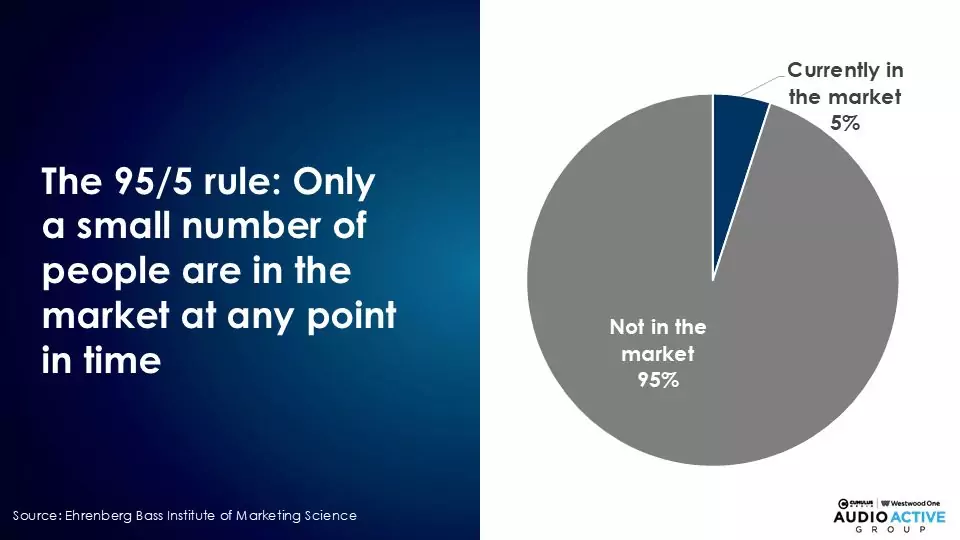
On average 5% are in-market for a product or service at any point in time. 95% are not. The key to growing your business is devote about 40% of your marketing against the 5% in-market consumers and 60% of your budget towards creating future demand with the 95% that are not in the market.
Advertising needs to form around these two key strategies. First, convert existing demand by reaching the five percent who are in the market. Usually that takes the form of a sales event or short-term promotion.
Second, create future demand via brand building. This focuses on the 95% of consumers who are not in the market, not thinking about the category, and not interested in a sales event.
There are very different media and creative strategies needed to convert existing demand and create future demand.
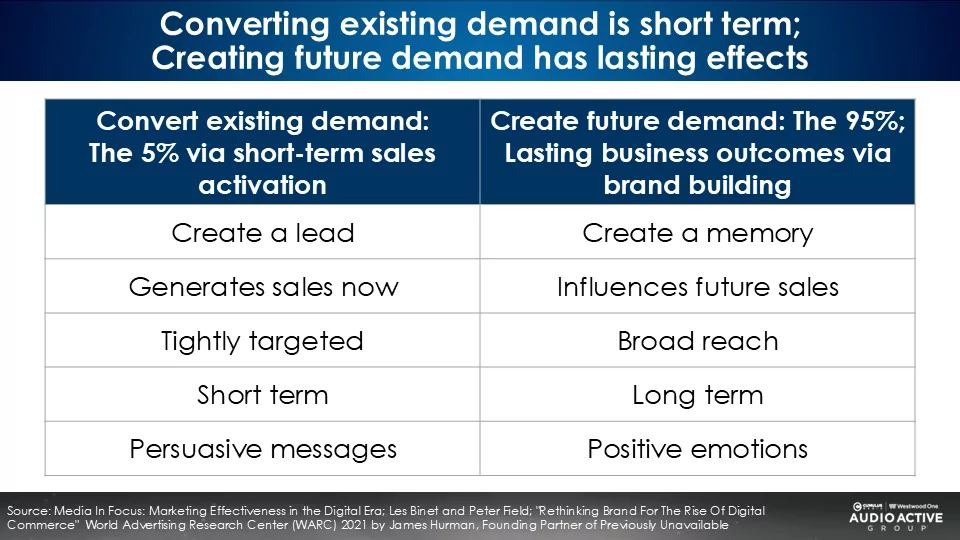
To convert existing demand, you can be tightly targeted. To create future demand, you need broad reach.
John Dawes from the Ehrenberg Bass Institute recommends:
- Expect sales results mostly in the long term, not in the short term.
- Develop creative that will be remembered mostly by future buyers, not current buyers.
- Maximize reach mostly against out-of-market buyers, not in-market buyers.
The performance marketing “valley of death”
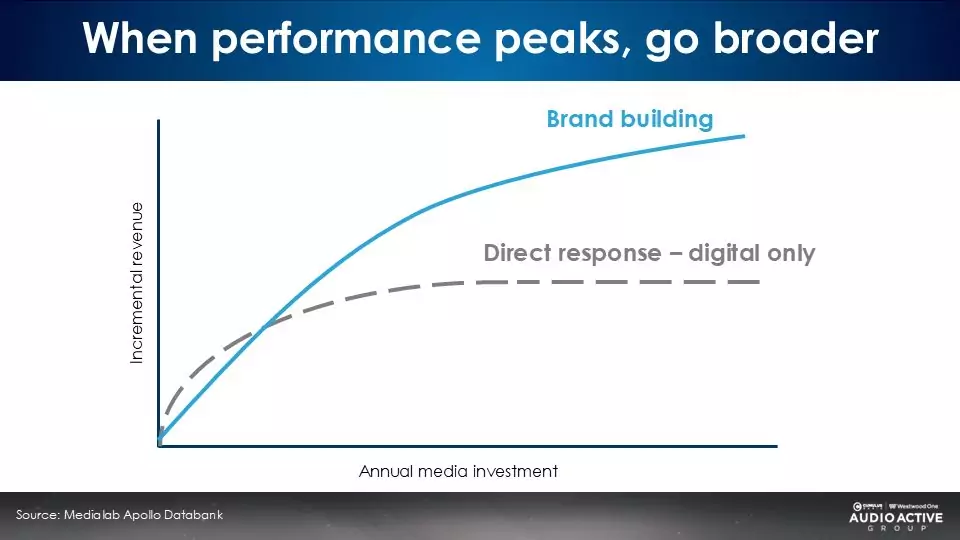
If you devote all your ad budget towards the 5% in-market consumers via sales events and promotions, you eventually hit a sales plateau.
Will Davis, writing in the Go Big or Go Home study, reports putting all your budget into digital direct response will cause sales to hit a wall. Shifting more investment to creating future demand via brand building with “big media” like AM/FM radio, TV, and out of home causes sales to increase.
Marketers overestimate the sales effect of targeting
How would you answer the following. What proportion of sales effect would you assign to targeting, ad creative, reach, brand, and recency?
Advertiser Perceptions, the gold standard firm that surveys media agencies and marketers, asked 300 advertising decision makers to estimate the quantity of sales generated by the five sales drivers.
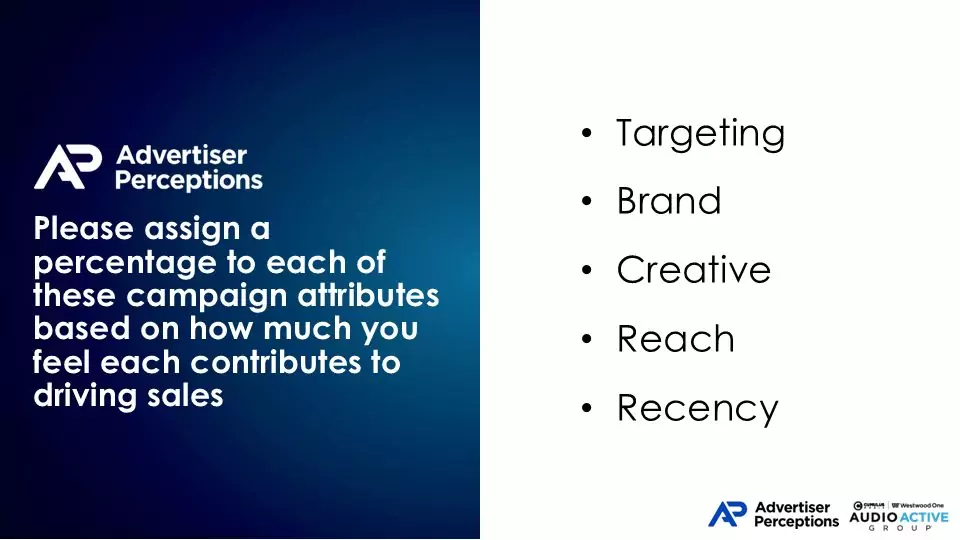
Marketers and media agencies overestimate the sales effect of targeting by a factor of 2X. Brands and agencies mistakenly think 22% of sales are driven by targeting. In reality, only 11% of sales effect is generated by targeting, according the consumer purchase measurement firm Circana.
“Big media” is ideal to create future demand: AM/FM radio, podcasts, TV, and out of home are America’s leading mass reach media
If reach is the primary driver of media effectiveness, “big media” are ideal additions to the media plan to generate significant reach.
AM/FM radio, podcasts, TV, and out of home leads all U.S. media in reach according to Nielsen, Edison, and MRI-Simmons.
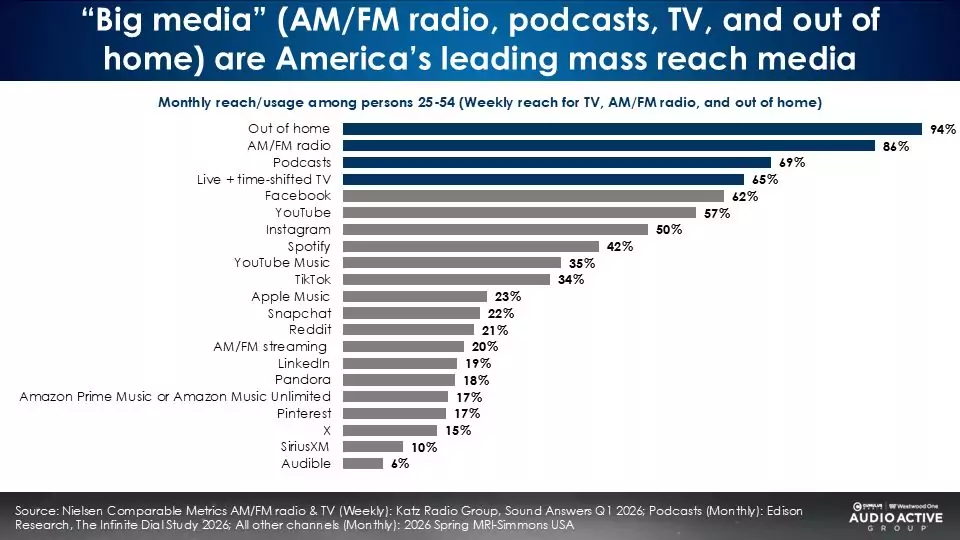
The greater the reach, the larger the sales lift, brand effect, and profit growth
James Hurman cites Les Binet’s and Peter Field’s research from their book, The Long and The Short of It: “Campaigns that target new buyers or the whole market are two to three times as effective than that those that just target existing customers.”
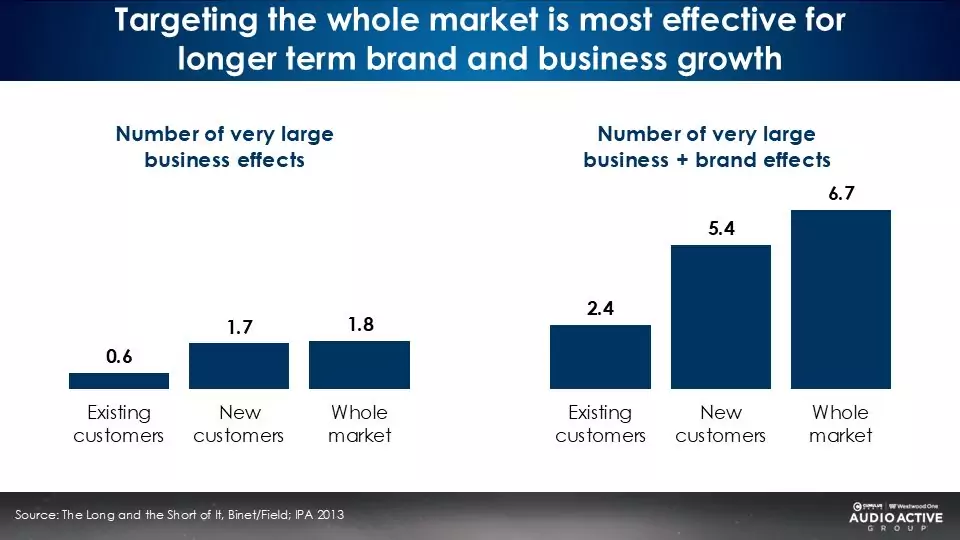
Targeting the entire market more than doubles the number of very large business effects versus those that narrow target existing customers. Campaigns that target the entire market have nearly three times the number of very large business and brand effects.
When it comes to driving profit, broadly targeting the entire market and new buyers is far more effective.
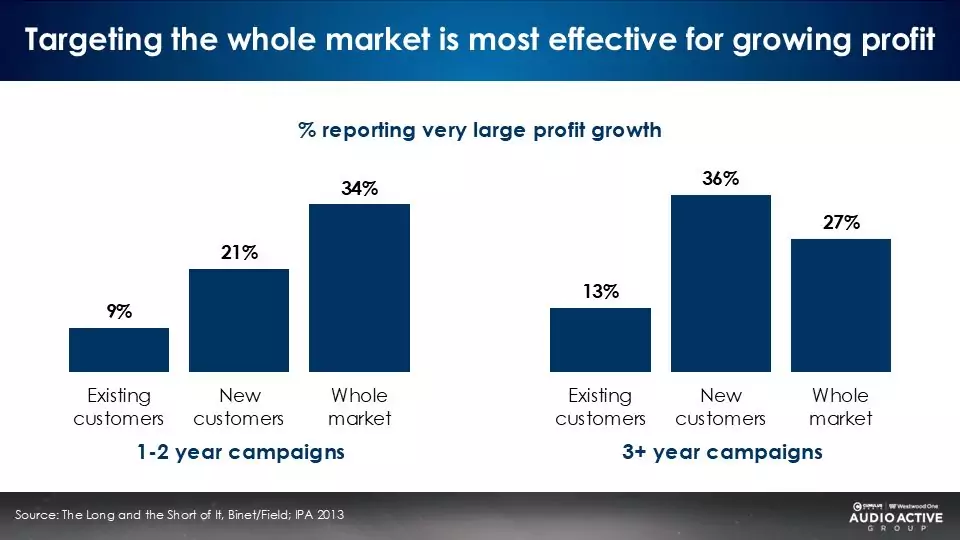
Over a one-to-two-year period, companies going for broad reach against the whole market were nearly four times as likely to report generating very large profit growth. Beyond three years, firms with a broad reach strategy against new customers or the whole market experienced 2X to 3X very large profit growth.
To generate strong reach, you need to add “big media” such as TV, AM/FM radio, and outdoor to the media plan. Hurman reports “big media” have a special advantage: their ads are more memorable.
Ads from “big media” (AM/FM radio, TV, and outdoor) stick in minds more that digital or social media ads
James Hurman reveals, “People pay more attention to ads in (radio, TV and outdoor) and we’re better at remembering things that we’ve paid attention to. “
Over 85% of online ads don’t reach the 2.5 second Attention-Memory Threshold, according to Amplified Intelligence’s Karen Nelson-Field
Hurman explains, “Attention measurement pioneer Dr. Karen Nelson-Field and her company Amplified Intelligence have shown that, unless we pay attention to an ad for 2.5 seconds or longer, we don’t commit it to our memory. She calls this ‘the attention-memory threshold.’”
Dr. Nelson-Field says, “We can see a relationship between active attention seconds and days in memory. (Based on 130,000 ad views across 1150 brands.) There is a point, the 2.5 second mark, where the number of active attention seconds starts to make a difference to the length of time a brand stays in a person’s memory.”
AM/FM radio, TV, and outdoor ads are more effective at creating future demand because they create a greater sense of quality, popularity, and trust for brands
James Hurman reports on a study that measured the quality, popularity, and trust effects of “big media” like TV, AM/FM radio, and outdoor versus digital channels such as social media and online video. Ads across various media channels were tested for quality, popularity, and trust.
The study found that the positive perceptions of ads run on big media (AM/FM radio, TV, and outdoor) “increased significantly more than when consumers saw ads in social media or online video. One reason is that people innately understand that running an ad in “big media” is more expensive. [Companies running in big media] need to have a requisite level of scale and quality to afford to advertise in that way. Whereas, we all know anyone can advertise on the internet for a few dollars.”
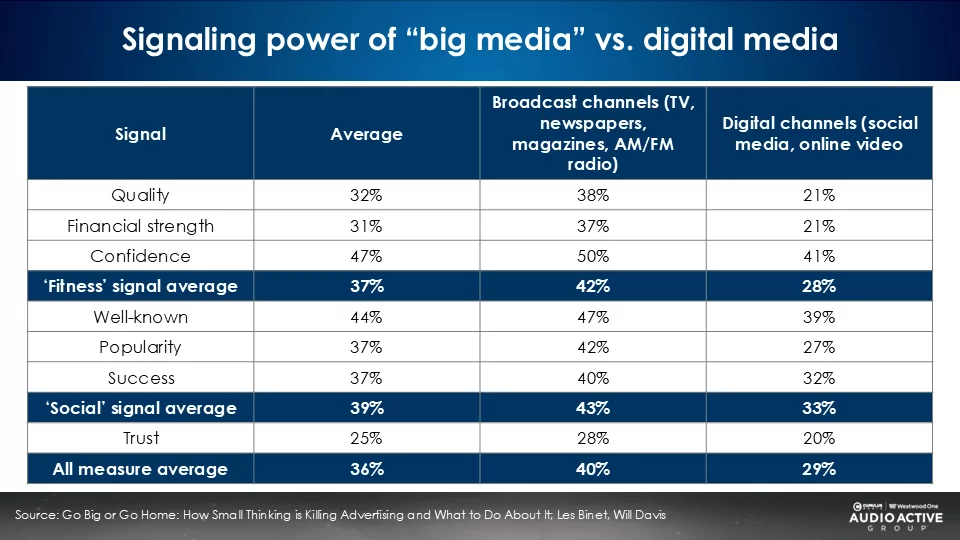
When the perceptions scores for quality, financial strength, confidence, being well-known, popularity, success, and trust are averaged, ads run in “big media” perform 38% better than on ads in digital media (40% versus 29%).
Ads run on big media are more famous as they are a shared experience
James Hurman explains that big media ads are “a shared experience. When you see or hear something on a billboard or on the radio, you know that a huge group of other people like you will also see or hear that ad. They’re public media.”
“Your social feeds and general internet experiences are personalized to you – the ads you see may not have been seen by anyone else you know. They’re “private media”. We are a herd species. We generally don’t like to buy things, wear things or use things that we aren’t sure others like us are buying, wearing or using – or at least know about and understand.”
“When we see a brand in (big media), that signals to us that others know about and understand that brand, and that a lot others must be buying it too (otherwise how could they afford to advertise in (big media))? That makes us feel more confident buying that brand in the future – we feel as though we’re making a socially acceptable choice.”
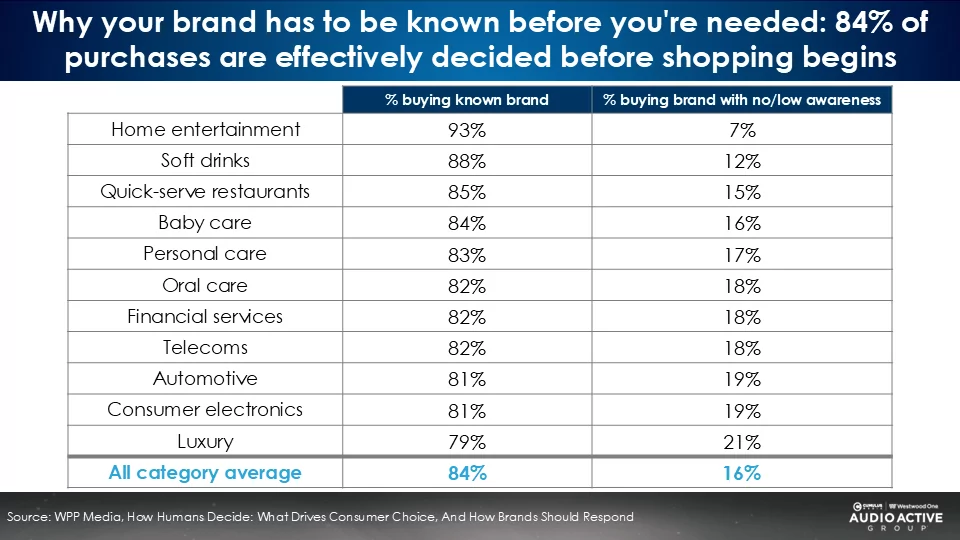
Since 84% of purchases are effectively decided before shopping begins, brands need to be known long before they’re needed
This key conclusion is from a major study called How Humans Decide from WPP Media, Saïd Business School, and Oxford University. The data is based on a decade of research of 1.2 million consumer journeys across over 200 categories in 47 countries.
Most consumers already know which brand they will buy. As such, the major job of advertising is to “create future demand,” influencing people long before they come in the market. You need “big media” to create future demand.
Erwin Ephron, considered the father of U.S. modern media planning, famously said, “Most advertising usually works by reminding people about brands they know, when they happen to need that product. Ads work best when the consumer is ready to buy. Reminding a lot of consumers is better than lecturing a few.”
Reach trumps frequency; “Big media” excel at big reach
The marketing strategy book How Not To Plan: 66 Ways to Screw It Up from Les Binet and Sarah Carter offers these recommendations:
- “Always aim to get more customers from all segments of the market. It’s the main way brands grow.
- Talk to everyone who buys your category. Talk to them regularly; advertising memories fade.
- Go for reach, rather than frequency. Reach as many category buyers as possible.
- Don’t target too narrowly. It may be efficient, but it’s rarely effective. Tight targeting means low sales and profits.”
Don’t be afraid of “waste”: It’s the part of advertising that works since your brand has “to be known before you’re needed”
One of the biggest myths in advertising is over media “waste.” Since 95% of people are not in the market for your product or service, you need to reach everyone to get the word out about your product or service.
In order to get consumers to gravitate to your brand in the future, you need to “be known before you’re needed.” You need to create positive memories of your firm.
Les Binet says “Doing something big and expensive like advertising on “Big Media” can be effective in its own right. It can signal that your brand is thriving, popular and profitable (the ‘Peacock’s Tail effect’).”
“In most categories, people’s brand choices are hugely influenced by what people around them think…publicly bought and used brands derive much of their value and meaning from what people outside the category think about them. To create these shared cultural meanings, we need people outside our target to overhear our communication. In other words, we need wastage.”
Key findings:
- James Hurman’s new book and Les Binet and Will Davis’ new study reveal reaching a lot of people with your advertising is crucial to growing your business.
- Advertisers have two jobs: Convert existing demand by reaching the five percent who are in the market and create future demand via brand building focused on the 95% of consumers who are not in the market.
- The greater the reach, the larger the sales lift, the bigger the brand effect, and profit growth.
- “Big media ads” (AM/FM radio, TV, and outdoor), are more effective at creating future demand because they create a greater sense of quality, popularity, and trust for brands.
- Ads from “big media” (AM/FM radio, TV, and outdoor) stick in minds more than digital or social media ads. Over 85% of online ads don’t reach the 2.5 second Attention-Memory Threshold, according to Amplified Intelligence’s Karen Nelson-Field.
- Don’t be afraid of “waste.” It’s the part of advertising that works.
Click here to view a 15-minute video of the key findings.
Pierre Bouvard is Chief Insights Officer of the Cumulus Media | Westwood One Audio Active Group®.
Contact the Insights team at CorpMarketing@westwoodone.com.