
Seeda Media Mix Modeling: A Fast-Food Brand Wanted To Cut AM/FM Radio; MMM Findings Retained And Expanded AM/FM Radio’s Role In The Media Plan
Click here to view a 15-minute video of the key findings.
Click here to download a PDF of the slides.
An Australian quick service restaurant planned to cut AM/FM radio spend after months of testing failed to show clear performance.
A 60‑day modern Marketing Mix Modelling engagement with Seeda and Supermetrics measured AM/FM radio alongside 20+ channels, reversed the cut, and grew weekly spend.
AM/FM radio’s role in the media plan was retained and increased based upon the evidence in Seeda’s Media Mix Modeling. The results? ~30% lift in marketing‑contributed revenue during the initial optimization window and +5% year-over-year sales growth through a tough seasonal period. AM/FM radio stayed and grew because the model proved when and how AM/FM radio pays.
Michael Kingston, CEO of Seeda Media Mix Modeling says, “We’ve seen this pattern repeatedly – brands ready to cut radio spend because they couldn’t prove it was working. Traditional marketing measurement simply can’t measure offline channels. When we apply rigorous Media Mix Modeling methodology, radio often emerges as one of the most efficient channels in the mix. This QSR client is a perfect example: they actually cut radio entirely before working with us, and now it’s a cornerstone of their media strategy.”
Key findings:
- AM/FM radio’s role in the media plan was retained and increased based upon the evidence in Seeda’s Media Mix Modeling.
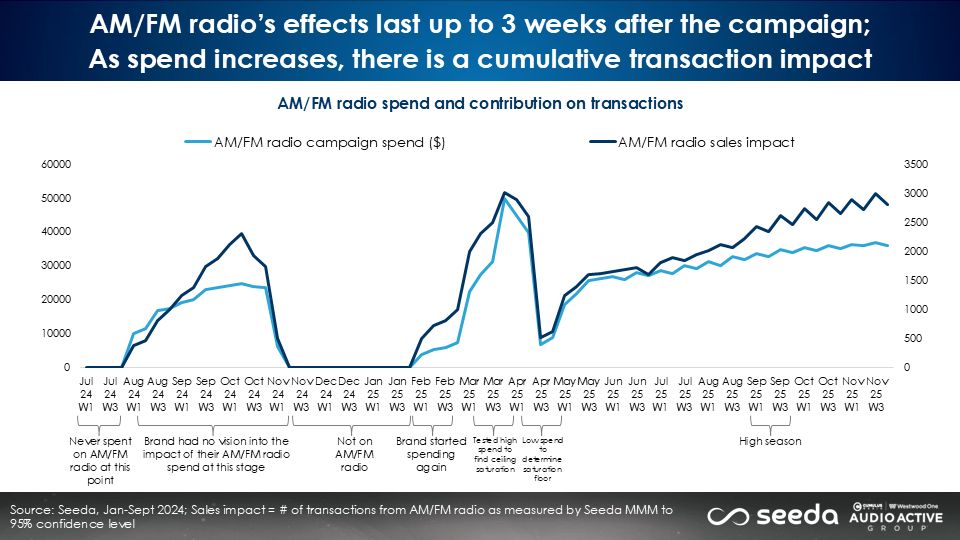
- AM/FM radio’s effects last up to 3 weeks after the campaign. As AM/FM radio spend increases, there is a cumulative transaction impact.
- Seeda’s study reveals the ROI paradox: Sometimes ROI is highest when ad spending is light and sales are weak. Binet and Carter advise it’s better to have strong sales and profits with weaker ROI.
- Seeda’s Media Mix Modeling reveals investment in Meta and Uber Offers is wasteful and exceeds the average fast-food order.
- AM/FM radio’s cost per QSR transaction is even more efficient on a past-2-month time horizon and five times more cost effective than Meta ads.
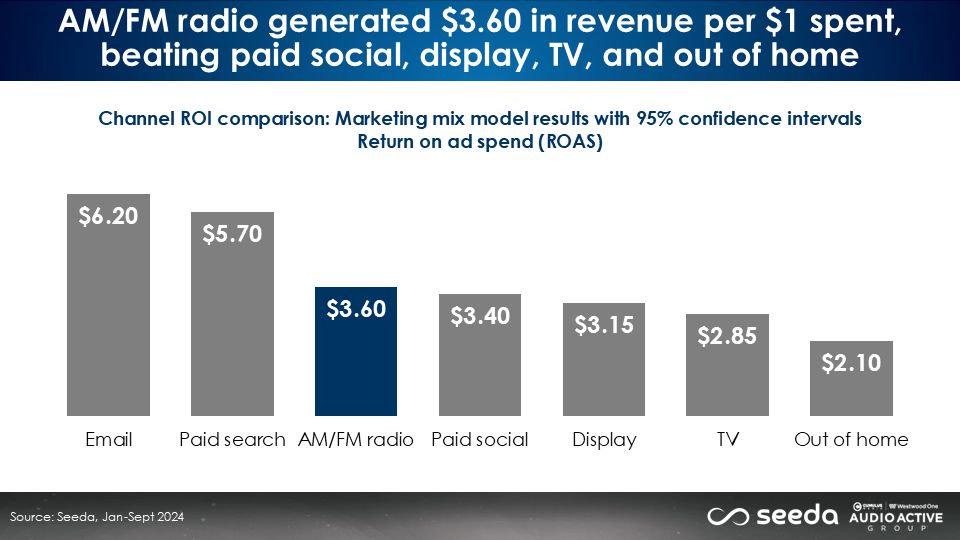
- AM/FM radio has the third highest ROI, beating paid social, display, TV, and out of home.
AM/FM radio’s effects last up to 3 weeks after the campaign; As AM/FM radio spend increases, there is a cumulative transaction impact
Seeda compared weekly sales of the QSR brand and the sales effect of the AM/FM radio campaign. There is direct relationship between AM/FM radio investment and its sales impact for the QSR brand. As AM/FM radio investment grows, there is a multiplier effect of AM/FM radio’s sales effect.
Seeda’s study reveals the ROI paradox: Sometimes ROI is highest when as ad spending is lowest
Les Binet and Sarah Carter, marketing effectiveness gurus, explain in their book How NOT To Plan: 66 Ways To Screw It Up:
“As you spend more on advertising, it often gets more effective (sales and profits generated go up), but less efficient (ROI goes down). That’s the nature of diminishing returns. It means that in practice, the highest ROIs tend to come from small budgets.”
They continue: “If your aim was to maximize ROI, you’d go for the small-budget campaign. But that would mean smaller profit. Going for the big-budget campaign would mean lower ROI, but bigger profit. And that’s the nub of it. As Tim Ambler points out in his classic article ‘ROI is dead: now bury it’, advertisers should try to maximize profits, not ROI. ROI is usually highest when sales and budget are close to zero. So trying to maximize ROI is a good way to destroy your brand.
This confusion is one example of a general confusion between effectiveness and efficiency. They’re often used interchangeably but can point in different directions. Effectiveness is about reaching targets. So, sales and profit are effectiveness measures.
Efficiency is about how much effort you expend to achieve a given effect.
ROI is an efficiency measure. Institute for the Practitioners of Advertising (IPA) research shows that, while pure direct response activity is a highly efficient way to spend budgets, it’s not very effective on its own. Sales effects tend to be small and short-term.
Long-running brand campaigns, however, tend to be highly effective (big sales and profit effects), but less efficient without the support of activation channels like Direct Marketing and search. Ideally, we should be effective and efficient. IPA research suggests that this means spending the majority of budget on brand (effective), supported by lower spend on direct (efficient).
But effectiveness matters most. Better to achieve your goals inefficiently than be a gloriously efficient failure.”
Seeda identified the optimal spend which balances sales effect and ROI
Seeda’s analysis found the sweet spot between sales growth and ROI. As Binet and Carter reveal, light spend generates strong ROIs and weak sales.

Seeda’s Media Mix Modeling reveals investment in Meta and Uber Offers is wasteful and exceeds the average fast-food order

AM/FM radio’s cost per QSR transaction is even more efficient on a past-2-month time horizon and is five times more efficient than Meta ads
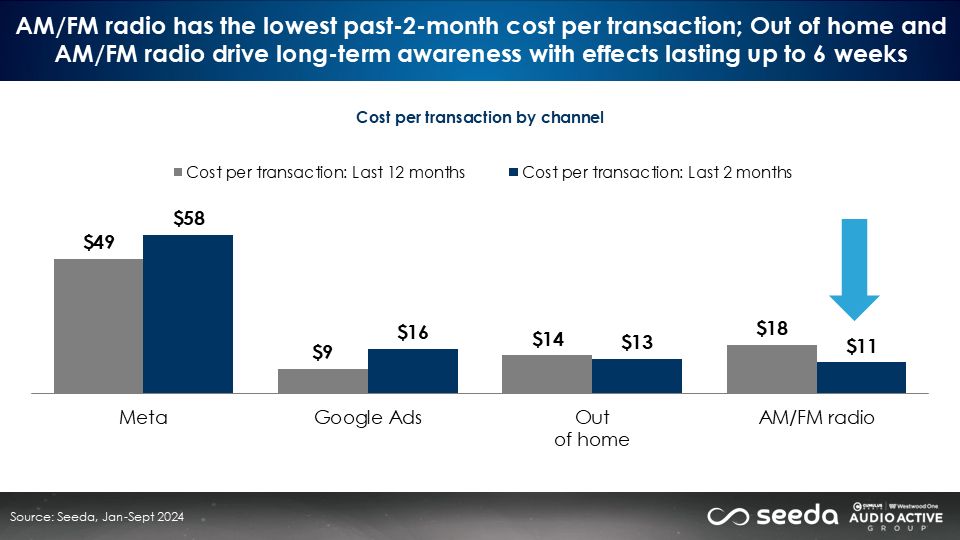
AM/FM radio ads’ costs per transaction are 45% more cost effective than Google Ads. Because AM/FM radio ad impacts last longer, they reduce the cost per transaction of the last two months. At an $11 cost per transaction, AM/FM radio is five times more cost effective than Meta’s whopping $58 cost per transaction.
AM/FM radio has the third highest ROI beating paid social, display, TV, and out of home
Seeda reported every dollar of AM/FM radio advertising generated $3.60 worth of sales.
Why is AM/FM radio such an effective QSR marketing platform?
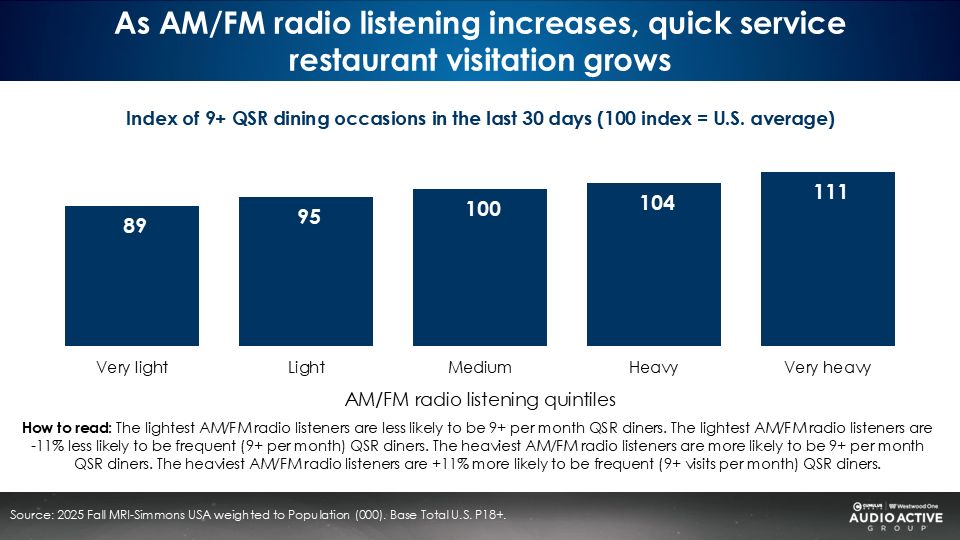
- MRI-Simmons reports frequent fast-food consumers have a similar profile to heavy AM/FM radio listeners: Younger, more likely to be employed, more likely to have kids, and clock a lot of miles in their vehicles
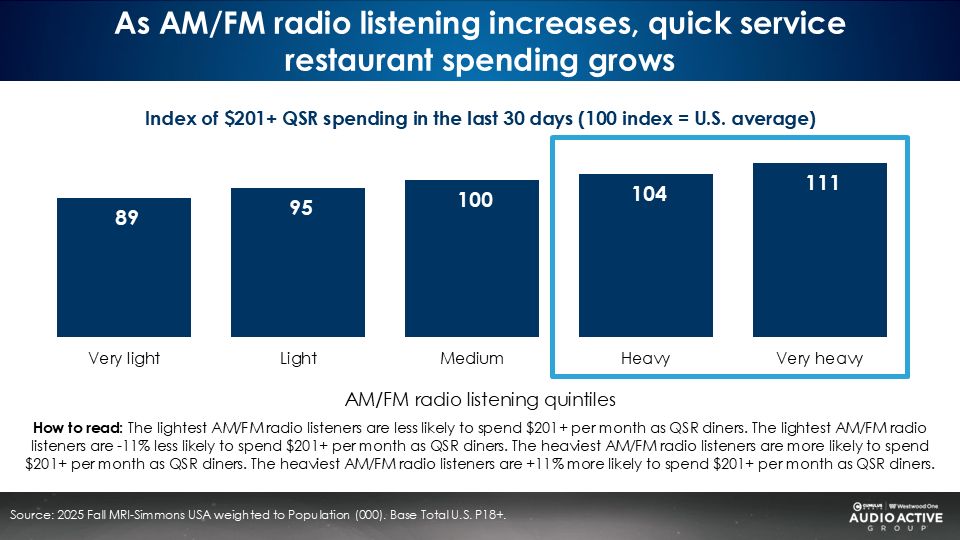
- Heavy AM/FM radio listeners are frequent fast-food diners: Most AM/FM radio ad impressions are generated by heavy QSR category users
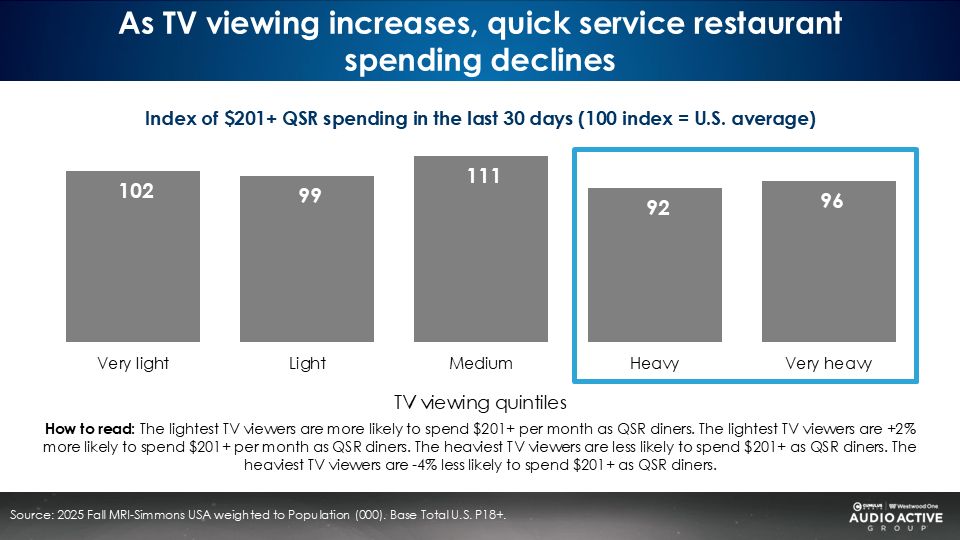
- Heavy TV viewers under index on QSR; Most TV impressions are generated by light QSR category users
- ABX creative testing: QSR AM/FM radio ads test at 89% of the effectiveness of TV at one-fourth the CPM
- Circana sales effect studies reveal AM/FM radio ads generate a +6% increase in total QSR buyers and a $3 to $1 return on investment
As AM/FM radio listening increases, frequency of QSR purchase occasions and spending grows; As TV viewing increases, QSR spend drops, according to MRI-Simmons
Seeda’s methodology and solution:
- Integrated and cleansed all relevant marketing and sales data – across Meta, influencers, AM/FM radio, CRM, and POS – into a single data warehouse for analysis.
- Built a custom Marketing Mix Model to isolate true revenue contribution from each channel, accounting for seasonality, external impacts saturation, and lag analysis.
- Tested the model’s accuracy with holdout validation, achieving a 97% fit between predicted and actual sales during the validation period.
- Identified over- and under-investment across channels, revealing exact ROI figures, historically – not just what in-platform reporting claimed.
- Delivered budget recommendations under multiple scenarios (current, +15%, +50%) to guide future planning.
Key findings:
- AM/FM radio’s role in the media plan was retained and increased based upon the evidence in Seeda’s Media Mix Modeling.
- AM/FM radio’s effects last up to 3 weeks after the campaign. As AM/FM radio spend increases, there is a cumulative transaction impact.
- Seeda’s study reveals the ROI paradox: Sometimes ROI is highest when ad spending is light and sales are weak. Binet and Carter advise it’s better to have strong sales and profits with weaker ROI.
- Seeda’s Media Mix Modeling reveals investment in Meta and Uber Offers is wasteful and exceeds the average fast-food order.
- AM/FM radio’s cost per QSR transaction is even more efficient on a past-2-month time horizon and five times more cost effective than Meta ads.
- AM/FM radio has the third highest ROI, beating paid social, display, TV, and out of home.
Seeda offers the following recommendations to audio publishers
Want AM/FM radio to shine in MMM? Help brands do these things:
- Ship as‑run occurrences and audience deliveries (not plans): Network/vendor, spot counts, length, daypart, cost, week‑level at minimum.
- Create variance (not 50 identical GRPs): The model needs movement to read the curve.
- Provide high‑frequency outcomes (weekly sales/transactions), plus promos and store cadences – then align to the media spend.
- Model the full mix (OOH, digital, PR) so AM/FM radio’s lift isn’t masked by platform self‑credit.
- Validate (holdouts/market tests when feasible) to win over finance and franchisees.
Click here to view a 15-minute video of the key findings.
Pierre Bouvard is Chief Insights Officer of the Cumulus Media | Westwood One Audio Active Group®.
Contact the Insights team at CorpMarketing@westwoodone.com.